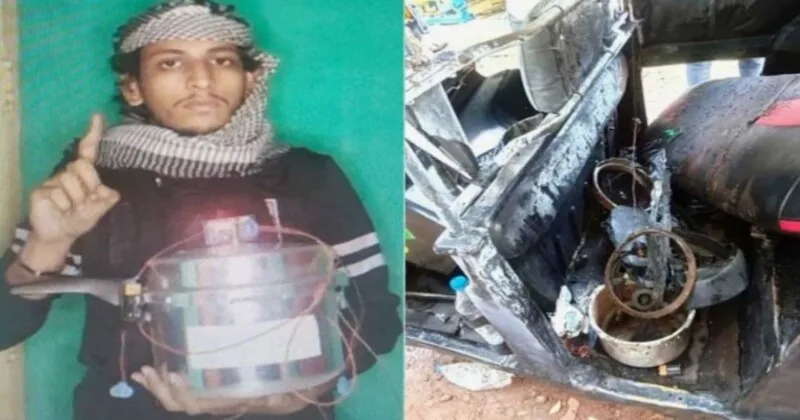
Mangaluru: In a significant verdict in a high-profile terror case, a special court of the National Investigation Agency in Bengaluru has convicted Mohammed Shariq in the 2022 Mangaluru cooker bomb blast case and sentenced him to 10 years of rigorous imprisonment. The ruling brings a major development in a case that had sent shockwaves across coastal Karnataka and raised serious concerns over internal security.
The 2022 Mangaluru blast that shook the city
The incident dates back to November 19, 2022, when a pressure cooker-based improvised explosive device (IED) exploded inside an autorickshaw near Kankanady in Mangaluru. The explosion occurred while Shariq was allegedly transporting the device, leading to injuries to both him and the autorickshaw driver, Purushottama Poojary.
Investigators later revealed that the blast was not accidental in nature but part of a larger, premeditated plan. However, the premature detonation is believed to have prevented a potentially catastrophic incident in a crowded public space.
Charges and legal provisions invoked
Following a detailed investigation, the NIA court found Shariq guilty under multiple stringent provisions of the Indian Penal Code (IPC) and the Unlawful Activities (Prevention) Act (UAPA). These include Section 121A (conspiracy to wage war against the Government of India), Section 122 (collecting arms with intent to wage war), and Section 326 (causing grievous hurt using dangerous weapons).
The court observed that the evidence presented by the prosecution established a clear conspiracy aimed at carrying out acts that could threaten national security. The application of UAPA provisions underscored the seriousness of the charges and the nature of the offence.
Investigation reveals wider conspiracy
During the course of the probe, authorities uncovered that the explosive device had been assembled using a pressure cooker fitted with detonators, circuits, and batteries. Burnt remnants recovered from the blast site played a crucial role in reconstructing the sequence of events.
Investigators also found that Shariq had been using a fake Aadhaar identity under the name “Premraj” from Hubballi. He had allegedly rented accommodation in Mysuru, where he procured and assembled materials required for the IED.
Given the gravity of the case, the Central government transferred the investigation to the NIA, which later described Shariq as a “lone wolf” operator inspired by extremist ideology, including links to the ISIS. Officials indicated that potential targets could have included crowded public spaces or religious sites in Mangaluru.
Court verdict after prolonged trial
After nearly four years of trial proceedings, the NIA special court in Bengaluru delivered its final judgment, holding Shariq guilty based on material evidence, forensic findings, and witness testimonies.
The court emphasised that the accused’s actions were not isolated but part of a deliberate attempt to carry out a destructive act. The 10-year rigorous imprisonment sentence reflects the court’s stance on deterring such activities and upholding national security.
Status of co-accused
In the same case, a second accused, identified as Syed, has denied all allegations against him during court proceedings. His trial is still ongoing, and the court will continue to examine evidence related to his role in the case.
Legal experts note that the continuation of proceedings against co-accused is standard practice in complex cases involving multiple individuals and alleged conspiracies.
Victim’s account underscores impact
Speaking after the verdict, autorickshaw driver Purushottama Poojary, who sustained injuries in the blast, expressed relief over the court’s decision. He stated that the punishment was justified and reflected the seriousness of the crime.
“I have suffered because of what happened. It is important that such acts are dealt with strictly so that no one else attempts something similar,” he said, highlighting the human cost of such incidents.
Security implications and lessons
The case has been widely viewed as a reminder of evolving security challenges, particularly the threat posed by individuals acting independently but influenced by extremist ideologies. Authorities have reiterated the need for continued vigilance, intelligence coordination, and public awareness to prevent such incidents.
Experts also point out that early detection and community-level alertness can play a crucial role in preventing attacks, especially in urban areas with high population density.