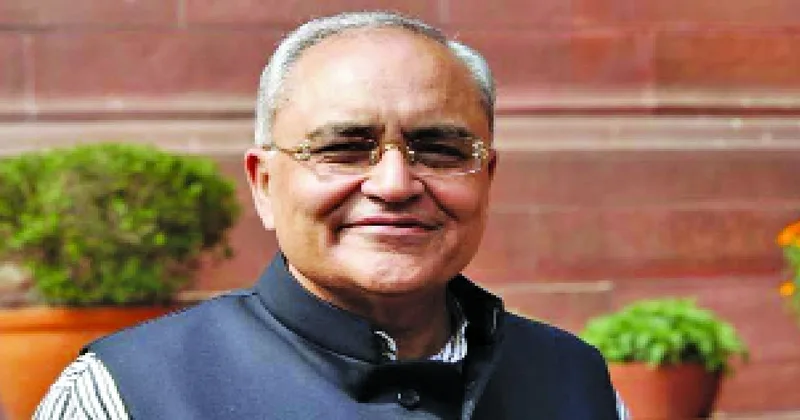
The noted thinker, writer, columnist and former Member of Parliament Balbir Punj is no more. The departure of a towering personality creates such a void that it may perhaps never be filled. The passing of Balbir Punj evokes a similar sense of profound emptiness. He was a personality who constantly inspired and encouraged those engaged in reading and writing. Whenever a writer, columnist or journalist associated with the national discourse produced a noteworthy article, he would offer his comments, provide guidance and share it with his friends and acquaintances for wider readership.
He would often call the author personally to explain the strengths and shortcomings of the article and also suggest which other writers should be read to gain a deeper understanding of the subject. Is this not truly rare. A person who himself was such a distinguished writer, who served twice as a Member of the Rajya Sabha, who was among the leading intellectual strategists of the Bharatiya Janata Party during the era of Atal Bihari Vajpayee and Lal Krishna Advani, who had been in charge of the party in several states and who had served as a national level vice president of a major political party, yet possessed such simplicity, humility, ease of approach, accessibility, detachment and absence of ego, not only impressed but at times appeared almost unbelievable.
And if any writer, journalist or columnist was going through health related issues or other personal difficulties, he never failed to call and enquire about their well being. Even when contact details were not readily available, he would obtain a phone number through acquaintances and share in their moments of pain and distress. Such goodwill and genuine concern for others is perhaps rare even among relatives and close friends in today’s time.
Even in the eighth decade of his life, the level of his engagement in writing, reflection and intellectual discourse was such that few could match it. Across dozens of WhatsApp groups, he wrote extensively not only on his own articles but also on a wide range of issues related to the nation, society and humanity. He did not merely share his own writings, but also read with great attention the articles and comments shared by others in these groups, offering his observations and guidance on them. At times, he would share other significant articles and encourage everyone to read them.
Just three or four days before his passing, on April 16, he wrote a powerful, insightful and thought provoking article for The Pioneer, Punjab Kesari, and Swadesh Jyoti. It would be rare to find a week in which he did not write on some serious, meaningful and relevant issue concerning his times and society. He would often say that if, by the grace of Ram Ji, one has been endowed with the ability to write, then that gift must be used in the service of the nation, dharma and culture. In this, he found a sense of fulfillment and purpose in life. He used to say that writers, journalists, columnists and editors should consider writing as their most powerful instrument.
Compared to events and public gatherings, writing, in his view, carried far greater significance. Writing, he believed, is a form of disciplined pursuit through which a writer attains both accomplishment and recognition. In this regard, he often advocated drawing inspiration from Sita Ram Goel, Ram Swarup and Dharampal. He believed that a true writer leaves an indelible imprint on the tablet of time through the strength of a disciplined pen alone, without the need for any other activity or event.
His understanding of any issue was profoundly deep. He was a true exponent of India and Indianness. His grasp of Indian discourse and narratives was exceptionally rare. In this context, his book Narratives ka Mayajaal, published by Prabhat Prakashan, is not only worth reading but also deserves to be referred to and cited repeatedly. Among contemporary writers, columnists, thinkers, and intellectuals, he was one whose understanding was not limited to immediate reactions, surface level developments or the transient nature of events. He went to the very roots of civilizational conflicts, striving to identify the core of the problem and suggest meaningful solutions.
He had deeply internalized the civilizational stream of Hindutva and Sanatan culture and had also explored their past and history in great depth. At the same time, he had undertaken a detailed and nuanced study of Abrahamic civilizations. As a result, even within a brief article, he was able to present a remarkably realistic account of the civilizational conflicts unfolding at the global level. His writings contained no trace of shallow or sentimental emotionalism. He presented arguments with clarity and facts with strong authenticity. His arguments were so compelling that even his critics often found it difficult to refute them with confidence.
He was a perceptive interpreter of the civilizational realities rooted in concepts such as belief and unbelief within Islam, as well as of religious rigidity. He had recognized the nature of Islam and Christianity in their original forms. Therefore, he was able to delineate their limitations, constraints and prescriptive frameworks with clarity and precision. At the same time, he deeply understood the liberal, pluralistic, integrative and coexistent ethos of Hindutva. He regarded its presence and expansion as essential and indispensable for the welfare of the world. However, this did not mean that in appreciating the virtues of Hindutva he remained unaware of the present and potential challenges confronting Sanatan culture.
In each of his writings, he consistently cautioned readers about these challenges and urged them to remain vigilant. He was fully aware that a fragmented Hindu society would not be able to face the combined pressures of leftist, jihadist and Eurocentric forces on its own. Therefore, he devoted his entire life to understanding and explaining the truth and importance of an organized Hindu society.
In private discussions, he would certainly point out areas that required organizational reform, yet in public he always upheld the dignity and discipline of the organization above all else. He remained constantly aware that the pursuit of any great objective requires unwavering commitment, the renunciation of personal ambitions and the primacy of dharma, nation and culture. He understood well the importance of discipline in public life and conduct rooted in organizational commitment. He was closely associated with the Rashtriya Swayamsevak Sangh and had firm faith in its ideology. He believed that every volunteer is akin to a spiritual practitioner.
According to him, it is through the disciplined pursuit of such volunteers that a favorable environment has been created in India toward Sanatan culture, and a sense of pride in dharma, culture, and the nation has been awakened among the people. At the same time, he was concerned that despite a favorable environment and political change, leftist influence continued to persist in public life, especially in intellectual and academic spheres. He often said that while significant changes had taken place in the political domain and in the Hindi media after 2014, leftist dominance still remained in institutions of power and in the English media. He believed that the principal battleground of the twenty first century would be at the level of narratives, and that whoever prevails in this contest will ultimately determine the direction of society. Therefore, he expected volunteers to develop a deeper interest in reading and writing and to consciously make time for it. He also emphasized that those engaged in public life, whether as workers, office bearers or social contributors, should never allow arrogance to take hold of them, as it diminishes the collective achievements born of the dedicated efforts of countless individuals. In personal conversations, he would sometimes remark that those who have already renounced worldly comforts must certainly renounce ego as well.
He was deeply concerned about the rapidly changing demographic situation and the resulting imbalances. Over the past year, he had been working on a book on this subject. In the process of writing it, he had already studied more than three hundred books as reference material. It is noteworthy that his thinking was never abstract or unfounded. He engaged with issues firmly grounded in reality. The pain of the division of an undivided India was often reflected even in his everyday conversations and writings. He was troubled and dissatisfied that the anguish of partition, which ought to have been deeply felt among the general public, especially within Hindu society, was rarely visible in its true intensity. He wrote extensively on the trauma of partition, examined its causes in depth and also highlighted the weaknesses of the leadership of that time through his writings.
He would often say that a major problem of the foundational society of this country, namely Hindu society, lies in the distortion of its virtues. Its understanding of friend and foe is not always grounded in reality. Over the past seventy eight years, he believed, the repeated conditioning in the name of secularism has further weakened this clarity. In contrast, he would point out that our ancestors possessed a realistic sense of distinguishing between friend and adversary. Even within the national discourse, there are many writers, thinkers and intellectuals who, while emphasizing the liberal and inclusive nature of Hindutva, often argue that if Hindu society has survived for thousands of years, why is there now a concern about existential threats, conversions or demographic decline, or about civilizational conflicts. Addressing such views, Balbir Punj would caution that within our own lifetime, the motherland was divided into three parts, a vast portion of its territory was separated and population exchange was not carried out in proportion to territory.
As a result, the number of followers of Sanatan traditions beyond the present borders of India became negligible and the demographic composition of many districts within India changed drastically. Were these not sufficient examples, he would ask, to show that much has already been lost over the past one or two centuries, and that if society still fails to awaken, it risks losing even more in the future.
Today, when Balbir Punj is no longer among us, the realization becomes even more intense that the nation has lost a vigilant, fearless, truth seeking and deeply committed ideological sentinel. His life will continue to remind us that unwavering dedication to a higher purpose, along with complete commitment to dharma, culture and the nation, alone gives true meaning to life. At a time when writing in favor of Hindutva, national thought and Sanatan culture was not readily accepted in the so called intellectual sphere and was often disregarded, he chose the path of conviction. Despite having the potential to shine like a comet, he remained steadfast in his commitment, stood firmly for the nation and upheld that position throughout his life. Undoubtedly, his memories and his writings will continue to inspire future generations with commitment, courage and a deeply rooted national consciousness.