New York witnessed a remarkable convergence of nations, united in their concern for gender-related issues in an increasingly conflict-ridden world. The gathering resonated slogans with powerful affirmations such as “women’s rights are human rights,” “gender equality makes families thrive,” “legislation leads to empowerment,” “women are agents for security and peace,” “young women leading change,” and “education is the first step to justice.”
More than 4,600 representatives from civil society organisations (CSOs) and leaders across the globe assembled at the United Nations Headquarters in New York to participate in the 70th session of the intergovernmental ‘Commission on the Status of Women’ (CSW70), the UN’s largest annual gathering dedicated to women’s issues held from March 9 to 19, 2026. The session was chaired by Maritza Chan Valverde of Costa Rica.
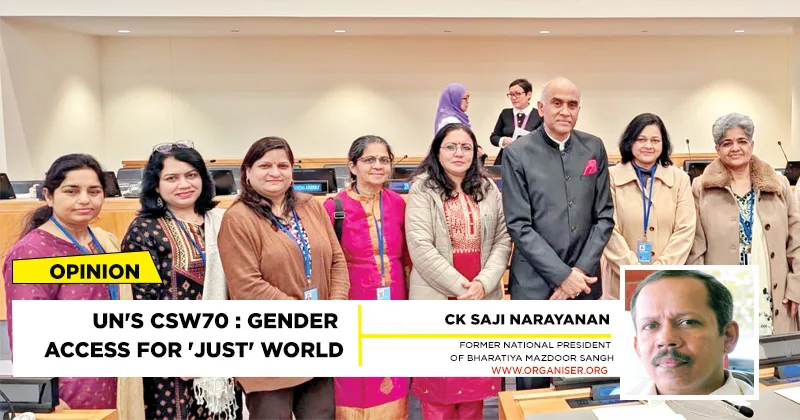
The 17-member Bharatiya delegation was led by Bharatiya Stree Shakti and Rambhau Mhalgi Prabodhini, along with representatives from some other organisations in Bharat. Ambassadors from various countries, known as ‘Permanent Representatives to UN’, alongside CSO representatives also attended. The central theme was “access to justice for all women.”
The session adopted its first resolution, “Women, the Girl Child and HIV and AIDS,” moved by South Africa. In relation to the outcome document titled “Agreed Conclusions,” the United States proposed eight oral amendments opposing abortion, gender identity, diversity, equity, and inclusion. Departing from the customary consensus-based approach, the matter was put to a vote, resulting in 37 votes in favour of agreed conclusions, one in favour of the United States, and six abstentions.
Leaders from numerous countries, both women and men, shared insights rooted in their respective national realities. Nearly all contemporary issues such as gender-transformative and gender-responsive recovery, scaling of solutions, and targeted initiatives addressing the multifaceted challenges faced by women globally found expression in these discussions. It was widely acknowledged that effective solutions require a whole-of-society approach grounded in broad-based partnerships. The programme also included a town hall interaction between CSOs and the United Nations Secretary-General, as well as dedicated CSO briefings.
The Year of Woman Farmer
The United Nations has declared 2026 as the ‘International Year of the Woman Farmer’. This holds particular significance for countries like Bharat, where a substantial proportion of women are engaged in agriculture, either as farmers or as agricultural labourers.
The discussions underscored the importance of securing rural women’s land rights and ensuring access to natural resources as pathways to economic empowerment, social advancement, and climate resilience. The conference also highlighted the need to expand young women’s access to justice within agrifood systems and recognised women as central to the transformation of food security. Emphasis was placed on enhancing investments in agrifood systems. Special attention was given to indigenous women, including their access to justice and participation in environmental governance and decision-making.
Gender-Responsive Legal Reforms
A sobering observation was that even in the twenty-first century, more than 45 countries continue to maintain laws that deny women equal rights. In many others, the challenge lies not in the absence of laws but in their ineffective enforcement. Importantly, the conference recognised that solutions must extend beyond legislation.
Accordingly, the central focus of CSW70 was on enhancing access to justice for women and girls through meaningful legal reforms. The discussions examined the role of women advocates in advancing justice for victims, the promotion of inclusive and equitable legal systems, and harmonised grievance redressal systems. The conference advocated for widespread awareness campaigns and legal literacy through education as essential tool of advancing gender equality.
The increasing participation of women in the judiciary was identified as a critical priority. The conference called for the development of a gender-sensitive judicial system and emphasised the need to strengthen women’s judicial leadership by increasing the number of women judges. Achieving equal representation of women in the judiciary was seen as essential for ensuring equitable justice.
The conference emphasised the importance of aligning legal reforms with human rights principles, fostering care, recovery, and resilience through justice systems. It highlighted the collective responsibility of states, courts, communities, and intergenerational leadership. It also explored strategic responses to backlash against gender justice and innovative approaches such as e-judiciary systems, as exemplified by Tanzania. The discussions also stressed the need for inclusive justice systems that cater to socially vulnerable groups.
Women in Politics
The conference raised significant concerns regarding the expansion of women’s political participation and the realisation of gender-equal representation in democratic processes. Issues relating to voting rights, broader political rights, and political violence were extensively discussed. It advocated for advancing women’s leadership by overcoming structural barriers to their participation in public life and by fostering innovation among women. It envisaged the creation of digital political platforms that would bring together women political leaders, parliamentarians, lawyers, judges, civil society actors, and allied partners.
The UN Women parliamentary meeting examined the role of legislative bodies in achieving parity in decision-making and in strengthening women’s access to justice. The discussions highlighted the critical role of women in UN peacekeeping operations, peace mediation, and peacebuilding processes. Women were recognised as capable of shaping sustainable and enduring peace.
Leadership Role of Bharat
On March 8, the Permanent Mission of India (PMI) to the United Nations organised a commemorative event honouring Late Smt Hansa Mehta, Bharat’s representative to the UN in the late 1940s and a distinguished member of the Constituent Assembly. Her pioneering role in advancing gender equality, at a time when women’s leadership in public life was exceedingly rare, she was widely remembered and celebrated. The event was attended by ministers and ambassadors from several countries along with a Canadian minister’s noteworthy presence. A panel discussion titled ‘Indian Pathway to Equality and Partnership’ was organised by PMI. It took the initiative in promoting the slogan “women-led development” and organised a panel discussion titled “Women-Led Development and South-South Cooperation: Success Stories from the IBSA Fund” in association with Brazil and South Africa. Additionally, the Permanent Mission, in partnership with Bharatiya Stree Shakti, convened an NGO dialogue on “AI for Equal Chance: Levelling the Playing Field.” Indian delegates actively participated in these discussions as speakers.