The world is currently passing through a phase of instability where energy has emerged as the very foundation of the global power balance. The ongoing conflict in Iran and the consequent surge in crude oil prices, has shaken the entire global economy. Every nation is grappling with the burden of inflation and India is no exception yet, amidst this very turbulence, India has chosen a path that could, in the coming decades, transform it into a self-reliant and empowered nation in the energy sector. This path is the Civil Nuclear Program and specifically, Fast Breeder Reactor technology.
In the 133rd episode of the “Mann Ki Baat” program, broadcast on April 26, Prime Minister Narendra Modi redefined the role of science and technology while highlighting India’s achievements in this domain. He stated: “Friends, India has always viewed science as intrinsically linked to the nation’s progress. Guided by this very mindset, our scientists are driving forward the Civil Nuclear Program. Thanks to their efforts, this program is making a pivotal contribution to nation-building. It has yielded immense benefits for our industrial growth, the energy sector, and the healthcare sector. From agriculture and farming to modern-day innovators, India’s Civil Nuclear Program has extended significant assistance across the board.”
The Prime Minister’s statement is, in essence, a glimpse of the sweeping transformation becoming visible across various sectors of the country- a transformation driven by India’s scientific endeavors. Nuclear energy has now moved beyond mere electricity generation to play a crucial role in boosting agricultural productivity, treating ailments such as cancer in the medical field, and facilitating high-quality production within industries. In this context, Prime Minister Modi also highlighted another historic achievement that has secured for India a distinct and prominent position within the global landscape of nuclear energy.
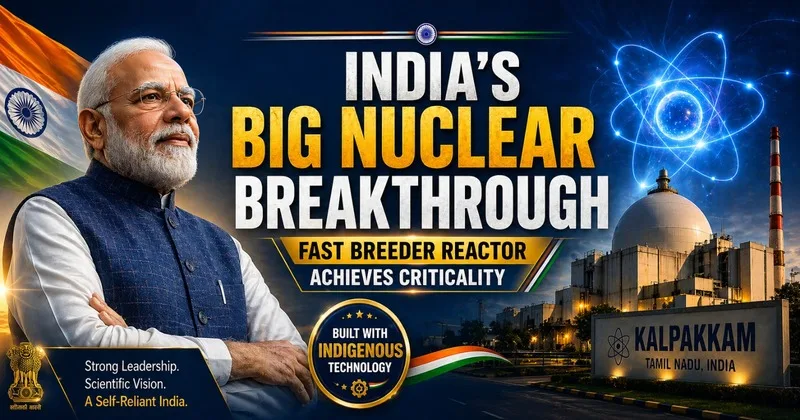
He stated, “Just a few days ago, our nuclear scientists enhanced India’s prestige with yet another major achievement. The Fast Breeder Reactor at Kalpakkam in Tamil Nadu has attained ‘criticality.’ In essence, criticality is the stage at which a reactor successfully initiates a self-sustaining nuclear chain reaction for the very first time. This stage signifies the reactor’s entry into its operational phase. This marks a historic milestone in India’s journey in nuclear energy. Furthermore and this is a significant point, this nuclear reactor has been built entirely using indigenous technology. Friends, why is this called a ‘Breeder Reactor’? There is a specific reason behind this. It is a system that, alongside generating energy, simultaneously produces new fuel for the future.”
The attainment of ‘criticality’ by the Prototype Fast Breeder Reactor (PFBR) established at Kalpakkam is, by any standard, no ordinary feat. It is the moment when the nuclear chain reaction within the reactor begins to sustain itself in a stable and controlled manner. It is from this point that the actual journey of energy generation commences. This achievement has conclusively demonstrated that India has now become so proficient in comprehending and developing complex technologies that it no longer requires the assistance of any other nation in this domain. Indeed, just as the technology behind Fast Breeder Reactors is intricate to master, its significance is equally profound.
Many developed nations across the globe strove for decades to acquire this technology. Countries such as the United States, Japan, France, Germany, and the United Kingdom invested billions of dollars in this endeavor; however, owing to various technical and economic hurdles, they were unable to implement this technology on a large scale. In contrast, despite having limited resources, India has achieved success in this field, thereby proving that with sheer willpower, scientific vision, and unwavering perseverance, any goal can be attained.
Underlying this success of India lies a scientific journey spanning seven decades, driven by visionary thinking. The three-stage nuclear energy program, the foundation of which was laid by the eminent scientist Homi Jehangir Bhabha, is proving its significance today. The first stage of this program is based on the generation of energy and the production of plutonium from natural uranium. In the second stage, additional fuel is generated through Fast Breeder Reactors, while the third stage ensures long-term energy production through thorium-based reactors.
It is worth noting that, in the Indian context, thorium holds immense significance. While the country possesses limited reserves of uranium, thorium is available in abundance. Approximately one-quarter of the world’s total thorium reserves are found in India. Fast Breeder Reactor technology serves as a crucial link in the process of converting this thorium into usable fuel. This will not only boost energy production but also reduce India’s dependence on foreign fuel sources.
The 500-megawatt capacity reactor established at Kalpakkam has been developed entirely using indigenous technology. Its design and research were undertaken by Indian scientists, while its construction and operation are being managed by domestic institutions. This achievement embodies the concept of ‘Atmanirbhar Bharat’ (Self-Reliant India) and demonstrates that India is rapidly advancing towards becoming technologically self-sufficient.
Sharing his recollections regarding this project, Prime Minister Modi remarked, “I recall that moment in March 2024 when I witnessed the core loading of the reactor at Kalpakkam. I extend my congratulations to all those who have made invaluable contributions to India’s nuclear program. Their efforts to make the lives of our fellow citizens better and easier are truly commendable. This initiative will also infuse new energy into our resolve to build a ‘Viksit Bharat’.”
Today, as the world grapples with the twin challenges of climate change and the energy crisis, technologies such as Fast Breeder Reactors are emerging as sustainable solutions. For India, this achievement also marks the dawn of a new energy economy. If this technology is expanded in the coming years and similar reactors are established across the country, India is poised to play a pivotal role in the global energy landscape.
Undeniably, this transformation in the energy sector will provide a new direction to India’s economic growth, industrial development and social progress. Today, this scientific achievement serves as the cornerstone of a future in which India stands at the forefront of the global community- self-reliant, empowered and assuming a role of global leadership. For this, no amount of gratitude extended to the country’s top leadership and scientists would be too much