The operationalization of the India–Russia Reciprocal Exchange of Logistics Agreement (RELOS) on January 12, 2026 marks a significant evolution in global geopolitics. At its core, the agreement allows both nations to access each other’s military infrastructure, including ports, airbases and logistics networks and enables the stationing of up to 3,000 troops, along with naval and air assets, in each other’s territories.
While such logistics agreements are not new—India has similar arrangements with the United States, France and Australia—the RELOS pact with Russia carries a deeper strategic weight. It is not merely about operational convenience; it is about geopolitical positioning, resource access and shaping the future of global power distribution, especially in the Arctic and Indo-Pacific.
Strategic Core of RELOS: Beyond logistics
At a functional level, RELOS facilitates refuelling, repair, maintenance and resupply for military assets operating far from home bases. However, its real significance lies in the geographical reach it unlocks.
For India, the agreement opens access to Russia’s vast network of military bases stretching from the Pacific (Vladivostok) to the Arctic (Murmansk). For Russia, it provides logistical entry into the Indian Ocean Region (IOR), one of the world’s most critical maritime corridors. This mutual access transforms both countries from regionally anchored powers into transcontinental strategic actors.
The Arctic Dimension: The real prize
The Arctic is increasingly emerging as the next frontier of global competition. With climate change melting ice caps, previously inaccessible reserves of oil, gas, and rare earth minerals are becoming exploitable. Estimates suggest that the Arctic holds nearly 13 per cent of the world’s undiscovered oil and 30 per cent of its natural gas reserves (widely cited global energy assessments).
Russia already dominates the Arctic coastline and has heavily militarized the region. India, on the other hand, has historically had limited presence, confined mainly to scientific missions. RELOS changes this equation.
By gaining logistical access to Russian Arctic bases, India can now:
- Expand its scientific and exploratory missions
- Participate in energy exploration projects
- Develop Arctic shipping route expertise(Northern Sea Route)
- Strengthen its claim as a stakeholder in Arctic governance
For Russia, India’s participation is equally valuable. Western sanctions and geopolitical isolation have pushed Moscow to seek reliable partners. India provides:
- A large and growing energy market
- Investment potential in Arctic resource extraction
- Political legitimacy for Russia’s Arctic ambitions
Thus, RELOS creates a mutually reinforcing Arctic partnership—Russia offers geography and infrastructure, while India brings demand, capital and diplomatic balance.
Indo-Pacific and Indian Ocean: Russia’s strategic entry
While much of the focus is on India gaining Arctic access, the reverse flow is equally important. Russia, traditionally a continental and Eurasian power, has limited influence in the Indian Ocean. Through RELOS, it gains access to Indian ports and airfields, enabling:
- Greater naval presence in the Indian Ocean Region
- Enhanced participation in Indo-Pacific security architecture
- Strategic balancing against Western naval dominance
This is particularly significant as the Indo-Pacific becomes the central theatre of global power competition.
A Multipolar Signal: India’s strategic autonomy
One of the most notable aspects of the RELOS agreement is what it signals diplomatically. Under Prime Minister Narendra Modi, India has consistently pursued a policy of strategic autonomy—engaging with multiple global powers without aligning exclusively with any one bloc.
India’s defence cooperation now spans:
- The United States (LEMOA, COMCASA, BECA)
- France and Australia (logistics agreements)
- Russia (RELOS)
This diversified approach allows India to:
- Avoid overdependence on any single partner
- Maximize strategic flexibility
- Maintain leverage in global negotiations
The RELOS pact reinforces India’s image as a swing power in a multipolar world, capable of engaging both Western and non-Western blocs simultaneously.
Putin–Modi Equation: Personal diplomacy at work
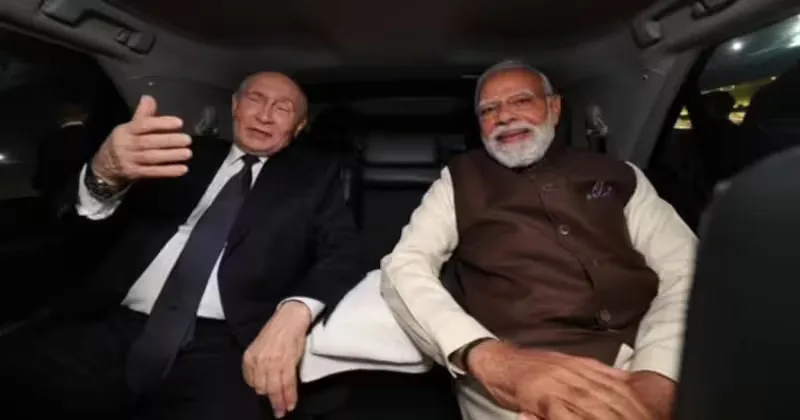
The operationalization of RELOS also reflects the strong personal rapport between Russian President Vladimir Putin and PM Narendra Modi. Despite global tensions, India has maintained consistent engagement with Russia, particularly in defence and energy sectors. This continuity has ensured:
- Uninterrupted defence supplies
- Expansion of strategic cooperation
- Trust-based long-term agreements like RELOS
In an era where alliances are increasingly transactional, the India–Russia relationship stands out for its strategic depth and historical continuity.
Countering western dominance and arctic politics
The RELOS agreement must also be viewed in the context of evolving global tensions, particularly involving the United States and its allies. The Arctic has become a zone of increasing Western interest, with NATO countries expanding their footprint. Simultaneously, geopolitical discussions around regions like Greenland highlight the strategic importance of polar territories.
In this context, the India–Russia partnership:
- Counters Western monopolization of Arctic resources
- Promotes a multipolar governance model
- Challenges unilateral strategic dominance
India’s involvement also adds legitimacy to Arctic discourse, transforming it from a Western-centric arena into a more inclusive geopolitical space.
Economic and military payoffs
For India:
- Access to Arctic energy and rare earth resources
- Extended naval and air operational reach
- Strengthened maritime security in Indo-Pacific
- Enhanced global strategic stature
For Russia:
- Entry into Indian Ocean strategic framework
- Diversification of economic partnerships amid sanctions
- Strengthening of non-Western alliances
- Greater legitimacy in Arctic expansion
Challenges and realistic limitations
While RELOS is strategically significant, it is not without challenges:
- Operationalizing Arctic projects requires massive investment and technology
- India must balance its ties with the US and Russia carefully
- Infrastructure and climate constraints in the Arctic remain severe
- The agreement is primarily logistical—it does not automatically translate into joint military deployment or alliance
Thus, RELOS should be seen as an enabler, not a guarantee of dominance.
A quiet but powerful strategic move
The India–Russia RELOS agreement is a classic example of quiet diplomacy with long-term impact. It does not make dramatic headlines like defence deals or military alliances, yet it fundamentally reshapes strategic possibilities.
By linking the Arctic and Indo-Pacific, the pact creates a geopolitical corridor of cooperation that could define future energy routes, trade pathways and military alignments. For India, it is a decisive step toward becoming a global rather than regional power. For Russia, it offers a reliable partner in an increasingly polarized world.
In a time when global politics is shifting from unipolar dominance to multipolar competition, RELOS stands as a testament to how strategic foresight, diplomatic balance and leadership-level trust can redefine international relations.