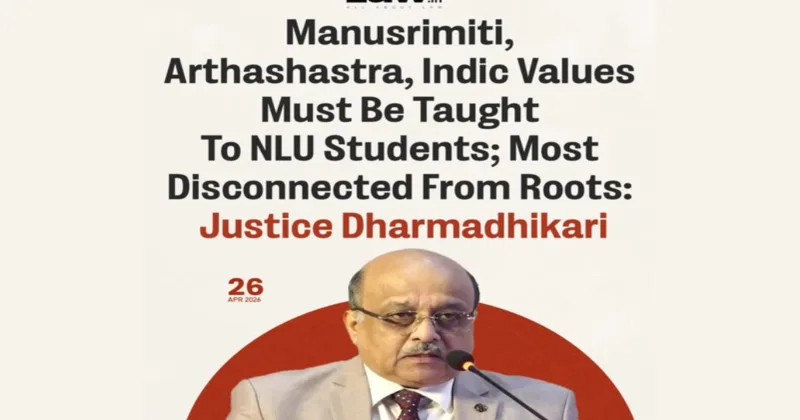
Madras High Court Chief Justice Sushrut Arvind Dharmadhikari has raised concerns that India’s premier law universities are producing academically brilliant graduates who are (unfortunately also) increasingly disconnected from their cultural and ideological roots, with many focused primarily on rapid financial success.
Concern Over Wealth-Driven Legal Aspirations
While speaking at an event recently, the Chief Justice said that National Law Universities were producing prodigies who were way ahead of their contemporaries, but whose ultimate aim was to become millionaires at the fastest pace.
“We are increasingly witnessing that though NLUs are producing prodigies who are way ahead of their contemporaries, the drawback is that they are graduating with the ultimate aim of becoming millionaires at the fastest pace. Majority of them have a complete disconnect from their cultural and ideological roots. Be it the principles of Jainism, Buddhism, Manusrimiti or Arathashastra.
https://www.instagram.com/reel/DXjecDVARay/
“The correlation of all these texts and rich literature must be necessarily known to all the law students. They will not only bring stability and maturity in their thinking but also make them enlightened about the great organic Indian culture of being extra conscious of our duties and karma for which we are born in this great country as a human being,” the judge said.
Call For Indic Knowledge In Legal Education
The remarks, reported by Live Law, underlined the need to integrate foundational Indian texts such as Manusmriti and Arthashastra into legal education.
“It is necessary that a separate dedicated course on Indic sciences, Indian culture, long enduring values and traditions of thousands of years which have sustained the spine of Indian civilization against any and every onslaught allowing it to attain permanence, must be incorporated mandatorily in the curriculum of all the law schools.
“Stories of Pancha Tantras, Jaataka tales, lectures of Chanakya and discussions and preaching which Ashoka received while adopting Buddhism which have mirrored in various parts of our Indian constitution all need to be taught necessarily to the young law students especially in premier NLUs of the country,” he said.
Warning Against ‘Robot-Like’ Lawyers
The Chief Justice cautioned that the current trajectory of legal education risks producing graduates who lack sensitivity towards society.
“The time is not far when premier law schools may be successful in producing intelligent graduates but thinking like robots and not like human beings with the sensitivity they ought to nurture and develop for serving the common man of the society.
“All of us have consciously chosen this noble intellectual profession not for becoming rich but respecting the promise that rule of law always acts as the sentinel for every common citizen of the country,” the judge said.
Indianisation Of The Judicial System
Speaking at the 2nd NLIU SBA Law Conclave at the National Law Institute University Bhopal, the Chief Justice emphasised that Indianisation of the judicial system is a step towards restoring India’s legal identity.
He said the colonial legacy continues to influence legal frameworks, procedures and mindset even after Independence, often making the system distant from Indian realities. He described this legacy as a fog that prevents a clear understanding of India’s own legal landscape and urged students to critically examine and reinterpret the law.
https://www.instagram.com/reel/DXQuSKRkiVD/
Accessibility And Colonial Hangover
Highlighting structural concerns, he pointed out that legal language remains inaccessible to ordinary citizens. He noted that complex English often prevents litigants from understanding court reasoning, effectively limiting access to justice.
He also flagged practices such as addressing judges as “lordships” or “ladyship” as remnants of a colonial system where justice had to be pleaded for rather than claimed as a right.
Shift Towards Bharatiya Legal Framework
The Chief Justice observed that the replacement of colonial era criminal laws with the Bharatiya Nyaya Sanhita, Bharatiya Nagarik Suraksha Sanhita, and Bharatiya Sakshya Adhiniyam marks an important shift towards a more justice oriented system.
He also praised the Supreme Court’s SUVAS initiative for promoting accessibility through regional languages. SUVAS (Supreme Court Vidhik Anuvaad Software) is an AI-based translation tool developed by the country’s apex court to translate legal documents and judgments into regional languages. It aims to make court proceedings and rulings more accessible to litigants who are not fluent in English.
https://www.threads.com/@livelaw.in/post/DXlmt2wlJlu/while-speaking-at-an-event-recently-madras-high-court-chief-justice-sa
Reimagining Lady Justice
Referring to the redesigned statue of Lady Justice at the Supreme Court of India, the Chief Justice said the removal of the blindfold reflects a shift in judicial philosophy.
“The Supreme Court of India has unveiled a designed statue of Lady Justice. Though traditionally Lady Justice is depicted wearing a blindfold symbolising impartiality and the idea that the law is blind to wealth, power and status. In the new design, the blindfold has been removed emphasising that the law is not blind. It sees everyone equally. The removal of the blindfold signifies a shift of judiciary’s evolving identity. One that acknowledges the need for awareness and sensitivity to inequalities in society rather than blind impartiality,” the judge said.
“With her eyes open and the constitution in hand, the new statue stands as a symbol of a justice system focused on fairness, equality, and transparency. The removal of the colonial era blindfold and sword reflects a judiciary committed to upholding constitutional values and addressing the social and legal inequalities that persist in modern society,” he said.Top of Form