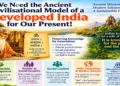

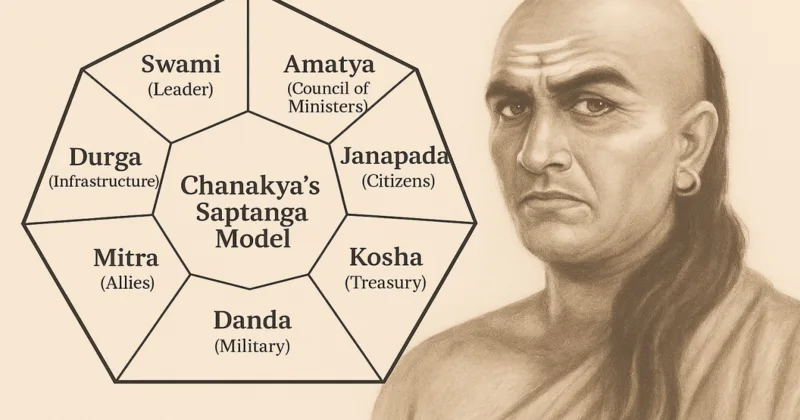
We must develop Eternal Governance and Intellectual Sovereignty in place of the current “reactive” politics if we are to create a civilisation that endures for thousands of years. We are at the start of the Surya-Udaya (Sunrise) of Bharat, not the “End of History.” For 400 years, the Westphalian Nation-State was an experiment. The Islamic Caliphates lasted for a millennium. The reality of Sanatana Dharma is multimillennial. Kautilya’s Saptang model and the Ramrajya principles are urgently needed.
Ramrajya: The ideal governance model
Ramrajya is essentially a socio-political framework centred on Dharma, which means righteousness/duty, and Antyodaya, which means uplifting the last mile person. It is frequently misinterpreted as being solely a religious idea. In his “Ekatma Manavdarshan” philosophy, Deendayal Upadhyay stressed the importance of Dharma and Antyodaya to elevate society and the nation.
Decentralisation and Subsidiarity
Ramrajya suggests a system in which power is dispersed to the grassroots rather than concentrated at the center, similar to the ideal Panchayati Raj. However, Dharma is the essential link between the center and the grassroots, without which decentralisation becomes corrupt, ineffective, and antisocial.
The ruler as a trustee
Rather than being a sovereign, the leader is a servant-trustee (Sevak). The wellbeing and opinions of the populace serve as their main indicator of success; Rama’s receptivity to public opinion is a well-known example. Only the reigning leader and his team will serve society and the nation as servants rather than as owners if the dynastic greedy politics of controlling everything are abandoned and a ruler and his party adopt the “Nation First, party last” principle.
Future civilisational implication
Institutions that outlive individuals are necessary for a viable civilisation. Ramrajya calls for the creation of systems in which the monarch and the oppressed are equally subject to the rule of law and responsibility. The systems should be created in a way that transforms them into cultural practices that are effectively and morally adhered to by all.
Kautilya: Saptanga theory’s relevance today
Chanakya’s Saptanga meaning Seven Limbs theory counterbalances Ramrajya’s idealistic principles providing a framework for strategic realism and pure statecraft. Modernisation of the Seven Limbs
Swami (Visionary Leadership)
Leadership founded on Seva (Service) and Tyaga (Renunciation of Ego). Amatya (Digital & Ethical Infrastructure): AI-driven systems under Dharmic ethics will take the place of chilly and corrupt bureaucracy. A group of people known as Janapada (Ecological Citizens) see the land as Vatika, or a sacred garden, rather than “territory.” Durga & Danda (Security & Justice): A justice system based on Nyaya (Truth-seeking) rather than merely legalism, and a “Shield” so sophisticated that it averts conflict before it begins. Kosha (Treasury/Economy), no greed in creation of wealth. Humanity and the environment are prioritised in economic development. Mitra (Foreign Policy/Strategic Alliances): In order to create a peaceful and environmentally sustainable world, strategic alliances should not be made at the expense of weakening one’s own country. The powerful Bharat will naturally make globe peaceful and prosperous.
Long-term implication
Only when all seven limbs are proportionately strong can a civilisation endure. Collapse results from over-indexing the economy (Kosha) while ignoring human capital (Janapada) or defence (Danda). According to Kautilya, in order to provide the stability required for Dharma to thrive, a state must be mercilessly self-preserving. No compromise should be made when it comes to foreign diplomacy or the internal and exterior security of individuals and the country; “Nation First” should be the guiding principle. We can declare Ramrajya to have emerged when these seven limbs are successfully applied.
Economics vs. Dharma: Conscious capitalism
State socialism inhibits human creativity, while unrestrained capitalism consumes social and environmental capital. Bharat needs to find a third path. Modern markets must adhere to the ancient principle of Aparigraha, which prohibits hoarding. Democratic institutions are at risk from excessive wealth concentration. MSMEs (Micro, Small, and Medium Enterprises) must be aggressively protected by policy, and digital mega-corporations must not be allowed to monopolise markets and data. The avaricious mindset of creating income through illicit activities and harming the environment should be addressed lawfully while keeping humanitarian considerations in mind.
GDP + Gross National Well-Being
GDP does not measure health; it measures transactions. In addition to material prosperity, a Dharmic economy gauges success based on the vitality of the environment, the strength of families, and the mental wellness of its population. GDP should not take into account money obtained through illicit activities or activities that harm the environment and human health, such as alcohol, narcotics, needless medical care, or medications. The GDP notion of today is deceptive. In contrast to the Western model, where maximising shareholder value is the only legal responsibility, corporate charters should legally require responsibilities toward local communities and ecological restoration.
Sustainability Beyond ESG: Sacred ecology
ESG in the modern era is frequently a corporate compliance activity. The Dharmic perspective on ecology is profoundly cultural and existential. Making the shift from considering nature as “property” to considering it as a living being. This entails building on recent legal precedents that give rivers like the Ganga motherhood, enabling ecosystems to sue polluters.
Creating circular designs
Landfills cannot sustain a civilisation that has existed for 10,000 years. Every product made in Bharat must be made with 100% recycling or biodegradability in mind, according to industrial policy. This may undoubtedly be made possible by research and innovation in academic institutions, businesses, and universities.
Decentralised energy makes communities more robust to climate shocks and geopolitical energy crises by replacing large, susceptible power networks with small, renewable energy microgrids in each hamlet. Priority should be given to renewable energy such as solar and wind electricity.
Narrative warfare & civilizational resilience
Long before a gunshot is fired, folks in the information age are engaged in mental warfare. In order to tell its own story, Bharat needs to finance its own universities, think tanks, and social science research. The civilisation continues to be intellectually colonised as long as Bharatiya students depend on Western colleges to comprehend Bharatiya sociology and history. societal media algorithms accentuate societal divisions, control elections, and set the tone for the nation. To stop foreign psychological operations, a civilisational state must have regulatory control over how algorithms function inside its boundaries. Putting a strong emphasis on the subcontinent’s shared civilisational values, interconnected histories, and shared destiny in order to protect the people from internal divisions stoked by external enemies.
Lessons from Bharat’s past mistakes
History is destined to subjugate those who do not learn from it.
The Panipat Syndrome
Due to their lack of strategic depth and inability to secure far-off frontiers, Bharatiya empires have historically engaged in existential conflicts like Panipat deep within their own borders. In order to secure the Bharatiya Ocean Region and neutralise threats long before they reach the nation, modern Bharat must extend power outward. Bharat lost the pace of technical advancement due to colonisation. It cannot afford to miss the revolutions in biotech, artificial intelligence, and space. Innovation must be considered not just for economic progress but also for the security and developing strength of the nation.
Eliminating internal fault lines
Foreign powers utilised regional chauvinism and caste discrimination as wedges to divide and conquer. The complete eradication of these social problems through both stringent legal enforcement and cultural reform is necessary for true civilisational security.
The role of individual consciousness
The integrity of a system depends on the individuals in charge of it. Character development must replace rote memorisation in the educational system (Vidya). To shield young people against algorithmic manipulation and digital addiction, it must impart critical thinking, resilience, and emotional intelligence. Encouraging people to pursue greatness in their natural talents instead than pressuring everyone to fit into a limited concept of success (such as engineering or medicine) is known as cultivating swadharma. When scholars, artists, farmers, and soldiers are treated equally, a civilisation flourishes. Developing a highly disciplined, stress-resilient populace that can handle the chaos of the upcoming decades by institutionalising habits of concentration, meditation, and physical culture.
Bharat’s role in the global future: The Vishwaguru
There is no need for another imperial hegemon in the planet. A stabilising force is required. Bharat’s soft power should be based on exporting solutions rather than debt-trap diplomacy. Providing the Global South with inexpensive medications, renewable energy technology, and digital public infrastructure (UPI, health stacks).
Bharat can spearhead the global agreement on AI ethics, ensuring that technology benefits mankind rather than making it obsolete or enslaved, as the world rushes toward unregulated Artificial General Intelligence (AGI). Serving as a mentor or Guru between the East and West and the Global North and South. In order to preserve international balance, Bharat’s civilisational ethos enables it to maintain complicated, seemingly incompatible partnerships such as dealing with both the US and Russia.
Western legal and technological structures aim to “save” the planet. Through consciousness and moral responsibility, the Dharmic framework aims to “sustain” the world. The only thing that endures for 10,000 years is consciousness; technology changes every ten years. The West builds “Systems” that are robust but fragile. Bharat produces a “Culture” that is dynamic but timeless.
A culture that is ingrained in its people’s breath cannot be destroyed by a single revolution, but a system can. While the East historically dominated the inner world (awareness), the West has dominated the outer world (technology, substance). The future of Bharat lies in combining the two: developing AI with morality, economic expansion with ecological balance and power with moderation. As a viable alternative to nihilistic materialism and predatory expansionism, Bharat will act as the pillar of international stability.