The decade following 2020 will be recorded in the annals of history as an era of systemic disintegration. From the frozen trenches of Eastern Europe to the scorched urban landscapes of Gaza and the volatile maritime corridors of the Red Sea, the post-Cold War illusion of a “rules-based order” has evaporated. In its place, a chaotic, multipolar reality has emerged where energy is weaponised, trade is securitised, and neutrality is often mistaken for weakness.
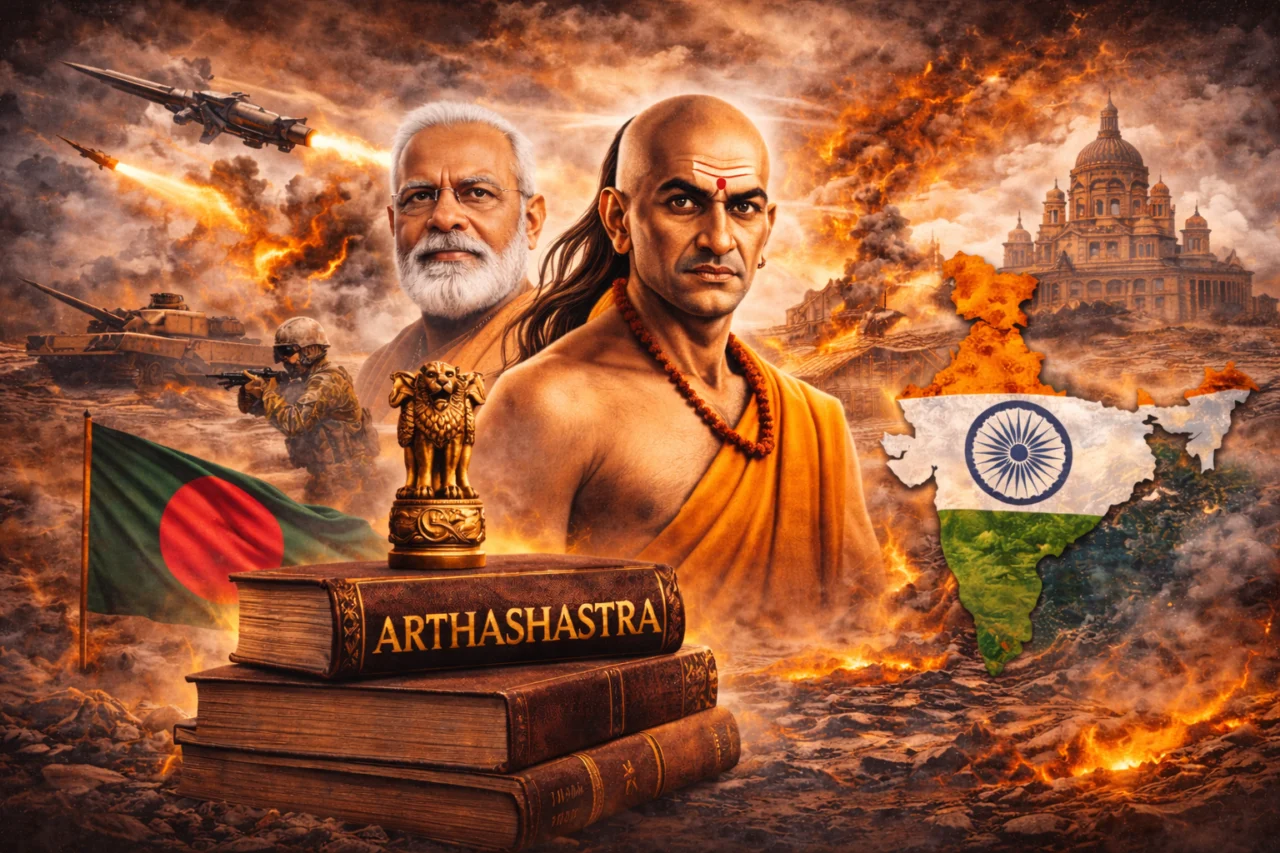
Amidst global fracture, Bharat emerges not as a bystander, but as the Vijigishu, the state aspiring for victory through calculated wisdom. This is the resurrection of the Chanakya Doctrine, transitioning from reflexive diplomacy to assertive, civilizational statecraft. Prioritising sovereign interest over global approval, Bharat now operationalises the Shatgunya (six-fold policy) of the Arthashastra. Moving beyond moral validation, the state secures its Yogakshema through the rigorous application of Sandhi, Vigraha, Yana, Asana, Dvaidhibhava, and Samashraya. Bharat no longer seeks permission; it wields strategic options to command its own destiny in a decade of war.
The Chanakya Shift: Why the Opposition’s Borrowed Vision Fails the New Bharat
The opposition’s struggle to comprehend Bharat’s global stature stems from a fundamental disconnect with our strategic heritage. Clinging to outdated Nehruvian romanticism and “Third Worldism,” they mistake the mastery of Dvaidhibhava, the Chanakyan policy of double-dealing to protect national interest, for “indecision.” Their critiques of the Vishwa Mitra concept as “event management” betray a deep-seated inferiority complex; they cannot fathom a Bharat that sets the global agenda rather than following it.
This ideological void is rooted in decades of strategic paralysis. The UPA era was characterised by a reactive posture that Chanakya would term a failure of Danda (power). From the “dossier diplomacy” following 26/11 to a “lost decade” of defence procurement, the previous regime’s policy was one of submission disguised as moralistic non-alignment. Most damningly, border infrastructure was neglected under the bizarre logic that building roads would invite invasion, a “fear-based” strategy that left soldiers vulnerable and borders porous. They practised Asana (staying quiet) out of incapacity, not as a strategy.
In contrast, the current Chanakya Doctrine has moved Bharat from a supplicant to a decision-maker. Through strategic multi-alignment, proactive kinetic responses like surgical strikes, and an Atmanirbhar defence ecosystem, Bharat has operationalised deterrence. The massive buildup of Himalayan infrastructure proves a newfound confidence: we build roads and bridges precisely because we have the resolve to defend them. By prioritising short-term electoral gains over long-term security, the opposition has effectively disqualified itself from the strategic conversation. Their vision remains borrowed; Bharat’s reality is now indigenous.
China: The Strategy of Asana and Vigraha in the Himalayas
The conflict with China is a long-term Vigraha (hostility) that requires a combination of military deterrence and economic decoupling. While the opposition plays to the galleries, claiming the government is in “denial” about the Line of Actual Control (LAC), the current doctrine has focused on the material reality of power. Chanakya taught that when facing a more powerful adversary, one must practice Asana, staying quiet while building internal strength, until the opportunity for Yana (marching) arises. The opposition’s demand for theatrical public denunciations of Beijing ignores the reality of global supply chains and the necessity of the “Atmanirbhar” transition.
Bharat’s current policy is one of Dvaidhibhava: maintaining diplomatic channels and trade where necessary while simultaneously building the military capability to ensure that any Chinese misadventure is met with a resolute response. This is the implementation of Asana (quiet preparation) combined with Yana (marching/deployment) to the heights of the Himalayas. By refusing to engage in empty rhetorical escalation while simultaneously hardening the border with the BRO (Border Roads Organisation) working at a record pace, Bharat is playing the long game. The opposition’s failure to recognise this as a sophisticated “patience-based” form of warfare reveals their lack of understanding of the Mandala theory, in which an equal or superior enemy must be handled using the strategy of Sama (conciliation) and Danda (force) in a calibrated sequence.
Pakistan and the End of Maya-Diplomacy
Regarding Pakistan, Bharat has decisively shattered a seventy-year cycle of “peace talks” that Chanakya would have condemned as a catastrophic failure of Sandhi. The previous regime’s obsession with “uninterruptible dialogue” in the face of bloodshed was a strategic surrender. Today, Bharat has shifted the paradigm to permanent Vigraha (hostility) until the terror infrastructure is pulverised. The opposition’s persistent call for dialogue is not diplomacy; it is a strategic dead-end and an insult to our fallen heroes.
The surgical and Balakot strikes were the lethal operationalisation of Yana (direct action). By calling the nuclear bluff, Bharat proved it is no longer a victim of asymmetrical warfare. Any scepticism toward these operations is a betrayal of the Danda necessary to protect the State. In the Mandala theory, an Ari (enemy neighbour) is neutralised through strength, not appeasement. By globally isolating the aggressor while prioritising Yogakshema in Jammu and Kashmir, Bharat is executing a masterclass in Upeksha (strategic indifference), a sophisticated tool of statecraft that the opposition’s hollow, 20th-century mindset simply cannot comprehend.
Russia-Ukraine: The Yogakshema of Energy and Defence
The Russia-Ukraine conflict served as a major test of Bharat’s Chanakya Doctrine. As Western powers demanded that New Delhi commit strategic suicide by severing ties with Moscow, Bharat remained unmoved. This was the implementation of Asana, staying quiet and maintaining one’s position while the “great powers” exhausted themselves in a conflict that did not concern Bharat’s core interests. The opposition’s response was a masterclass in strategic illiteracy. By questioning Bharat’s purchase of discounted Russian oil, they demonstrated a total disregard for the economic security of the Indian citizen.
They seemed to prefer a scenario where the Indian middle class suffered from hyper-inflation just so they could receive a pat on the back from the editorial boards of Western newspapers. Chanakya taught that a king’s primary duty is to his own treasury (Kosa) and his own people’s prosperity. By securing energy at competitive prices and refusing to alienate a long-term defence partner, the government practised the highest form of realism. Russia remains a critical component of Bharat’s Mandala strategy, a counterweight in a world where no single power should be allowed to dominate the Eurasian heartland. The opposition’s critique here was not just anti-government; it was anti-people.
West Asia: Navigating the Quadrangle- Threat Mandala (Palestine, Israel, Iran, US)
This strategic brilliance is most visible in the quadruple Mandala of West Asia, involving the US, Israel, Iran, and Palestine. Bharat has achieved a masterstroke by fully de-hyphenating its relations; it maintains a non-negotiable strategic embrace of Israel (Samashraya) for defence and high-tech cooperation while simultaneously upholding a principled commitment to a Palestinian state. By providing over 135 metric tonnes of humanitarian aid to Gaza while deepening intelligence ties with Tel Aviv, Bharat proves that moral stances and cold realism are not mutually exclusive. This is Sandhi (peace) and Vigraha (hostility) managed with the precision of a master strategist, ensuring Bharat remains the only major power capable of speaking to every player in the conflict.
Simultaneously, Bharat navigates the escalating tensions between the US, Israel, and Iran by protecting its own economic corridors. While the US remains our largest trading partner, Iran remains a vital gateway via the Chabahar Port, essential for bypassing a hostile Pakistan and reaching Central Asia. The opposition’s penchant for “taking a stand” would have shuttered the energy lanes and maritime routes that sustain Bharat’s growth. Instead, by employing Upeksha (strategic indifference) toward regional provocations and focusing on quiet diplomacy, Bharat ensures its 8 million-strong diaspora in the Gulf remains safe. In this decade of wars, Bharat has ceased to be a partisan spectator; it has become the indispensable, sovereign balancer that utilizes its Danda (power) to protect its borders and its future.
Kosa: The Economic Treasury as the Backbone of War
Chanakya famously stated that “all undertakings depend on the treasury (Kosa).” In the fiscal year 2025-26, Bharat’s economic realism has reached new heights. With foreign exchange reserves crossing the $720 billion mark in early 2026, the Reserve Bank of India has provided the “fortress walls” necessary to withstand the global tariff shocks and currency wars of the decade. While the opposition continues to moan about “jobless growth,” the reality is a resilient GDP growth rate of 7.5 per cent to 7.8 per cent, fuelled by a massive capital expenditure push.
The Union Budget for 2026-27 has allocated a record $94 billion (Rs 7.85 lakh crore) to the Ministry of Defence, a 15 per cent increase that brings defence spending to 2 per cent of the GDP. This is not just a number; it is the materialisation of Danda. Over 75% of the modernisation budget is now earmarked for domestic procurement, ensuring that the wealth of the state remains within its borders while building a self-reliant war machine. The opposition’s historical tendency to siphon funds into populist “doles” rather than building this Kosa is the reason Bharat was once a fragile economy. Today, it is a high-growth fortress.
Danda: Atmanirbhar Defence and the Space Frontier
The implementation of Danda in the 2020s extends beyond the battlefield into the stars. In November 2025, ISRO successfully launched GSAT-7R, Bharat’s most advanced military communication satellite. Weighing over 4.4 tonnes, this “eye in the sky” provides seamless, secure, and anti-jamming communication for the Indian Navy across the entire Indian Ocean Region. This is a critical component of maritime domain awareness, allowing our ships and submarines to operate as a cohesive, network-centric force. The opposition’s previous neglect of space as a strategic domain left Bharat’s military dependent on foreign data. Today, under the Atmanirbhar shift, we are building everything from hypersonic missiles to indigenous aircraft carriers. The opposition mocks these achievements as “expensive toys,” failing to understand that in the Chanakyan view, a king who relies on others for his weapons is a king who has already lost his kingdom. Bharat has finally heeded that warning, building a defence industrial base that is the backbone of its strategic autonomy.
Atmanirbhar Defence and the Malacca Strait: The Maritime Necklace
The shift toward Atmanirbhar defence is fundamentally redefining power dynamics in the Indian Ocean. For decades, Bharat was a “net security provider” in name only. Today, by operationalising its role as the guardian of the Ratnakara, Bharat has moved from rhetoric to reality. The commissioning of the indigenous INS Vikrant and the expansion of the submarine fleet signal a new era of maritime dominance. Strategic depth is being reclaimed through the Samashraya doctrine, seeking protection through indigenous strength and the Quad. By transforming the Andaman and Nicobar Islands into an “unsinkable aircraft carrier” at the mouth of the Malacca Strait, Bharat now holds the Danda (power) to intercept China’s energy lifelines. While previous administrations dismissed these islands as distant outposts, the current Chanakyan state views them as the frontline of 21st-century security.
To break China’s “String of Pearls,” Bharat has deployed the “Necklace of Diamonds,” securing naval access from Oman’s Duqm to Indonesia’s Sabang. This is the Mandala principle in action: circling the circler. Unlike the opposition, whose historical preference for foreign deals over domestic ingenuity left Bharat’s shores vulnerable, the current focus on indigenisation, from BrahMos missiles to Tejas fighters, ensures that our defence is not subject to foreign “off-switches.” A king who relies on others for his weapons has already lost his kingdom. By building a defence industrial base, Bharat has secured its strategic autonomy, evolving from a regional player into a global maritime balancer.
The Rise of the Vijigishu
The decade of wars is a crucible that is melting away the remnants of a weak, indecisive India and forging a resurgent Bharat. We are witnessing the end of an era where Indian foreign policy was a performance for a global audience, and the beginning of an era where it is a tool for national transformation. The opposition’s failure to comprehend this shift is a tragedy of their own making. They remain spectators in a game where Bharat has become a lead player, unable to grasp that the world respects strength, not petitions for peace.
The Chanakya Doctrine is not merely a collection of ancient verses; it is a living, breathing framework for the 21st century. It is the reason Bharat can look the West in the eye while buying oil from the East. It is the reason Bharat can condemn terror in Israel while building ports in Iran. It is the reason Bharat is no longer “balancing” between powers, but is becoming a pole around which other powers must balance. As the decade of wars continues to unfold, one truth remains: in a fractured world, survival belongs to the wise, and success belongs to the strong. Bharat has chosen the path of the Vijigishu, anchored in civilizational confidence and guided by the timeless wisdom of Chanakya. The opposition may continue to take their “digs” from the sidelines, but the march of the Chanakyan state toward its rightful place in the global order is now unstoppable.