“यत्र नार्यस्तु पूज्यन्ते रमन्ते तत्र देवताः” – where women are honoured, there the Divine resides. This is not merely a civilisational ethos that India recites with pride. It is a governing principle. A society that internalised this idea thousands of years ago cannot remain comfortable with a political structure where women, who form nearly half the population, occupy a fraction of legislative seats. The journey from reverence to representation is not optional. It is the unfinished business of Indian democracy.
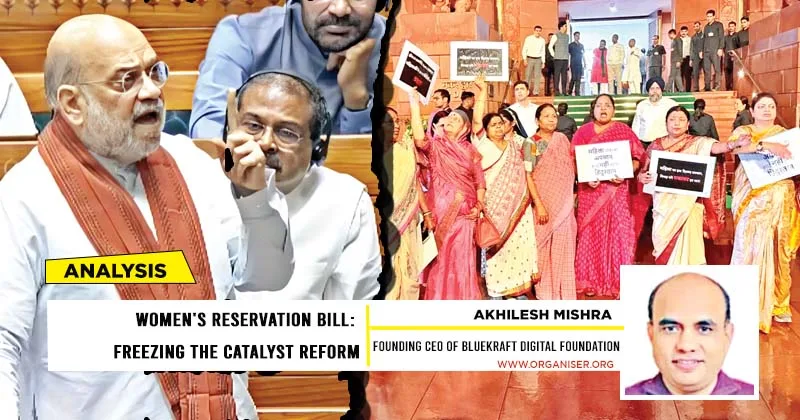
For decades, India has lived with a curious contradiction. Women have emerged as a decisive electoral force, often matching or even surpassing male voter turnout in several States. They participate, they decide outcomes, they shape mandates. And yet, when it comes to representation in legislatures, their presence remains disproportionately low. This gap between participation and power is not a statistical anomaly. It is a structural flaw that weakens the very foundations of democracy. The Women’s Reservation Bill was meant to correct precisely this imbalance. But its history tells a different story. Introduced, debated, deferred, and derailed repeatedly, it became a victim of political calculations of parties controlled by dynasties. From the mid-1990s onwards, every serious attempt to pass it encountered resistance, often not in principle but in practice.
Congress: Habitual Saboteur
The Congress party has been the principal saboteur of the idea of Women’s Reservation Bill. It first sabotaged PM Deve Gowda’s attempt (1996) by threatening him with withdrawal of Congress support to his Government, as his Government’s very survival depended on Congress support. Later, Congress defeated PM Vajpayee’s attempts four times (1998, 1999, 2002, 2003) since PM Vajpayee also needed Congress support for 2/3rd majority in both houses of Parliament. The peak of Congress hypocrisy and malintent became visible during the UPA era. Congress sabotaged its own Government’s efforts in 2010 in the Lok Sabha. Despite the history of Congress not supporting PM Vajpayee’s efforts, the BJP still supported Congress when the UPA introduced the bill in Rajya Sabha and helped it pass. When the bill reached the Lok Sabha in 2010, Congress was alarmed that the bill may finally become a reality. That is when the two-faced nature of Congress became public and the divergence between its propaganda and reality became apparent. Despite the Opposition’s support, the Congress did not present its own bill in Lok Sabha in 2010 and allowed it to lapse.
Enemy of Nari Shakti
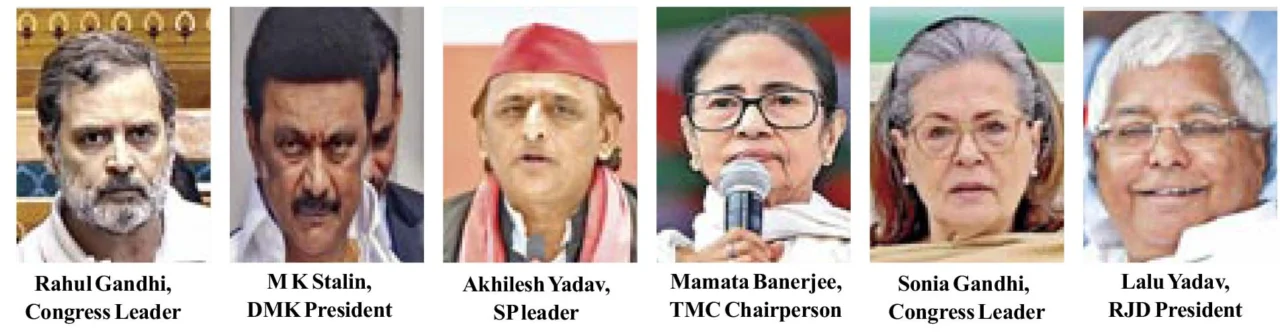
Women representation in Parliament first gained momentum in the 1990s. The journey from 1996 to 2026 has been full of ups and downs.
- lThe first attempt was in 1996 during the Janata Dal government led by HD Deve Gowda. On September 12, 1996, it was introduced as the 81st Constitutional Amendment Bill. Amid heavy uproar, it was sent to a joint parliamentary committee led by Geeta Mukherjee. The bill lapsed because the Lok Sabha was dissolved.
- The second attempt was in 1998 under Atal Bihari Vajpayee’s NDA government. Then Law Minister M Thambidurai introduced it. Opposition parties, especially RJD and SP, strongly opposed it, demanding a ‘quota within quota’ for OBC reservation. The bill lapsed again when the 12th Lok Sabha was dissolved.
- The third attempt was in 1999, when the Vajpayee government tried again. The NDA government reintroduced it. This time, there were unpleasant incidents in Parliament like scuffles and tearing of bill copies. Due to lack of consensus, it failed for the third time.
- The fourth attempt was during the UPA-1 Government from 2002 to 2003. Efforts were made to revive it during the Vajpayee government and early UPA years, but political deadlock continued. Official attempts to pass it failed in Parliament.
- The fifth attempt was during Manmohan Singh’s UPA Government. In 2010, a historic moment came. On March 9, 2010, the bill was passed in the Rajya Sabha for the first time. Marshals had to be called, but the upper house approved it. However, the Government could not present it in the Lok Sabha because allies threatened to withdraw support. The bill lapsed when the Lok Sabha was dissolved in 2014.
- The sixth attempt was in 2023 during Narendra Modi’s Government. On September 20, 2023, in the first session of the new Parliament building, the Modi Government introduced it as the ‘Nari Shakti Vandan Act.’ It was passed by both houses and became law, but with a condition that it would only be implemented after delimitation and a new census.
- The current attempt was on April 17, 2026. For the seventh time, it failed. While 352 votes were needed for a two-thirds majority, only 298 were received.
The passage of the Nari Shakti Vandan Adhiniyam in 2023 therefore marked a decisive break from this past. For the first time, the intent to ensure one-third representation for women in Parliament and State Assemblies was translated into a constitutional commitment. It was a moment of legislative clarity after decades of political ambiguity.
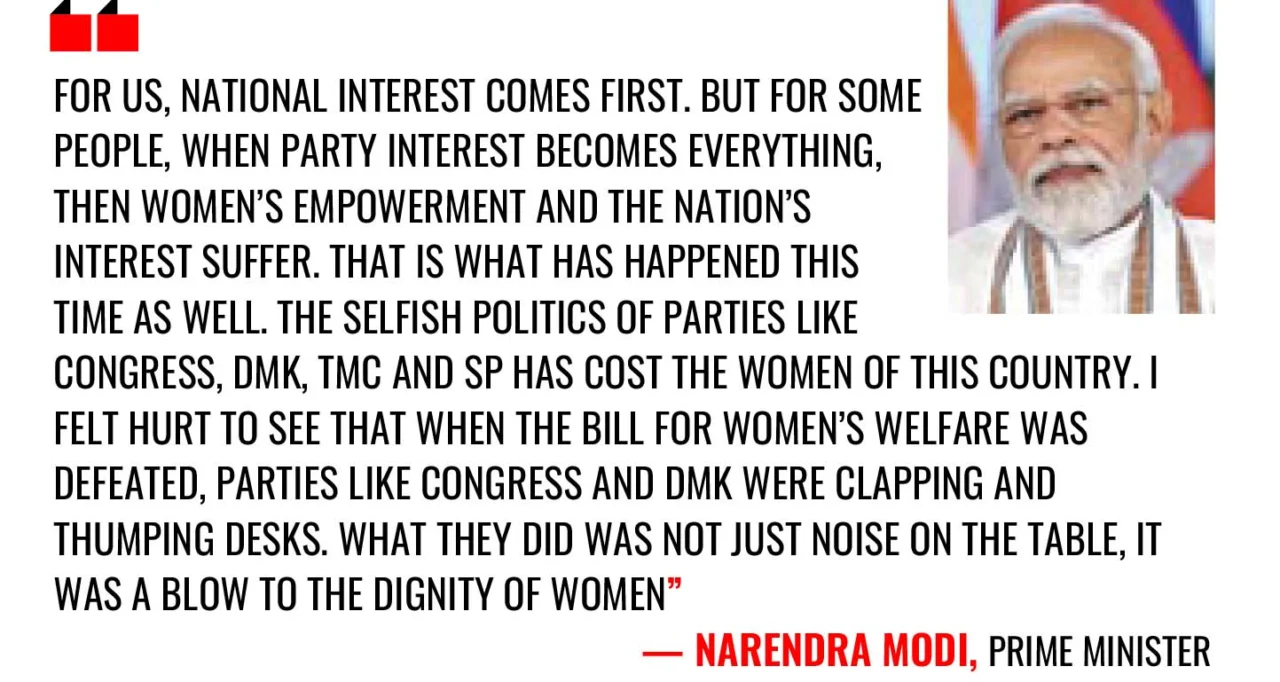
However, it is this history of the bill from its inception to final passage that must inform us as to why Congress pretended to support the 2023 bill by the Modi Government but opposed it in 2026. The support in 2023 was pro-forma support to Nari Shakti Vandan Adhiniyam bill, since it was then a merely future idea whose implementation would be over a long horizon, a decade away. The moment it looked like becoming an immediate reality, Congress again sabotaged the 2026 bill.
From Promise to Practice
But laws do not operate in a vacuum. They require pathways to implementation. And it is here that the real contest begins. The 2023 law, while historic, came with a built-in delay. It linked implementation to the next census and subsequent delimitation. Under this framework, women’s reservation could have been pushed well into the next decade as the completion of next census (2026-2027), only after which next delimitation could begin, and which itself would take considerable time, would mean that the process could not have been completed before 2029. Recognising this gap, the Modi Government sought to accelerate the timeline through a constitutional amendment in 2026. The objective was straightforward: drop the correlation between next census and delimitation; enable immediate delimitation (based on the existing 2011 available census data) and expand the number of seats so that reservation could be implemented as early as the 2029 elections. The design of this proposal deserves careful attention. It was not a blunt instrument. It was a calibrated reform.
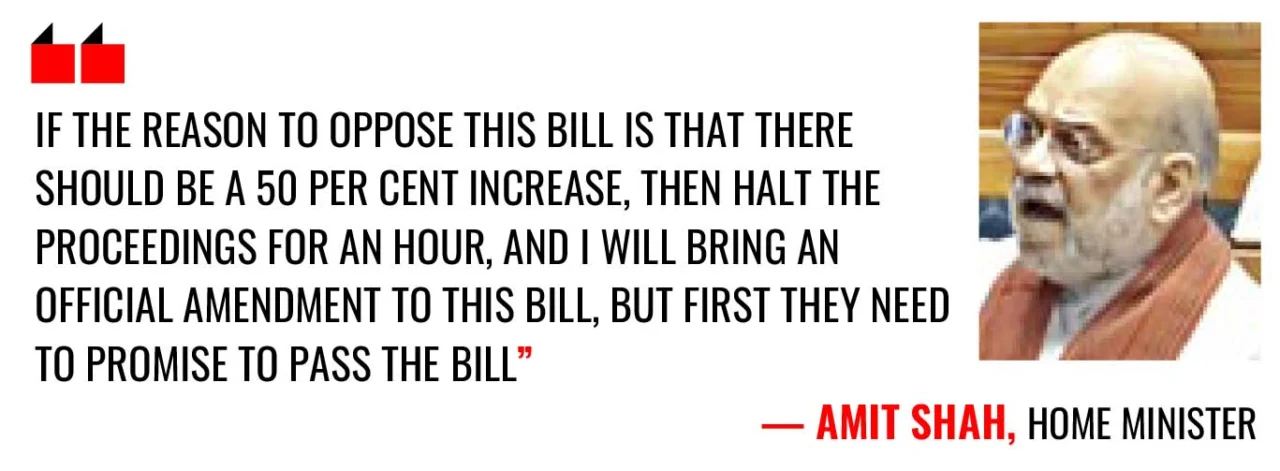
By increasing the total number of seats, it ensured that representation for women would expand without displacing existing constituencies. No sitting Member of Parliament would lose their seat. At the same time, the present proportional representation across States would be maintained, addressing concerns of regional imbalance. In other words, it combined political feasibility with institutional fairness. It sought to enlarge the democratic pie rather than redistribute it in a manner that could trigger resistance. Yet, despite this careful balancing, the amendment failed in the Lok Sabha.
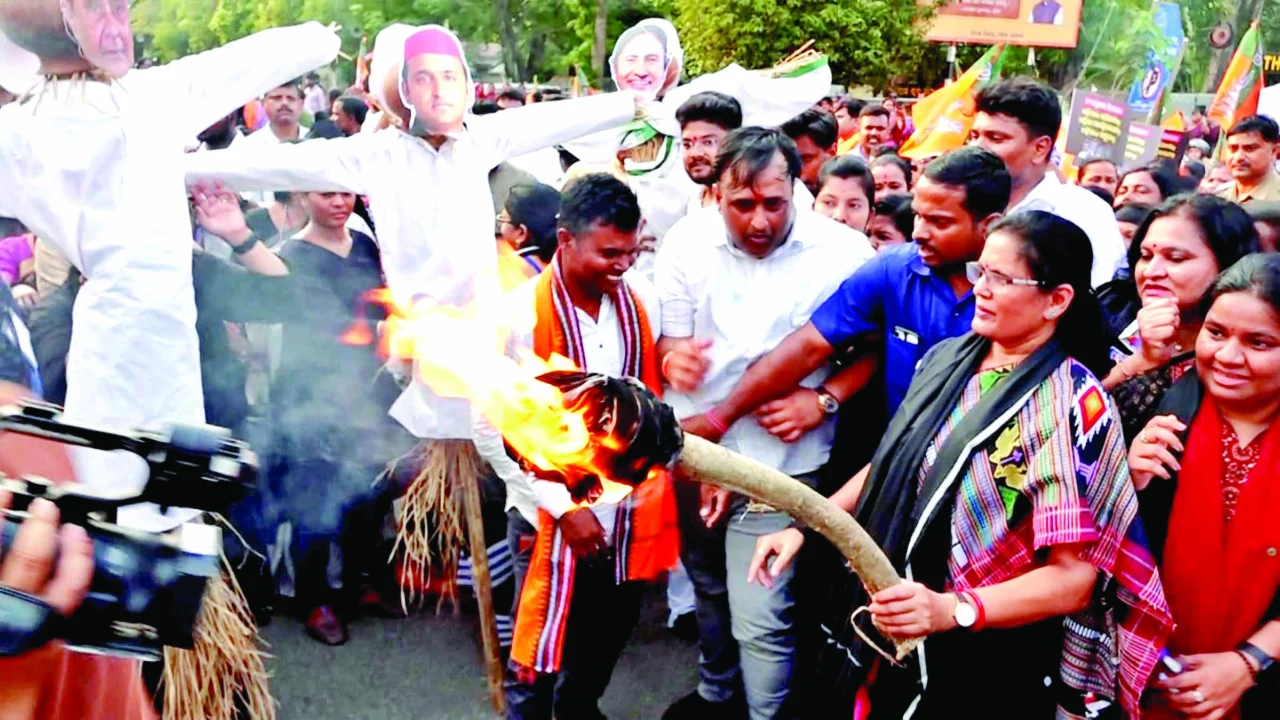
The failure of the 2026 amendment is not merely a legislative setback. It reveals a deeper pattern in Indian politics. There is often broad agreement on reform in principle, but hesitation when it comes to implementation. Support tends to be strongest when the consequences are distant and weakest when they become immediate. This was evident in the trajectory of women’s reservation itself. When it appeared as a long-term aspiration, it attracted rhetorical endorsement. But when the possibility of implementation moved closer, objections surfaced, often framed in procedural or technical terms. The result is a familiar cycle. Reform is acknowledged, delayed, and then revisited years later under similar conditions. The immediate consequence of the amendment’s failure is clear. Women’s reservation is unlikely to be implemented in the 2029 elections. The existing constitutional framework, which requires census and delimitation, remains intact. This pushes the timeline to 2034 or beyond.
But the implications go beyond delay. Delimitation will still take place, but without the safeguards proposed in the amendment. The freeze on delimitation is only till 2026. So, it is a constitutional requirement to undertake delimitation. In effect, the ruse of delimitation, that was used by Congress led opposition to defeat the women’s reservation bill, would still take place while women’s reservation has been delayed.
With Modi’s Government’s proposal to increase overall number of Lok Sabha and Assembly seats by 50 per cent got defeated, the total number of seats will remain capped, and representation across States will be recalibrated purely on the basis of population. This introduces new complexities, particularly for States that have successfully controlled population growth. Ironically, in opposing a reform designed to protect proportionality, some political actors may have weakened their own position in future negotiations. At the heart of the debate lies a fundamental question. Why is reservation necessary at all?
The answer lies in the nature of political access in India. Electoral politics is not a level playing field. It requires resources, networks, and institutional backing. Political parties act as gatekeepers, and they continue to nominate far fewer women candidates than men. Dynastic parties, which other than the BJP almost all are, have no further incentive to nominate women as it would otherwise loosen the hold of their families. The consequence is a self-reinforcing cycle. Low representation leads to limited visibility, which in turn discourages participation, perpetuating the imbalance. Voluntary measures have been attempted. Political parties have, at various points, promised to increase the number of women candidates. But these commitments have rarely translated into sustained action. Structural barriers cannot be dismantled through goodwill alone. They require structural interventions. Reservation is one such intervention. It does not guarantee outcomes. It guarantees access.
Lessons from the Grassroots
India does not have to look far for evidence of what reservation can achieve. The experience of Panchayati Raj institutions provides a compelling case. At the local level, where seats have been reserved for women, the impact has been transformative. Women leaders have not only participated effectively but have also influenced policy priorities. Issues such as healthcare, education, water, and sanitation have received greater attention. These are not peripheral concerns. They lie at the core of human development.
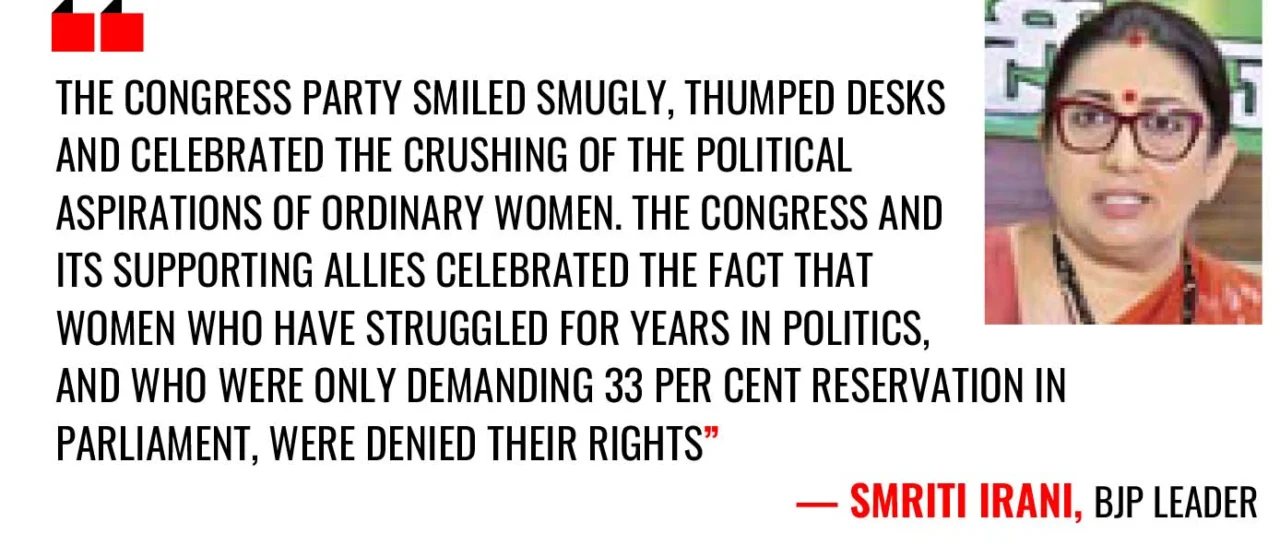
More importantly, representation has altered social perceptions. It has normalised the presence of women in positions of authority. It has created role models and expanded aspirations. Over time, this has the potential to reshape the political landscape itself. Reservation, therefore, is not an end state. It is a catalyst.
A democracy that excludes or underrepresents half its population operates below its full potential. This is not just a normative argument. It is a functional one. Inclusive governance leads to better outcomes. Diverse perspectives improve decision-making. Policies become more responsive and equitable. Development becomes more sustainable. Conversely, exclusion carries costs. It limits the range of ideas, narrows policy focus, and weakens institutional legitimacy.
India’s democratic journey has been remarkable in many respects. High voter participation, peaceful transfers of power, and robust public debate are all strengths. But representation remains an unfinished chapter. With women constituting only a small fraction of legislators, both at the State and national levels, the gap between democratic ideals and institutional reality remains significant.
Civilisational Lens
There is also a deeper dimension to this debate. India is not merely a modern nation-state. It is a civilisation with a long memory. The idea of respecting and empowering women is embedded in its philosophical traditions. From the Vedic seers to the Bhakti movement, from social reformers to freedom fighters, women have played central roles in shaping India’s intellectual and political life. The challenge has been to translate this civilisational ethos into contemporary institutions. Women’s reservation is part of that translation. It aligns modern democratic practice with ancient philosophical commitment. It bridges the gap between what India believes and how it governs.
The defeat of the 2026 amendment is a setback, but it is not the end of the road. First, the political narrative must remain anchored in empowerment. It is a national imperative that transcends electoral cycles. Second, public pressure must be sustained. Women voters have already emerged as a decisive force in Indian politics. Their voice will be critical in shaping the future trajectory of this reform. Finally, accountability must be enforced. The history of delays cannot be allowed to repeat itself indefinitely. Political choices must be scrutinised, and their consequences must be made visible to the parties who have sabotaged women’s due rights.
Explaining the 2026 Bills
The Need of The Bills: Nari Shakti Vandan Adhiniyam was passed in 2023 itself. So why has it not been implemented till now? Because the current Article 334 (A) of Constitution, that enables women’s reservations, says such reservation will come in effect only after a delimitation is done after the first census is done post the commencement of 2023 bill.
Such a census has started in 2026. It will be completed in late 2027. So, delimitation can start only after it, even though it has been fast tracked digitally. Delimitation is a time-consuming exercise, as it will involve Lok Sabha as well as all State Assemblies and includes conducting public hearings. Therefore, if delimitation were to start, the end in 2027 or even 2028 would obviously not be completed in time for 2029 elections.
So, what was the solution? To start delimitation today itself and drop the need of any fresh census and instead take already available 2011 census data. This is exactly what the 2026 amendments bill proposed to do. In effect, the Congress led opposition defeated the enabling provision for immediate implementation of Women’s Reservation Bill. They did not defeat the delimitation bill, but instead the women’s reservation bill itself. Distribution of seats, and which of those existing will be reserved for women is a quasi- judicial function and not an executive decision. If Governments decide what existing seats to reserve for women, they could do so in many biased ways which will not be fair in a democracy. Such an exercise must be done by a neutral body, which is what the delimitation commission is.