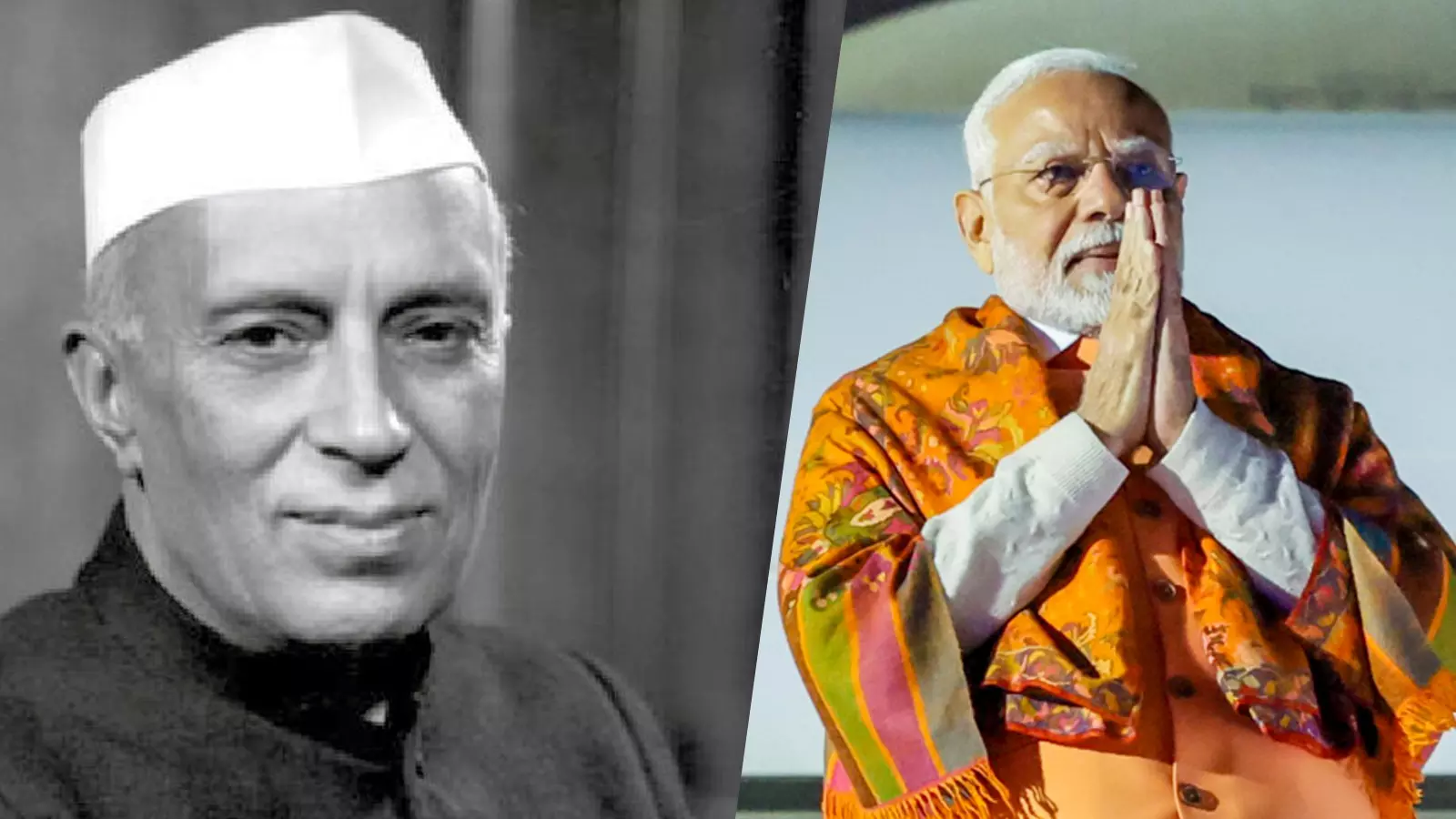
Prime Minister Narendra Modi is poised to achieve a historic milestone in Indian politics by becoming the country’s longest-serving elected Prime Minister. On June 10, 2026, Modi will complete 4,399 consecutive days in office, surpassing the record of India’s first Prime Minister, Jawaharlal Nehru, who served 4,398 days as an elected leader after India’s first general elections.
The achievement is being viewed as a landmark moment in independent India’s political history. Having first assumed office on May 26, 2014, Modi has led the country through three consecutive Lok Sabha mandates, becoming the central figure in one of the most dominant political eras since Independence.
The distinction between Nehru’s total tenure and his tenure as an elected Prime Minister is central to understanding the significance of the milestone.
Nehru served as Prime Minister from August 15, 1947, following India’s Independence. However, his tenure before the first general elections was as the head of an interim government. His elected tenure officially began on May 13, 1952, after India completed its first democratic exercise under the Constitution.
From May 1952 until his death on May 27, 1964, Nehru served for 4,398 days as an elected Prime Minister. Narendra Modi, whose entire tenure has been backed by direct electoral mandates, will surpass that figure on June 10.
Political observers note that while Nehru remains India’s longest-serving Prime Minister overall, Modi will hold the distinction of being the longest-serving elected Prime Minister in the country’s history.
PM Modi’s rise to this milestone has been built on successive electoral victories that reshaped India’s political landscape. The Bharatiya Janata Party (BJP), under his leadership, secured a majority in the 2014 Lok Sabha elections, repeated the feat with an even larger mandate in 2019, and returned to power again in 2024.
These victories have enabled the government to maintain continuity in policymaking while avoiding the instability often associated with coalition politics.
Many attribute Modi’s sustained popularity to a combination of welfare delivery, infrastructure development, digital governance initiatives, national security policies, and a governance model focused on direct engagement with citizens.
Over the past twelve years, the Modi government has emphasized technology-driven governance and direct benefit delivery mechanisms.
Flagship welfare programmes, financial inclusion initiatives, housing schemes, sanitation campaigns, healthcare expansion, and digital public infrastructure have significantly altered the way government services are delivered.
The administration has also undertaken large-scale infrastructure expansion, including highways, expressways, airports, railway modernisation, and logistics corridors, aimed at accelerating economic growth and connectivity.
Supporters argue that these initiatives have helped create a broad social coalition that cuts across traditional caste, regional, and socio-economic divisions.
Modi’s impending record is also being viewed through the lens of India’s evolving economic and geopolitical identity.
While the Nehru era was characterised by a state-led economic framework and the policy of non-alignment during the Cold War, the Modi years have witnessed a stronger emphasis on market-led growth, digital innovation, manufacturing expansion, and strategic partnerships.
India’s foreign policy under Modi has focused on strengthening relations with major powers while simultaneously enhancing its role as a leading voice of the Global South.
The country’s growing international profile, active diplomacy, and increasing participation in global economic and strategic forums have contributed to a perception of India as an emerging major power.
The continuity of leadership has allowed the government to pursue major policy reforms that previous administrations often found difficult to implement.
Among the notable initiatives undertaken during Modi’s tenure are tax reforms, expansion of digital governance systems, improvements in public service delivery, large-scale infrastructure investments, and significant legislative and administrative changes.
Observers note that sustained political stability has enabled long-term policy execution and reduced uncertainty in governance.
Beyond the numerical record, Modi’s achievement is widely seen as symbolic of a larger transformation in India’s political culture.
For decades, Indian politics was largely measured against the legacy of the post-Independence leadership. Modi’s record reflects the emergence of a new political era defined by strong mandates, centralized decision-making, and a focus on national development, technology, and global influence.
As he crosses the 4,399-day mark on June 10, Narendra Modi will not only surpass a historic record but also underline the remarkable durability of his political appeal in the world’s largest democracy.
The milestone marks a significant chapter in India’s democratic journey, highlighting how electoral legitimacy, policy continuity, and political stability have shaped the country’s governance trajectory over the past decade.