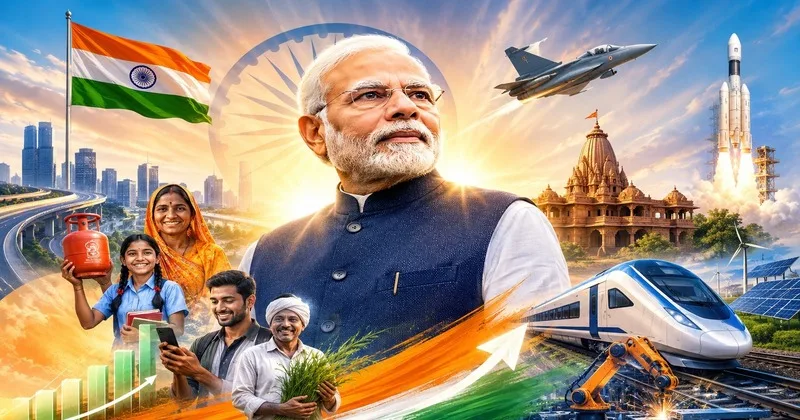
The oath ceremony on May 26, 2014, was not merely a beginning of a quantum leap, a game changer, a disruption, a transformation or a revolution; it was a metamorphosis of people’s aspirations that caused a major paradigm shift in almost all sectors. The mathematics of politics was rewritten in the 2014 general election, and major shifts occurred over the 12 years from 2014 to 2026.
When India is witnessing the longest-serving Prime Minister in 2026, it certainly indicates proper accommodation of the aspirations of the new India,, which has really shaped the Modi Government. The aspirational India, pride in Make in India, an emboldened stand in foreign policy, protecting its own national interests, reaching out to poor people through many schemes, coupled with civilisational revival and the Ram Mandir, have been the historical marks of this Government. “Abki Baar Modi Sarkar” has influenced the Government to a new consensus of “Sabka Saath, Sabka Vishwas, Sabka Vikas, Sabka Prayas”. The journey has not been hunky-dory, and the interregnum in speed caused by many adverse situations like Covid 19, but it was successfully managed and took India as a refurbished power as a nation.
On June 11, when Narendra Modi became the longest serving Prime Minister of India, it is naturally proven that most of the aspirations are fulfilled or heard in a true sense. This metamorphosis has delivered some historic paradigm shifts which will be remembered or even analysed in the coming long years. PM Modi himself, by image, is not only reflective as quoted by Sh. H. D. Devegowda, but his policies have undergone a drastic change from the past to the present. Reflective by image and manifested by policies, as can be seen in some of the major shifts in policies under different domains.
There are millions of voters in India who have been voting for the BJP only because of Modi and only based on ideological synergy. These voters don’t bother about inflation, oil crisis, rupee vs dollar issue, or even care what others may say about Modi. They support him because Sh. Modi supports his voters’ ideology, culture, religious faith and aspirations. This is a rare example in world history when a charismatic leader does not impose his thought but shapes his own thought in accordance with his electorate. The response has been massive during these 12 years related to civilizational identity, cultural heritage, religious symbolism and historical interpretation in factual manners. The result is historical in many senses because under his leadership, civilisational revival in the form of promotion of Indian knowledge traditions and cultural diplomacy initiatives got currency. The major stamp is registered in the upcoming history, that is, the Ram Mandir. This is the most important shift from the Congress-led Secular-National consensus to the Cultural-Civilizational Narrative. It is a shift from India to Bharat.
The Modi government will be known forever for bringing a shift from Entitlement-Based Politics to Beneficiary-Based Politics. Pre-2014, the politics in India were heavily dependent upon the entitlements like caste, community and language, but post-2014, Indian politics has shifted towards the poor or unprivileged to be beneficiary groups through many schemes like housing, LPG connections, health insurance, sanitation and drinking water supply.
Reaching these beneficiaries in a real sense, there is another shift, which is from Welfare Delivery to Direct Benefit Delivery. The famous Rs. 19 reaching villages has become just an identity of pre-2014 India because through the JAM trinity (Jan Dhan-Aadhaar-Mobile), major schemes’ benefits have started being transferred directly into beneficiaries’ bank accounts. To get more transparency and stop the leakages, State-centric administration is transformed into Technology-Driven Governance in Post-2014 by taking up Technology as a central key factor in public service delivery, tax administration, Procurement, Healthcare platforms, digital identity, etc. There has also been a constant push for manufacturing, and it has marked a gigantic shift from Service-Led Growth to Manufacturing Ambitions. “Make in India” and “Production Linked Incentives” (PLI) are major examples of this push, and it is manifested historically when C-295 military transport aircraft successfully completed its maiden test flight on 10th June, 2026. Therefore, for the first time, the incremental approach of making India developed was dropped, and the Government took major decisions to fill the gaps in the development through many schemes. Huge expenditure and greater emphasis are placed on Expressways, Airports, Rail modernisation, Metro systems, Logistics corridors and Digital infrastructure. This is again a shift from incremental development to a large-scale infrastructure push.
In foreign policy and national security, these 12 years have taken India from Defensive Global Posture to Aspirational Global Leadership. A neo-realistic approach in place of the idealistic Nehruvian approach for protecting one’s own national interest has taken shape in the foreign policy without shedding away the core principles of consensus-based foreign policy. The short-term goal, like getting stuck balances between powers and not only protecting but advancing one’s own national interests, is fully taken care of, which is towards the processes of achieving long-term goals like Permanent Membership in the Security Council. For both these goals, India has shifted its manoeuvring from Non-Alignment Legacy to Multi-Alignment Diplomacy.
From “Not-possible” to “To be Possible” shift is witnessed many times during these 12 years; no one, including many belonging to Modi supporters, was able to dare to think about the abrogation of Article 370, and India can do surgical strikes against Pakistan. This shift has taken India from an insecure defensive power to an emboldened force to admit itself to do all possible to protect itself. Such bold steps are still needed in terms of making a truly Developed country in 2047, at least in two sectors, Education and Healthcare. For being a developed country, it is necessary to focus more on education at the local level. The majority of people are talking about the quality of education, access to education, implementation of NEP and all other things, but the time has come to shake the structure of education. The structural reform from village primary school to the University level should be reviewed, and it should be decided how to administer the education. Similarly, in healthcare, many improvements have been adopted, but delivery of government healthcare and access to this delivery are still unfinished agendas. Schools should be new Mandir and Doctors should be true God for patients as per the mounting expectations of Modi supporters.
Some would say, Narendra Modi is a mere reaction to more than 50 years of apathy, but there is a wider consensus on this opinion, Sh. Modi is not a reaction but an embodiment of the natural development of modern aspirations of the people of India. This persona is filled with zeal for fulfilling all possible needs that are going towards making India an Atmanirbhar, Viksit and Shaktishaali.