
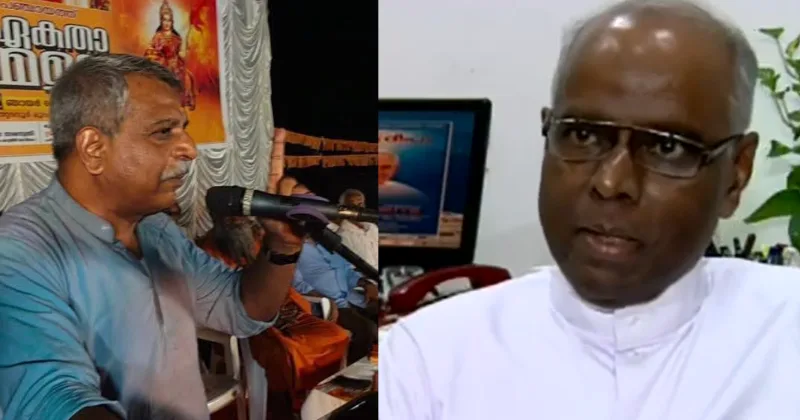
Hindu organisations have retaliated against the accusation of “hoarding tons of gold”. Hindu Aikya Vedi President R.V. Babu said that temples’ wealth has been offered by devotees, not brought from abroad by showcasing images of the poor in Bharat. He asserted that Hindus are capable of deciding how temple wealth and gold should be utilised.
This comes in response to Fr. Paul Telekat, who stated on April 11 that the Church does not hoard wealth. He said Christians are minorities and claimed that foreign funds are received through government-controlled channels.
According to Church leader, these funds are utilised for welfare activities such as schools, colleges, hospitals, and orphanages. He also expressed concern over the non-renewal of FCRA licences if norms are not complied with, adding that properties could be attached and seized if licences are not renewed. He alleged that there is a Hindutva-driven negative agenda behind such actions.
Church leaders continue to raise concerns around FCRA regulations while simultaneously targeting Hindu temples by alleging large-scale wealth accumulation. Fr. Telekat, a senior priest of the Syro-Malabar Church, reiterated these claims while criticising regulatory mechanisms.
Fr. Telekat also acknowledged that licences are not renewed if norms and accounts are not properly maintained. However, despite this admission, he continued to criticise temples over alleged wealth accumulation.
Responding strongly, R.V. Babu of Hindu Aikya Vedi rejected these claims. He stated that temple wealth is a result of devotees’ offerings and not foreign inflows. He emphasised that Hindus have the right to determine how their religious institutions manage their resources.
Babu further explained that earlier 50% of foreign funds could be used for administrative purposes, which was reduced to 20% in 2021. Under current provisions, failure to comply with norms such as filing returns and maintaining accounts can lead to cancellation or non-renewal of licences, resulting in the takeover of assets, wealth, and bank accounts.
In a social media post, Babu alleged that Christian religious extremists and jihadis are keeping an eye on temple properties. Though their methods differ, he claimed their goal is the same. He said they should first stop using crores of rupees brought into India through smuggling, black money, and illegal foreign donations for religious conversions.
He further alleged that both groups aim to establish their own religious state. One seeks to continue the Portuguese tradition, while the other follows the Mughal tradition. He claimed there is an underlying nexus between them. According to him, both oppose Hindus, Hindu culture, and religion, and view Hindu organisations as obstacles, which is why they target them.
The developments highlight that regulatory compliance under FCRA applies to all organisations, irrespective of religion. Properly managed institutions have little to fear, as adherence to financial norms remains the central requirement.
Fr. Paul Telekat previously served as editor of Sathyadeepam for 38 years and later led Light of Truth, an English bi-weekly of the Church. He retired in 2024 and had also served as the official spokesperson of the Syro-Malabar Church.
Union Minister Kiren Rijiju, during his Kerala campaign, assured the Christian community that proposed FCRA amendments would not harm genuine organisations, stating the bill targets only illegal entities and has been put on hold for further consultations.
It is a known fact that thousands of organisations have set up NGOs in India in the name of charity and social work, but many were found violating FCRA norms. Some big and well-known ones like Amnesty International, World Vision India, Oxfam India, Greenpeace India, Centre for Equity Studies, Commonwealth Human Rights Initiative (CHRI), Rajiv Gandhi Foundation (RGF), Rajiv Gandhi Charitable Trust (RGCT), New Hope Foundation (Tamil Nadu), Holy Spirit Ministries (Karnataka), Jesus Redeems, Caritas India, Harvest India, Mothers Touch Charity Foundation, and Rahbar Foundation have faced scrutiny for the misuse of foreign funds, and their licences were cancelled.
According to the government, more than 18,000 NGOs had their FCRA licences cancelled over a three-year period by 2022.
As per the latest data available on the Government of India’s FCRA dashboard, the total number of active/alive FCRA associations stands at 14,546. The top states having NGOs with FCRA licences and active operations are: Tamil Nadu – 6,742; Maharashtra – 5,437; Andhra Pradesh – 4,269; West Bengal – 4,246; Karnataka – 3,861; Kerala – 3,090.
Observers say that levelling accusations against temple wealth, which is donated by devotees, is a tactic to blame others and play the victim card in this context.They argue that this portrays the BJP government’s intended amendments as laws against the Church or Christian organisations. It creates a narrative that the government is particularly against Christians. They say it attempts to influence the countrymen with false claims. This is aimed at building political opinion against the democratically elected NDA government and Parliamentary amendments.