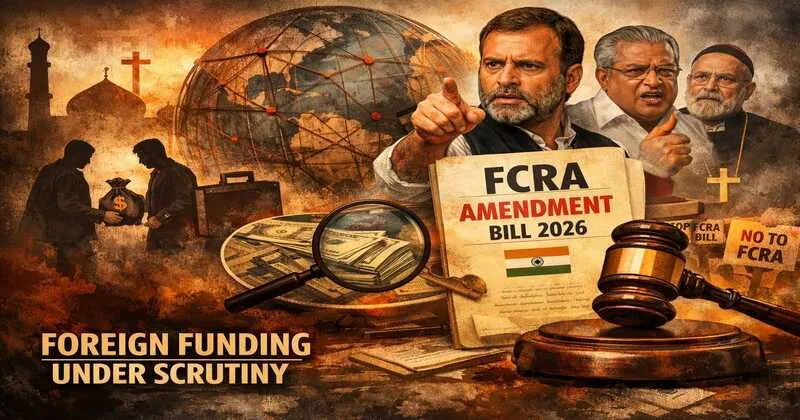
The real discomfort around the FCRA Amendment is not about the law, but about the end of unchecked influence.
When the Government of India introduced amendments to the Foreign Contribution (Regulation) Act, 2010, on March 25, 2026, the objective was unambiguous: to bring transparency, accountability, and national oversight into the inflow and utilisation of foreign funds. Yet, the political tremors that followed were disproportionate, almost as if a long-protected ecosystem had suddenly come under existential scrutiny.
The question that naturally arises is: why does transparency provoke such anxiety?
For decades, foreign contributions have entered India under the garb of charity, development, and humanitarian work. While many institutions have indeed contributed meaningfully to social upliftment, there has also existed a parallel reality, one where foreign funding has been leveraged to influence ideological narratives, facilitate religious conversions, and shape political discourse in subtle but sustained ways. It is precisely this grey zone that the 2026 amendment seeks to illuminate.
Criticism from leaders such as Pinarayi Vijayan, who termed the bill as fear-inducing for minorities, appears less like a principled stand and more like a political reflex. The argument conveniently sidesteps a crucial issue: should foreign funding be allowed to operate without strict scrutiny in a sovereign democracy?
Similarly, Rahul Gandhi’s claim that the government is attempting to monopolise foreign funding is a mischaracterisation. The state is not seeking control over funds; it is demanding accountability. There is a fundamental difference between regulation and appropriation, a distinction that is deliberately blurred in political rhetoric.
The amendment addresses long-standing structural deficiencies within the existing legal framework. One of the most significant gaps in the original legislation was the absence of a clear mechanism governing assets created out of foreign contributions. When licences were cancelled, these assets often slipped into ambiguity, leaving room for misuse and diversion.
By introducing a “designated authority” to regulate such assets, the government has taken a step towards safeguarding public interest. Yet, this very provision has been portrayed as state overreach, an argument that does not withstand serious scrutiny.
The resistance from certain church groups and organisations in Kerala further exposes the deeper fault lines. The apprehension that educational and medical institutions may come under state control is not only exaggerated but also legally untenable.
The amendment explicitly preserves the essential religious and charitable character of such institutions. The propagation of fear, therefore, appears less about legal reality and more about preserving operational opacity.
What is unfolding is not merely a legislative debate; it is a confrontation between two competing visions of India.
On one side stands the principle of national sovereignty, which asserts that no external financial influence should operate without transparency and accountability. On the other hand, stands an entrenched ecosystem that has, over the years, benefited from regulatory ambiguities and now resists any attempt at reform.
Union Minister Nityanand Rai’s assertion that misuse of foreign funds will not be tolerated must be seen in this larger context. This is not simply governance; it is a matter of national security. In an era where influence operations are increasingly sophisticated, financial flows become instruments of soft power and ideological penetration.
Significantly, the amendment also tempers the penal provisions. By reducing the maximum punishment from five years to one year, the government has demonstrated restraint and proportionality. Yet, even this calibrated approach has been labelled “draconian” a claim that collapses under objective analysis.
The political reactions surrounding the bill reveal a familiar pattern. The same voices that once endorsed the FCRA framework now resist its strengthening. This inconsistency is not ideological; it is strategic.
As electoral considerations, particularly in states like Kerala, begin to shape narratives, legislative intent is overshadowed by vote-bank calculations. The result is a manufactured controversy, where regulation is framed as repression and accountability as authoritarianism.
At its core, the issue is simple: can a sovereign nation afford to remain indifferent to the sources and uses of foreign funding within its borders?
The answer, unequivocally, is no. Transparency is not a threat; it is a necessity. Accountability is not repression; it is the foundation of democratic integrity. Those who operate within the law have nothing to fear. But for those who have thrived in its shadows, even a ray of transparency can appear blinding. And perhaps, that is what this resistance is truly about.