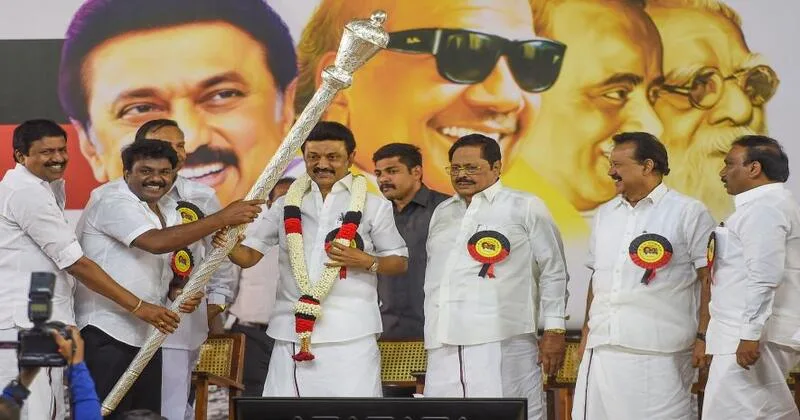
There is a political strategy so effective that it does not even look like a strategy. You do not need to rig elections when you have already ensured that the generation voting in them never learned how to question you. In Tamil Nadu, DMK political party has spent decades perfecting exactly this. DMK has governed this state for decades. Their victories are treated by commentators as proof of vibrant democracy. The reality is considerably darker. A significant part of their uninterrupted dominance rests on something they will never admit publicly: the deliberate killing of student political culture across Tamil Nadu’s campuses.
This is not a natural death. It was assisted. And the party that began the assistance was DMK itself. The anti-Hindi agitation of 1965 is the event DMK loves to cite as proof of its deep connection to Tamil youth. Every election season, the party dusts off this history and presents it as evidence of a genuine and organic student movement that DMK stood behind. That version of events does not undergo to scrutiny.
Students during that agitation were not politically independent, making autonomous decisions. They were mobilised, directed and in several cases expendable pawns in a larger game that Annadurai and the other DMK leaders were playing against the Congress government. The party needed dead bodies in the streets. It needed the optics of youth fury. It needed casualties that could turn into martyrs. The students provided all of that. What DMK provided in return was political capital for itself, not a genuine investment in student leadership or campus democracy.
The students who came out of jail in 1965 did not return to a party that was building anything for them. DMK was busy strengthening its own structure and filling its own ranks. The young people who got ahead did so by falling in line with the party, not by becoming independent leaders. DMK rewarded loyalty, not leadership. That distinction matters enormously. DMK never wanted student leaders. It wanted student followers who could be activated on command and quieted when no longer needed.
That template, use students when convenient and suppress their independence when not, is the foundational logic behind everything that has happened to campus democracy in Tamil Nadu since 1967. The ownership structure of Tamil Nadu’s private education sector is where this logic became infrastructure. The state witnessed an extraordinary explosion of private engineering colleges, universities and schools through the 1990s and 2000s. Hundreds of institutions came up within a decade. The land clearances moved fast. The approvals came through without unusual delays. The regulatory bodies were accommodating.
If you asked why, the answer was not complicated. A very large number of these colleges were founded by politicians, their immediate family members or their closest associates from both the DMK ecosystems. Not all of them. But enough to constitute a structural pattern rather than individual opportunism. These are not allegations requiring extraordinary evidence. Election affidavits are public documents. Company registration records exist. The connections between educational trusts and political families in Tamil Nadu are traceable and have been traced repeatedly by journalists and researchers.
What has never happened is any serious legislative or regulatory response, because the legislature itself is populated by people who benefit from the arrangement. The interest of a politician who owns a college is straightforward. Students who stay politically uninvolved do not embarrass the institution. They do not agitate against the management. They do not form opposition contacts. They graduate, find jobs or don’t and move on quietly. A student who develops genuine political consciousness is a liability to an owner whose other identity is an elected representative of a party that needs those same young people to vote predictably every five years.
So the culture gets shaped accordingly. Student union elections in these institutions are not serious democratic exercises. Outcomes are frequently managed. Candidates who are not aligned with management preferences face informal pressure. Students with political ambitions outside the approved orbit find their academic life becoming unexpectedly complicated. The message is transmitted without needing to be spoken directly. Over four years of engineering college in Tamil Nadu private intuitions, most students receive a very consistent education in one political lesson: “KEEP YOUR HEAD DOWN”.
But private colleges suppressing student activism through ownership pressure is only half the story. What happens in state-owned universities, institutions that theoretically have no political promoter dictating culture from above, is in some ways more revealing. This is where the “Lyngdoh Committee recommendations” enter the picture and where a document originally designed to protect student democracy has been quietly converted into a tool for strangling it.
The J.M. Lyngdoh Committee was constituted by the Supreme Court in 2005 to bring order to student union elections across India. Its recommendations, accepted by the court, were genuinely well-intentioned. Minimum attendance requirements, academic eligibility criteria, expenditure caps and age limits. The reasoning was sound. A regulatory framework was needed. What nobody adequately anticipated was how flexibly these recommendations could be interpreted by university administrations that had no interest in holding elections in the first place.
The attendance requirement, set at 75 per cent, sounds reasonable until you consider that a student who is also an activist, who attends protests, participates in union work or simply misses classes due to financial pressures, is almost automatically disqualified before the process begins. The criteria do not distinguish between a student bunking for no reason and a student absent because they were at a sit-in protesting fee hikes. Both get disqualified equally. Universities in Tamil Nadu have used this provision selectively and consistently against candidates who are seen as inconvenient.
The academic performance thresholds written into the Lyngdoh framework have been operationalised similarly. Minimum marks requirements sound neutral but their application is not always neutral. A student who is academically average but politically active can be kept off the ballot through strict enforcement of criteria that the same university will ignore in other contexts when it suits them.
More damaging still is the procedural complexity the recommendations introduced. Universities are required to follow a specific election schedule, appoint returning officers, publish detailed voter rolls and observe a code of conduct. All of this is legitimate in principle. In practice, university administrations in Tamil Nadu, including those under state universities directly controlled by whichever party is currently in government, have used the procedural requirements as an excuse for indefinite postponement.
Elections are announced, then delayed for administrative reasons, then delayed again pending committee formation, then quietly shelved until the academic year ends and the eligible student cohort graduates out. This cycle repeats. Anna University, Madras University and several other state institutions have seen years go by without functional student union elections. The official explanation is always procedural. There is always some compliance requirement that has not been met yet. But the Lyngdoh recommendations do not actually require universities to wait years between elections. That choice is being made by administrations that answer to governments that answer to parties that benefit from the absence of organised student voices.
The Supreme Court’s intent in accepting the Lyngdoh recommendations was to regularise campus elections, not to give state governments a bureaucratic mechanism for avoiding them altogether. Tamil Nadu’s both dravidian establishments has managed to achieve precisely the opposite of what the court intended, not by violating the letter of the recommendations but by exploiting every ambiguity within them. That is a more sophisticated form of subversion. It is also considerably harder to challenge in court because everything on paper looks compliant.
This is what DMK has quietly cultivated across an entire generation. Not through one dramatic decision but through a thousand small institutional arrangements that together produce a youth population that votes along caste lines, responds to freebie announcements and has no framework for evaluating governance performance, which is precisely the electorate that both parties need to keep existing. The electoral consequence is not subtle once you look for it.
Tamil Nadu’s first and second-time voters are coming almost entirely out of institutions that gave them no political education worth the name. They have strong family loyalties and strong caste instincts. Both are things that DMK know how to work with extraordinary precision. DMK has spent decades building caste arithmetic into its candidate selection and alliance strategy.
Both the parties have faced a genuine youth challenge in decades. Not because young people in Tamil Nadu lack intelligence or anger. They demonstrably do not. But because the institutional environment that would convert that anger into organised political alternatives has been systematically prevented from forming. The new parties trying to build youth bases, including some recent film-star-fronted ventures, are discovering this the hard way. Without campus movements feeding into them, without a generation trained in actual political work, they are collecting enthusiasm without building anything that can withstand two full election cycles and DMK understands this perfectly. DMK is not worried about these new challengers because they know the infrastructure for a real challenge does not exist.
There is a civic damage here that goes beyond election results and deserves to be named directly. Democracy requires citizens who know how to demand accountability. That knowledge is not innate. It is learned, usually in the messy, argumentative environment of student activism where you practice disagreement and learn that authority can be questioned without catastrophe. By removing that environment from an entire generation and we are not producing politically neutral adults. The so called Dravidian ecosystem is producing adults who default to obedience, respond to patronage and evaluate governments based on whether the freebies arrived on time rather than whether the public school in their village has a functioning teacher.
Tamil Nadu’s governance record, examined honestly, is not as glamorous as its development statistics sometimes suggest. Public health institutions in many districts are chronically understaffed. Government school quality has deteriorated steadily in areas where private schools have grown. Corruption in local administration is widespread and largely unreported. The press covers electoral politics extensively but sustained investigative pressure from below, the kind that historically comes from organised civic and student movements, is almost entirely absent.
DMK has governed during this deterioration and benefited from the absence of organised accountability. Neither has any interest in changing the conditions that make that absence possible. The argument sometimes made in defence of the current arrangement is that student activism brings violence and that Tamil Nadu is better off without it. This deserves a direct response.
The choice is not between violent student activism and peaceful political emptiness. The choice is between a democracy that produces citizens capable of civic engagement and a managed political system where two parties rotate power indefinitely while the people who vote for them have been effectively trained out of expecting anything more. The violence argument is a deflection. It is also, given what DMK have done to each other’s workers over the decades, a remarkable piece of hypocrisy. What is happening on Tamil Nadu’s campuses is not peace. It is suppression dressed as order.
For this to change, something structural needs to break. Genuine autonomy for student unions, enforced by regulation rather than left to institutional discretion. Strict separation between political office and educational institution ownership, with real penalties for violations rather than the current wink-and-look-away approach. Neither of these will come from DMK because it is primary beneficiaries of exactly what needs dismantling.
Before the Dravidian parties swallowed Tamil Nadu’s political imagination, this state had a public culture that was genuinely combative about power. Even the Justice Party, for all its faults as a colonial-era outfit that made its peace with the British, operated in a political environment where ideas were actually debated and leadership was earned. The Dravidian movement did not build on that tradition. It replaced it with personality cults, family dynasties and party loyalty as the only currency that mattered. The people invoking Tamil pride at every rally are the same people who reduced Tamil political life to a competition between two family businesses.
DMK did not just benefit from the death of campus democracy. They engineered it, maintained it and continue to profit from it election after election. The campuses are quiet today and the party is very comfortable with that quiet. They built it deliberately. And every five years, they collect the reward.