India’s medical education landscape has undergone one of the most dramatic transformations in its post-Independence history over the past 12 years. What was once marked by a severe shortage of medical colleges, limited MBBS seats, an acute doctor deficit, and thousands of students forced to seek expensive medical education abroad has evolved into an unprecedented expansion of medical infrastructure.
Official data from the National Medical Commission (NMC), Ministry of Health and Family Welfare (MoHFW), Parliament replies, the Economic Survey, and the Union Budget 2026-27 indicate that India has more than doubled the number of medical colleges, nearly tripled MBBS seats, significantly expanded postgraduate opportunities, strengthened nursing education, increased healthcare spending, and built one of the world’s largest public healthcare delivery systems.
A severe shortage before 2014
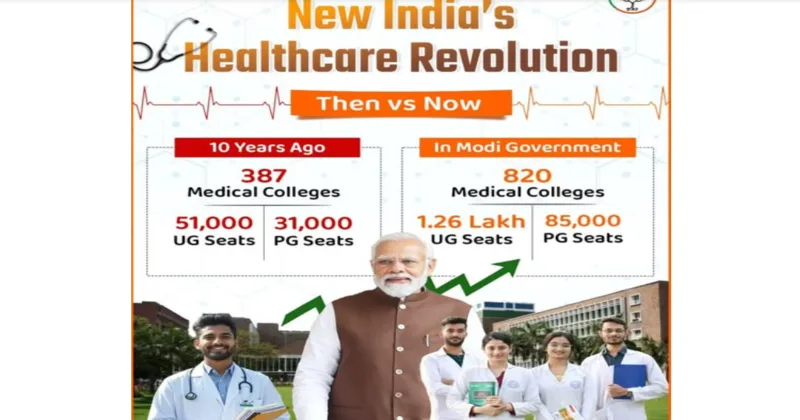
Until 2014, India’s medical education system struggled to meet the aspirations of millions of students. According to the Economic Survey 2019-20 and MoHFW data presented in Parliament, the country had just 387 medical colleges with 51,348 MBBS seats for a population exceeding 1.2 billion.
The shortage extended beyond undergraduate education. There were only 31,185 postgraduate (PG) medical seats, creating a bottleneck where thousands of MBBS graduates found themselves unable to pursue specialisation.
How India Quietly Built a Medical Education Revolution (Thread)
In 2014, India had 387 medical colleges and 51,348 MBBS seats for a country of 1.2 billion people. A student ranking in the top percentile of the entrance exam could still miss every seat in their home state.
That… pic.twitter.com/HLH9vMpCHw
— The Chronology (@TheChronology__) July 17, 2026
India also faced a serious shortage of doctors. The doctor-population ratio stood at 1:1456, significantly below the World Health Organisation’s recommended benchmark of 1 doctor per 1,000 people.
For lakhs of medical aspirants, even securing high ranks in entrance examinations often did not guarantee admission in their home states. Many families eventually turned to costly medical education abroad because domestic capacity simply could not accommodate demand.
Medical colleges more than double
The most visible transformation has been the rapid expansion of medical colleges. According to the National Medical Commission’s official seat matrix released in July 2026, India now has 823 medical colleges, more than double the 387 institutions that existed before 2014.
These include:
- 441 government medical colleges
- 382 private medical colleges
This count excludes AIIMS and other Institutes of National Importance. The expansion has dramatically increased geographical access to medical education, especially in underserved districts and smaller cities.
MBBS seats witness massive expansion
The increase in medical colleges has been accompanied by a sharp rise in undergraduate medical seats. For the 2026–27 academic session, India has 1,36,939 MBBS seats, compared to 51,348 seats in 2014.
This represents an increase of approximately 167 per cent. Government institutions account for 63,296 MBBS seats, substantially expanding affordable medical education opportunities. The increase means significantly more students now have the opportunity to pursue medical education within India rather than seeking admissions overseas.
While undergraduate seats attract significant public attention, postgraduate seats determine how many doctors can become specialists. According to the Ministry of Health and Family Welfare’s reply in the Lok Sabha in April 2025, postgraduate medical seats have increased from 31,185 before 2014 to 74,306.
This represents an increase of more than 138 per cent, allowing more MBBS graduates to pursue specialisation and helping address shortages across medical disciplines.
Expansion of AIIMS across India
For decades, AIIMS largely meant one institution in New Delhi. Under the Pradhan Mantri Swasthya Suraksha Yojana (PMSSY), the network has expanded considerably. According to the Union Budget 2026-27 release:
- 22 AIIMS have been approved
- 18 AIIMS are fully functional
- 15 AIIMS were approved after 2014
- 12 of these have already become operational
The expansion has brought advanced medical education, tertiary healthcare, and research facilities to multiple regions beyond the national capital. One of the less-publicised yet significant reforms has been the conversion of district and referral hospitals into teaching institutions.
According to the Ministry of Health and Family Welfare, 157 medical colleges have been approved under the centrally sponsored scheme aimed at upgrading district and referral hospitals into full-fledged medical colleges.
Most of these institutions have already become operational. The initiative has enabled medical education to reach districts that previously had no medical colleges, reducing regional disparities in healthcare education.
The expansion has not been limited to doctors alone.
Government data indicates that:
- Nursing colleges have grown by 36 per cent since 2014-15.
- Nursing seats have increased by approximately 40 per cent during the same period.
Further strengthening nursing education, the Union Budget 2023-24 announced 157 new nursing colleges, all being co-located with the newly established medical colleges. This integrated approach aims to strengthen the broader healthcare workforce.
The cumulative effect of expanding medical education has begun reflecting in healthcare availability. According to the Ministry of Health and Family Welfare’s Lok Sabha reply in April 2025, India’s doctor-population ratio has improved from:
- 2014: 1 doctor for every 1,456 people
- 2025: 1 doctor for every 811 people
The latest ratio is now better than the World Health Organisation’s benchmark of 1:1000, marking a significant milestone in India’s healthcare capacity. The expansion of infrastructure has been supported by substantial increases in public expenditure. According to the Union Budget 2026-27:
- Health Ministry allocation stood at approximately Rs 36,180 crore in 2014-15.
- It has risen to Rs 1,06,530.42 crore in 2026-27.
This represents a cumulative increase exceeding 194per cent, with the health budget crossing the Rs 1 lakh crore mark for the first time.
PMSSY and Medical Research receive major funding
The Pradhan Mantri Swasthya Suraksha Yojana (PMSSY), which finances AIIMS expansion and super-specialty hospital upgrades, has been allocated Rs 11,307 crore in the 2026-27 Budget.
Medical research has also received increased support. The Indian Council of Medical Research (ICMR) has been allocated Rs 4,000 crore, representing nearly a 27 per cent year-on-year increase.
India’s primary healthcare delivery system has also expanded substantially. According to Ministry of Health and Family Welfare data cited by DD India in June 2026, more than 1.86 lakh Ayushman Arogya Mandirs (formerly Health and Wellness Centres) are now operational across the country.
Collectively, these centres have recorded over 540 crore cumulative patient visits, providing accessible primary healthcare closer to people’s homes.
Telemedicine bridges rural healthcare gap
Digital healthcare has emerged as another major pillar of India’s healthcare expansion. Launched in 2019, the eSanjeevani telemedicine platform has crossed 47 crore consultations.
The platform now connects patients with more than 2.34 lakh healthcare providers, enabling rural populations to consult specialists without travelling to urban hospitals. The initiative has significantly expanded access to specialist medical advice in remote and underserved regions.
Ayushman Bharat and affordable medicines
The government’s flagship health insurance programme, Ayushman Bharat-Pradhan Mantri Jan Arogya Yojana (PM-JAY), now covers approximately 12.37 crore families, translating to nearly 55 crore people.
Eligible beneficiaries receive cashless hospitalisation coverage of up to Rs 5 lakh per family annually. Affordable medicines have also become more accessible. According to official data, Jan Aushadhi Kendras have crossed 15,000 stores, more than doubling their numbers compared to 2019-20, providing generic medicines at lower prices.
Specialised healthcare infrastructure has also expanded considerably. Government data shows:
- 19 State Cancer Institutes
- 20 Tertiary Cancer Care Centres
- 621 Critical Care Hospital Blocks approved under the PM-Ayushman Bharat Health Infrastructure Mission (PM-ABHIM) for high-population districts.
India’s diagnostic capacity has also increased dramatically. The number of diagnostic testing laboratories has grown from just 14 before the COVID-19 pandemic to over 3,400 laboratories, significantly strengthening disease surveillance and testing infrastructure.
Doctor-population ratio improves beyond WHO benchmark
The cumulative impact of these reforms extends beyond statistics. The expansion of medical colleges and MBBS seats has reduced the pressure that once compelled many Indian students to pursue costly medical education overseas.
Greater availability of postgraduate seats has increased opportunities for specialisation, while the establishment of AIIMS across multiple states has created new centres for advanced medical education and research beyond Delhi.
The conversion of district hospitals into medical colleges has enabled students from smaller towns and rural districts to pursue medical education closer to home, reducing migration and associated financial burdens.
Taken together, the expansion of medical education capacity, increased healthcare spending, strengthening of primary healthcare, wider insurance coverage, telemedicine growth, and improved research infrastructure mark one of the largest healthcare infrastructure expansions undertaken in independent India.
According to official government data, these changes have collectively reshaped the country’s medical education ecosystem and healthcare delivery architecture over the last twelve years.
(The story is based on a twitter thread in The Chronology)