
Trump’s ‘Madman Theory’ in West Asia
June 24, 2026
  • Read Ecopy
  • Circulation
  • Advertise
  • Careers
  • About Us
  • Contact Us
Android AppiPhone AppArattai
Organiser
  • ‌
  • Bharat
    • Assam
    • Bihar
    • Chhattisgarh
    • Jharkhand
    • Maharashtra
    • View All States
  • World
    • Asia
    • Europe
    • North America
    • South America
    • Africa
    • Australia
  • Editorial
  • International
  • Opinion
  • RSS @ 100
  • More
    • Op Sindoor
    • Analysis
    • Sports
    • Defence
    • Politics
    • Business
    • Economy
    • Culture
    • Special Report
    • Sci & Tech
    • Entertainment
    • G20
    • Azadi Ka Amrit Mahotsav
    • Vocal4Local
    • Web Stories
    • Education
    • Employment
    • Books
    • Interviews
    • Travel
    • Law
    • Health
    • Obituary
  • Subscribe
    • Subscribe Print Edition
    • Subscribe Ecopy
    • Read Ecopy
  • ‌
  • Bharat
    • Assam
    • Bihar
    • Chhattisgarh
    • Jharkhand
    • Maharashtra
    • View All States
  • World
    • Asia
    • Europe
    • North America
    • South America
    • Africa
    • Australia
  • Editorial
  • International
  • Opinion
  • RSS @ 100
  • More
    • Op Sindoor
    • Analysis
    • Sports
    • Defence
    • Politics
    • Business
    • Economy
    • Culture
    • Special Report
    • Sci & Tech
    • Entertainment
    • G20
    • Azadi Ka Amrit Mahotsav
    • Vocal4Local
    • Web Stories
    • Education
    • Employment
    • Books
    • Interviews
    • Travel
    • Law
    • Health
    • Obituary
  • Subscribe
    • Subscribe Print Edition
    • Subscribe Ecopy
    • Read Ecopy
Organiser
  • Home
  • Bharat
  • World
  • Operation Sindoor
  • Editorial
  • Analysis
  • Opinion
  • Culture
  • Defence
  • International Edition
  • RSS @ 100
  • Magazine
  • Read Ecopy
Home World North America USA

Trump’s ‘Madman Theory’ in West Asia: Brinkmanship, coercion, and the limits of strategic unpredictability

As tensions escalate across West Asia, the ongoing confrontation involving Iran, Israel, and the United States has revived a controversial Cold War-era strategy — the “madman theory

Siddhartha DaveSiddhartha Dave
Apr 10, 2026, 06:40 pm IST
in USA, World, Asia, International Edition
Follow on Google News
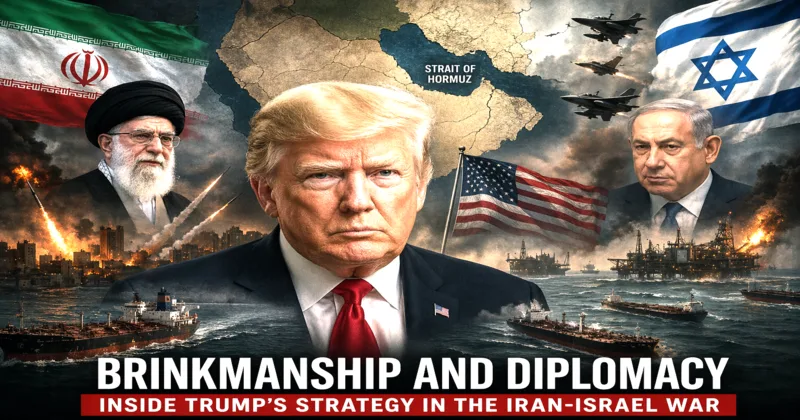
Brinkmanship, coercion, and the limits of strategic unpredictability

Brinkmanship, coercion, and the limits of strategic unpredictability

FacebookTwitterWhatsAppTelegramEmail

The ongoing Iran-Israel-US conflict has revived one of the most controversial ideas in diplomatic history: the “madman theory” — the strategic use of calculated unpredictability to pressure adversaries into concessions. First associated with Richard Nixon during the Vietnam War, the doctrine is now widely invoked by analysts to explain Donald Trump’s conduct in the current West Asian crisis. As The Guardian recently observed, Trump’s alternating posture of fury and conciliation bears unmistakable resemblance to Nixon’s attempt to convince adversaries that he was capable of going to any length to secure an outcome.

The current crisis began in late February, when joint U.S.-Israeli military strikes on Iran triggered a severe regional escalation. Tehran responded through missile strikes, proxy mobilisation, and, most consequentially, by tightening control over the Strait of Hormuz — the world’s most vital energy chokepoint. Roughly one-fifth of global oil and LNG trade moves through this narrow corridor. Reuters reports that the resulting disruption has become the worst supply shock in the history of the modern oil market, with hundreds of tankers stranded and maritime traffic dropping to well below 10 per cent of normal volumes.

It is in this context that Trump’s conduct has drawn scrutiny. Throughout the crisis, he has issued a series of maximalist threats — warning Iran of devastating strikes on infrastructure, power plants, and military assets — while simultaneously floating ceasefire offers, negotiation windows, and claims of diplomatic breakthroughs. This oscillation between coercion and conciliation has led many observers to argue that Trump is using strategic ambiguity not as a sign of chaos, but as a deliberate bargaining tool.

Also Read: Operation Sindoor a defining example of domain jointness: Indian Army Chief U Dwivedi

The logic behind such an approach is simple: if an adversary believes a leader may act irrationally or disproportionately, it may choose compromise over confrontation. Reuters, in its analysis of the crisis, notes that the essence of the madman theory lies in weaponising uncertainty to compress an adversary’s decision-making and create pressure for de-escalation.

In tactical terms, the strategy may have yielded short-term results. A two-week ceasefire was announced this week, reportedly linked to a phased reopening of the Strait of Hormuz and renewed talks between Washington and Tehran. The White House has presented the truce as proof that Trump’s hardline rhetoric forced Iran to the table. US officials have argued that sustained pressure and deadlines helped create diplomatic urgency.

Yet the reality on the ground suggests that the ceasefire is more of a pause than a peace.

Despite the truce, shipping through Hormuz remains near a standstill. Reuters reported on April 9 that Iran is allowing no more than 15 vessels a day through the strait — a fraction of normal traffic — while continuing to insist that ships remain under its territorial control. Major shipping firms such as Maersk and Mitsui O.S.K. have refused to resume normal operations, citing the absence of “full maritime certainty.” Insurance costs remain elevated, and energy markets remain nervous.

The Washington Post has also highlighted the contradictions surrounding the ceasefire. Washington insists the truce includes guarantees on shipping access and de-escalation, while Tehran maintains that it has not surrendered any sovereign rights, particularly over uranium enrichment and maritime security. Iranian officials have accused Washington of misrepresenting the deal, while Trump’s public statements have at times appeared at odds with US negotiators’ positions.

This confusion underscores the central limitation of madman diplomacy in the contemporary era: unpredictability may create leverage, but it can also erode credibility.

During the Cold War, Nixon’s strategy operated in a relatively structured bipolar system. There were clear channels of communication, known red lines, and a narrower set of actors. Even then, the results were mixed. While Nixon’s posture may have pressured adversaries, it did not decisively alter the strategic end-state in Vietnam. In the present West Asian theatre, the challenges are far greater.

Today’s conflict environment is crowded with multiple state and non-state actors, fragile alliances, globalised supply chains, instantaneous information flows, and high domestic political scrutiny. In such a setting, strategic ambiguity can easily morph into dangerous ambiguity. A threat intended as bargaining pressure can be misread as intent to escalate. A temporary pause can be mistaken for a settlement. A rhetorical flourish can unsettle allies as much as adversaries.

For Iran, Trump’s rhetoric has likely reinforced long-standing suspicions that Washington cannot be trusted as a stable negotiating partner. Hardliners in Tehran may well see this crisis as proof that only resistance preserves strategic space. For U.S. allies in the Gulf, the war has exposed the risks of overdependence on an American security umbrella increasingly shaped by personality-driven decision-making.

For Israel, the conflict has once again demonstrated that military superiority can create operational advantage, but not necessarily political resolution. For Gulf states and Asian economies dependent on Hormuz, the lesson is starker: regional instability in West Asia is now inseparable from global economic vulnerability.

The broader foreign policy lesson from this crisis is that coercive diplomacy can force pauses, but it rarely delivers durable peace unless backed by institutional follow-through. Ceasefires secured under duress can buy time, but they cannot substitute for structured agreements on nuclear safeguards, maritime rules, regional proxy conflicts, and mutual verification.

Trump’s use of the madman theory may have created a tactical off-ramp in the immediate crisis. But diplomacy rooted in fear is inherently unstable. It depends on sustaining uncertainty without crossing into catastrophe — a balance that is difficult to maintain, and even harder to institutionalise.

In West Asia, where history is layered with mistrust, humiliation, and unfinished wars, theatrics may command headlines. But only consistent statecraft can secure peace. The real test of Trump’s strategy is not whether it produced a temporary ceasefire. It is whether brinkmanship can be converted into a credible political settlement. As of now, the answer remains deeply uncertain.


Topics: West Asia ConflictUS President Donald TrumpIran-Israel-US conflictMadman Theory
Siddhartha Dave
Siddhartha Dave
Siddhartha Dave is an alumnus of the United Nations University in Tokyo and a former Lok Sabha Research Fellow. He writes on foreign affairs and national security. [Read more]
ShareTweetSendShareSend
✮ Subscribe Organiser YouTube Channel. ✮
✮ Join Organiser's WhatsApp channel for Nationalist views beyond the news. ✮
Previous News

Uttar Pradesh cabinet approves Rs 491 crore for Forestry and Horticulture University to be set up in Gorakhpur

Next News

Puducherry Elections 2026 records historic 91.83 per cent turnout, highest since 1964

Related News

At the G7 Summit, PM Modi urged support for developing nations affected by the West Asia crisis

G7 Summit 2026: PM Modi seeks economic shield for global south from West Asia war fallout

Prime Minister Narendra Modi with US President Donald Trump

Hormuz Disruptions: “Several Indian civilians lost lives,” says PM Modi & expresses concern in presence of Trump

Representative image

West Asia Conflict: Donald Trump announces landmark US-Iran agreement, raises hopes for peace

West Asia Conflict: 3 Days, 3 Tankers & 3 Deaths; How US muscle flexing is fueling humanitarian crisis in Hormuz?

America’s Friend, Pakistan’s Burden: The hidden cost of Washington’s Iran strategy

Representative Image

The Labyrinth of War: Easy to enter; Difficult to exit

Load More

Latest News

President Droupadi Murmu confers the Padma Shri on former civil servant R.V.S. Mani on June 23, 2026.

Former MHA official RVS Mani honoured with Padma Shri for contributions to internal security

Tamil Nadu: Temple funds only for temple property; TVK govt concedes before Madras High Court

Keralam’s former Industries Secretary, Mohammed Haneesh IAS (Right Side)

Keralam Cashew Scam: Former Industries Secretary Md Haneesh apologises before High Court after contempt proceedings

Tamil Nadu: Assembly Speaker directs all bureaucrats to strictly follow warrant of precedence after Mayor-MLA row

Kamakhya Mandir

Kamakhya Mandir’s Ambubachi Mela: The ancient tradition that honours the menstruation of mother Earth

Amazon in dock for mocking Hindu Gods

Amazon File: From Ganesha to Aryabhata-Has Amazon India become a platform for Anti-Hindu narratives?

The West Bengal Budget 2026–27 aims to drive growth through infrastructure, industry, innovation and welfare

Reimagining Bengal: How the West Bengal Budget 2026–27 seeks to balance growth, welfare & economic transformation

Pratiraksha is Gujarat Police's Aadhaar-based verification platform designed to identify illegal workers and prevent identity fraud in industrial sectors

Pratiraksha: How Gujarat police uses Aadhaar verification to secure industrial workforce against identity fraud

Israel-Iran crisis has highlighted not only shifting dynamics of West Asia but also growing confidence of India's foreign policy

India, Israel and the rise of strategic autonomy in an era of global geopolitical realignment

Saleem and Jaleel arrested in forced religious conversion case

Karnataka Conversion Case: Forced conversion of Hindu woman and minor son sparks outrage; Saleem and Jaleel arrested

Load More
  • Privacy
  • Terms
  • Cookie Policy
  • Refund and Cancellation
  • Delivery and Shipping

© Bharat Prakashan (Delhi) Limited.
Tech-enabled by Ananthapuri Technologies

  • Home
  • Search Organiser
  • Bharat
    • Assam
    • Bihar
    • Chhattisgarh
    • Jharkhand
    • Maharashtra
    • View All States
  • World
    • Asia
    • Africa
    • North America
    • South America
    • Europe
    • Australia
  • Editorial
  • Operation Sindoor
  • Opinion
  • Analysis
  • Defence
  • Culture
  • Sports
  • Business
  • RSS @ 100
  • Entertainment
  • More ..
    • Sci & Tech
    • Vocal4Local
    • Special Report
    • Education
    • Employment
    • Books
    • Interviews
    • Travel
    • Health
    • Politics
    • Law
    • Economy
    • Obituary
  • Subscribe Magazine
  • Read Ecopy
  • Advertise
  • Circulation
  • Careers
  • About Us
  • Contact Us
  • Policies & Terms
    • Privacy Policy
    • Cookie Policy
    • Refund and Cancellation
    • Terms of Use

© Bharat Prakashan (Delhi) Limited.
Tech-enabled by Ananthapuri Technologies