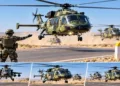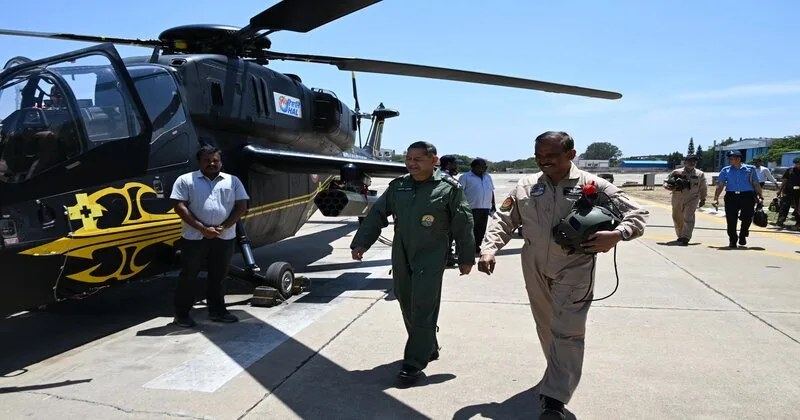
The defence indigenisation path of India carves another milestone as the Chief of the Indian Army General Upendra Dwivedi took a flight on the LCH Prachand, country’s maiden indigenous attack helicopter. The Army Chief visited Hindustan Aeronautics Limited(HAL) in Bengaluru earlier this week, during which he reviewed the emerging indigenous defence capabilities of India. He also took note of the ongoing Army aviation projects that adds momentum to the country’s goal of achieving Atmanirbharata or self-reliance in the defence sector.
During the visit to HAL, Army Chief General Upendra Dwivedi also witnessed key defence apparatus such as Advanced Light Helicopter(ALH) Dhruv that helps for transportation of logistics and troops to high altitude region, maritime surveillance, humanitarian assistance, emergency response and also aids for combat operations when weapon systems are integrated with it. The Army Chief also reviewed the upgrade, maintenance and production ecosystems related to the Army aviation sector. Beyond this, the highlight of the visit was the Army Chief’s flight on the LCH Prachand, country’s first attack helicopter meant to defend against the enemies during high-altitude combat scenarios.
#GeneralUpendraDwivedi, #COAS visited Hindustan Aeronautics Limited (HAL), Bengaluru, to review indigenous aerospace capabilities and ongoing Army Aviation projects along with their upgrade and maintenance ecosystems supporting Army Aviation.
The #COAS also undertook a maiden… pic.twitter.com/fDbr87Qniw
— ADG PI – INDIAN ARMY (@adgpi) April 8, 2026
LCH Prachand: The flying gun for high altitude combat
By taking a flight on LCH Prachand, the Army Chief gained a first hand experience regarding the superior and overarching operational capabilities of the emerging indigenous critical military technology. LCH Prachand is deemed as an aerial superpower or flying gunship, that aids to strengthen national security and establish a clear and decisive strategic deterrence against enemy threats. LCH Prachand acts as a firepower in the high-altitude battlefield. Thus, as an indigenous attacking helicopter, LCH Prachand is specifically and strategically designed to act as a firebrand during high-altitude face-off and at rarified conditions exceeding 6,000 metres above the sea level.
LCH Prachand is embedded with advanced avionics, precision weapons and other survivability features that helps for air-to-air support, anti-armour missions and other armed reconnaissance. Prachand is also equipped with advanced sensors and fire control systems thus ensuring swift response mechanisms during emergencies and other military contingencies. LCH Pranchand is also enabled with real-time data that helps for faster decision making and swift action during unforeseen encounters. Thus, LCH Prachand also acts as a battlefield intelligence unit that gives timely military inputs and helps to translate it into effective strikes.
Strategic significance of LCH Prachand for India
LCH Prachand as an attack helicopter adds strategic leverage to the Indian Army in terms of its offensive and defensive capabilities. Especially, its high-altitude operational smartness helps to out power the intruding threats in the Himalayan borders. In the rigid landscape and challenging terrain of the Himalayas, where most of the helicopters struggle to take-off, LCH Prachand can be involved in an intense combat to defend and protect national security. It can carry missiles, guns and other smart weapons and simultaneously support the ground troops as well. It can destroy enemy tanks and issue warnings or alarms about the enemy threats. This multi-dimensional operational effectiveness of LCH Prachand makes it most suitable for the Indian Army to deal with the emerging nature of modern warfare.
In an era where war fields are predominantly aerial and dominated by drones, loitering munitions and other Unmanned Aerial Vehicles(UAVs), weapons like LCH Prachand are vital to strengthen India’s footprint in the tactical aerial battlefield. Prachand is flexibly designed to navigate through low or mid-altitude and narrow aerial spaces in the mountainous region. It can find out and thwart the intruding or hidden enemy weapons that aim to make surprise and sudden attacks in the complex web. This adds a huge strategic advantage to India in case of a conflict in the Himalayan frontier.
The recent conflicts around the globe has evidently exposed that the low altitude or the maiden layer of the aerial space above the battlefield is a key region during any confrontation. Whoever controls and dominates this aerial space can easily gain strategic edge. Strategic control over this aerial zone ultimately determines the outcomes of the land battle as it gives comprehensive control in the conflict. Thus, weapons like LCH Prachand helps to achieve the holistic military goal. India needs 156 LCH Prachand for the defence forces to operate at its fullest potential. Out of this 90 attack helicopters are for the Indian Army and 66 for the Indian Airforce.
Military manoeuvring of attack helicopters in Phokran
Prior to taking a flight on LCH Prachand, an operational demonstration of the attacking helicopters was witnessed in Pokhran Field Firing Ranges in Rajasthan. The attack helicopters including AH-64 Apache, carried out first field firing and successfully neutralised the targets along with Hellfire missiles and other onboard weapons. The military manoeuvring reiterated how attack helicopters operate in coordination with the ground troops even in high-threat and volatile combat circumstances. The weapons integrated into the attack helicopters can successfully intercept small arms fire, shoulder fired missiles and drones.
Attack helicopters are capable of precision strikes and rapid target acquisition, thus rendering a major boost to the military during highly precarious situations and helps to carve clear strategic deterrence and defeat the enemy threats. For example, the Apache attack helicopter demonstrated its capability as a force multiplier with its swift responsiveness to the ground forces.
LCH Prachand as India’s maiden indigenously crafted attack helicopter is not just a testament to the growing self-reliance in the defence ecosystem of the country, but it also heralds a new chapter for India in the lower airspace conflict, a zone that is evolving as increasingly contentious. With the induction of LCH Prachand, the defence and strategic doctrine of India gains huge potential in an era where the nature of modern warfare is rapidly evolving, dominated by cutting-edge technologies and an expanding terrain network beyond territorial limits. LCH Prachand thus helps to achieve synchronisation and integration between land and aerial warspace thus revolutionise an overarching strategic edge.