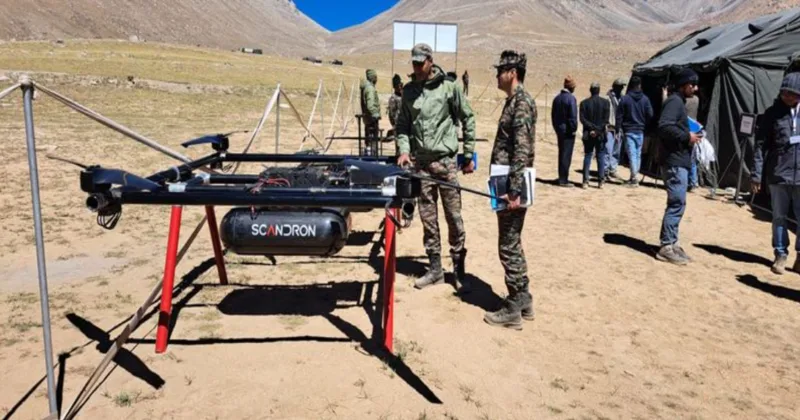
The Indian Army is preparing for a major overhaul and upgradation with respect to battlefield logistics, as the Ministry of Defence (MoD) has issued a Request for Information (RFI) for 2,715 logistics drones. These Unmanned Aerial Vehicles(UAVs) are used to deliver rations, ammunition and other essential supplies to troops who are deployed at high-altitudes along the borders of China and Pakistan.
The proposed demand for the fleet of drones, is the Army’s largest requirement of its kind so far. It is aimed at reducing dependence on porters, mule columns and helicopters for last-mile resupply in one of the world’s most challenging terrain. It aims to strengthen and ease logistical and supply bottlenecks encountered in difficult mountaneous terrain.
Drones for high-altitude & remote forward posts to fortify resupply chains
The RFI, issued on August 5 by the Army’s Directorate General of Capability Development, seeks three categories of logistics drones based on their operating altitude.
The first category will operate up to 6,000 feet, the second between 6,000 and 12,000 feet, while the high-altitude variant will operate between 12,000 and 20,000 feet. The top-end drones are expected to be capable of taking off from elevations as high as 19,000 feet.
The requirement is aimed to fulfill the basic amenities at the difficult geography of India’s northern and northeastern borders. The forward positions in Jammu and Kashmir, Ladakh, Himachal Pradesh, Uttarakhand, Sikkim and Arunachal Pradesh remain difficult to access for extended periods due to steep terrain, snow and extreme weather. The proposed logistical drones aim to eradicate these supply hurdles in the remote areas.
For decades, the last-mile movement of supplies to isolated posts has relied heavily on soldiers, porters and animal transport. Helicopters are also used for heavy-lift missions. But their deployment are expensive and vulnerable to weather and operational constraints. Logistics drones thus, could provide a faster, safer and potentially more economical alternative, with reduced human cost.
Autonomous, all-weather drones with anti-jamming protection
The proposed drones are being designed for operations in some of the harshest environments faced by the Indian military. They are designed to function in temperatures ranging from minus 30°C to 50°C and operate for unprepared landing areas. It will be equipped to complete at least 1,000 landings during a minimum service life of seven years.
Depending on their altitude category, the drones are built to have a one-way mission range of 10 to 20 kilometres. They are also required to operate in fully autonomous, manual and automatic return-to-home modes, with a crew of no more than two or three personnel. The logistical drones thus are designed to withstand unanticipated or unforeseen circumstances, in the difficult geographical and geopolitical landscape.
Another critical requirement of the logistical drones are survivability in an electronic-warfare environment. The drones must have safeguards against jamming and spoofing, thus preventing adversaries from disrupting their navigation or attempts to take control of the platforms.
The Army has also sought for identification technology to ensure that its own air-defence systems can distinguish the logistics drones from hostile aircraft during combat operations. LIDAR-based obstacle detection and onboard movement-tracking systems are expected to enhance navigation and safety, particularly when flying through mountainous terrain.
Army’s logistics drone requirement has surged
The latest requirement represents a significant expansion of the Army’s logistics-drone programme. In December 2022, the MoD had sought information for 570 logistics drones, divided between standard and high-altitude variants.
A subsequent fast-track tender sought another 363 drones, comprising 200 medium-altitude and 163 high-altitude platforms, primarily to strengthen supply lines along difficult border sectors. Another RFI followed in 2025 for medium and high-altitude logistics drones.
Against this backdrop, the latest requirement for 2,715 drones marks a significant jump and signals the growing importance of unmanned logistics for sustaining troops deployed along the remote regions and the forward posts of the high-altitude Himalayan terrain. The procurement is also aligned with the government’s Atmanirbhar Bharat & defence indigenisation push and is expected to further scale the home-grown military capabilities of the country.
The RFI is at the preliminary stage of the procurement process and responses are open to original equipment manufacturers, authorised vendors and government-backed export agencies. Shortlisted platforms are expected to undergo field trials in India before any formal procurement decision.
If rationalised, the planned fleet of logistical drones will significantly transform the capabilities of the Indian Army to sustains troops in remote battlefields and high-altitude areas.