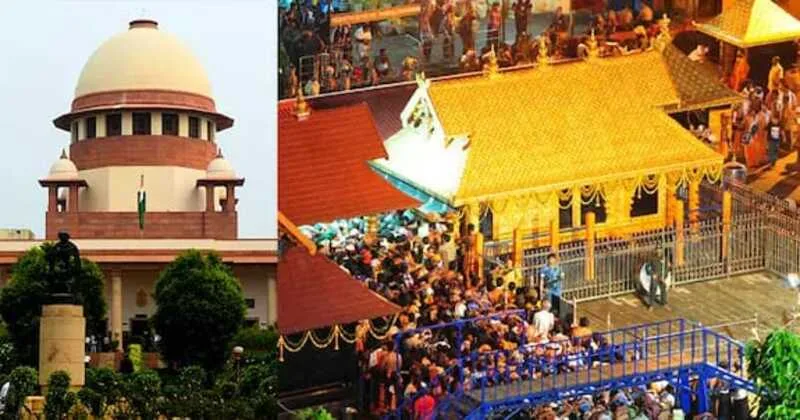
New Delhi: In the ongoing hearing of the Sabarimala case, the Supreme Court of India made significant observations on the relationship between faith, rituals, and judicial intervention. The bench underscored that temple customs must be respected by devotees, regardless of personal belief, as arguments continue on issues including the entry of women into the Sabarimala mandir.
Justice Joymalya Bagchi, part of the nine-judge bench, observed that even a non-believer must follow Mandir rituals when visiting places of worship. The only woman judge on the bench, B. V. Nagarathna, also stated that devotees and non-believers are expected to adhere to the practices and customs associated with Mandirs.
Pluralism and limits of judicial intervention
The observations came after NSS counsel C. S. Vaidyanathan argued that Hinduism does not have a rigid or uniform structure and is inherently pluralistic in its rituals and practices. Representing the Nair Service Society, he contended that the judiciary does not possess the authority to adjudicate on religious practices and traditions.
Responding to this, Justice M. M. Sundaresh pointed out that certain mandir customs are deeply rooted and must be respected. He cited the example of mandirs in Keralam where wearing shirts is not permitted. “You cannot compel people to wear shirts to enter the Guruvayur Mandir,” he noted.
Chief Justice Surya Kant echoed this sentiment, stating that specific dress codes, such as not wearing shirts in Guruvayur Mandir, are integral to the tradition. He further added that covering one’s head is mandatory when entering a Gurudwara, underlining that such practices are part of religious discipline.
The hearing will continue next week before a larger bench comprising Justices B. V. Nagarathna, M. M. Sundaresh, Ahsanuddin Amanullah, Arvind Kumar, Augustine George Masih, Prasanna B. Varale, R. Mahadevan, and Justice Joymalya Bagchi. The Devaswom Board is expected to present its arguments on Wednesday.
Ayyappa devotees as a distinct religious group
The NSS argued that devotees of Bhagwan Ayyappa constitute a distinct religious group with specific beliefs and practices. It pointed out that people from other religions are allowed to enter Sabarimala and that there is no prohibition on Christians or Muslims. According to the NSS, faith in Bhagwan Ayyappa is the primary requirement, but devotees are also expected to observe rituals, including the traditional 41-day fast.
Appearing for the Union government, Solicitor General Tushar Mehta argued that certain mandirs impose restrictions that are not necessarily gender-biased but are rooted in specific rituals. He cited examples such as the Brahma mandir Pushkar, where married men are not allowed entry, and the Kottankulangara Devi mandir in Keralam, where men dress as women to offer puja.
He emphasised that the issue is not whether a practice is male-centric or female-centric, but whether it is intrinsic to the mandir’s tradition. Justice Nagarathna clarified that it would not be appropriate for Hinduism to promote exclusivity by restricting entry only to members of a particular sect. She added that it is the responsibility of the state to ensure access for all sects. Justice Arvind Kumar cautioned that exclusionary practices could lead to divisions within the community.
The discussion also referred to the Mulki mandir, which belongs to the Gowda Saraswat Brahmin community. The Supreme Court had earlier intervened in a dispute regarding the denial of entry to other communities and ruled that the Temple Entry Act would apply to the Mulki mandir as well. The judges revisited this precedent after it was raised by the NSS during the proceedings.