
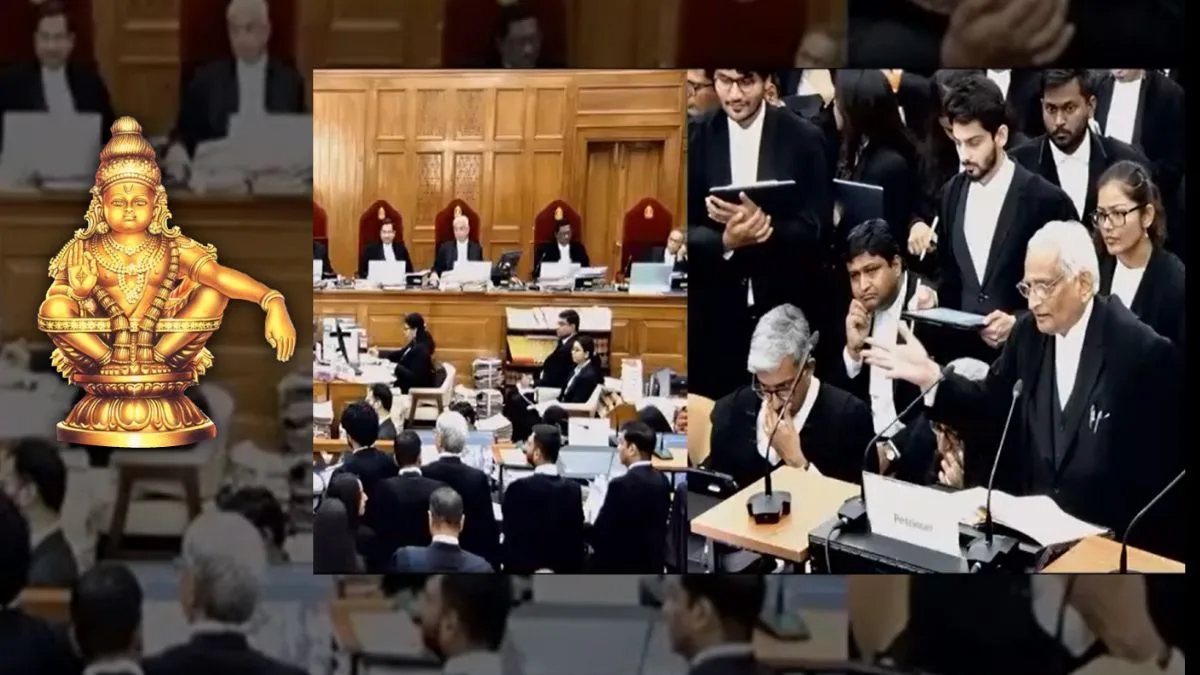
Supreme Court Sabarimala Hearing: “When I say idol worship, there can be no dispute. Worshipping a deity in a temple is part of the core belief of Hindus. Therefore, the essential characteristics of the deity form part of the worship conducted in that temple. When I go to a temple, I do not go to challenge.” Senior Advocate Giri submitted his submissions in Sabarimala women entry case before the nine-judge constitution bench.
On Day 5 of the Sabarimala reference hearing (April 17, 2026), Senior Advocate V. Giri, appearing for the Sabarimala Achara Samrakshna Samiti, emphasized that in Hinduism, an idol is not a mere object but a living deity with specific, identifiable characteristics that define the manner of worship.
The bench is examining seven important legal questions concerning religious rights and freedoms in India.
“When I go to a temple, I do not go to challenge. I go for asserting my belief. I do not visit a temple or any place of worship to question the character of the deity. I do not go there to question it. They cannot come to the temple like a museum.” Giri said.
Before the Bench which comprises CJI Surya Kant, Justice BV Nagarathna, Justice MM Sundresh, Justice Ahsanuddin Amanullah, Justice Aravind Kumar, Justice Augustine George Masih, Justice Prasanna B Varale, Justice R Mahadevan and Justice Joymalya Bagchi, he submitted that a person has the right to practise their own religion. This right is not only because of a legal provision, but also because they follow that religion.
If someone wants to visit a temple to practise their faith, their actions should be in line with the customs and beliefs followed in that temple.
Justice Nagarathna observed that while practices considered “essential” to a religion may be protected from interference, courts would still examine disputes over whether a practice truly qualifies as essential. Responding to this, Giri clarified that he was not advocating for the complete removal of the “essential religious practices” test.
Justice Amanullah further noted that religious belief is not confined to inner faith alone but also includes its outward expression, suggesting that acts such as constructing a temple can be viewed as a legitimate manifestation of religious practice.
Giri also clarified a procedural point regarding the diverse groups involved in the reference. He confirmed that the organisations he represented were dedicated to protecting the specific customs and usages of the faith, countering any confusion regarding the representation of different associations earlier in the week.
What the Supreme Court is Examining
A nine-judge Constitution Bench of the Supreme Court is examining seven important legal questions concerning religious rights and freedoms in India. The top court began hearing the reference arising out of the Sabarimala review case on April 7. The Court’s verdict will have a major impact on various individual cases including whether women can be allowed to enter the Sabarimala temple in Kerala.
The 7 questions for consideration before the Supreme Court are:
- What is the scope of the right to freedom of religion under Article 25 of the Constitution of India?
- How do the rights under Article 25 interact with the rights of religious denominations under Article 26?
- Are the rights of religious denominations under Article 26 subject to other fundamental rights, beyond public order, morality, and health?
- How should the term “morality” in Articles 25 and 26 be interpreted, and does it include constitutional morality?
- To what extent can courts review religious practices under Article 25?
- What does the phrase “sections of Hindus” mean in Article 25(2)(b)?
- Can a person who is not part of a religious denomination challenge its practices through a PIL?