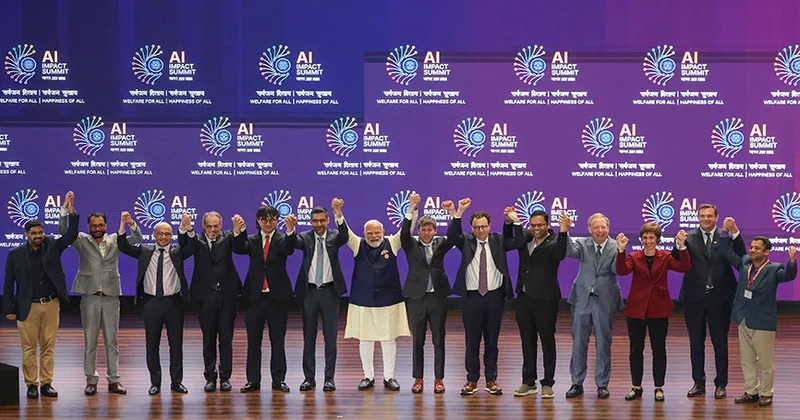
The India AI Impact Summit 2026 was the most significant global convening on Artificial Intelligence(AI) this year and marked India’s emerging voice in the global AI order. With the Summit behind us, the question worth asking is not what was announced, as there was no shortage of numbers, signatories or declarations, but what was actually achieved. The main outcomes can be counted across four areas: governance and policy, private sector commitments, AI for social good and democratisation of participation. Taken together, it is evident that India did more than host a summit; it defined what AI governance looks like when the Global South shapes the agenda.
Governance and policy outcomes
The Summit’s main achievement was 91 countries and international organisations adopting the AI Impact Summit Declaration. The agreement marked a shift from the previous editions in Bletchley, Seoul and Paris’s ‘risk’ framing to Delhi’s ‘impact’ framing. While previous summit declarations garnered 29, 11 and 60 signatures respectively, a broader consensus was achieved in New Delhi through a focus on human-centric AI, trust and developmental priorities. It was particularly notable that India was able to secure support from both the United States and China, despite the United States not signing the 2025 AI Action Summit Declaration. Moving the focus from potential harms to potential benefits created sufficient breadth for agreement across what are otherwise divergent positions on AI regulation and competition.
Beyond the declaration, the Summit also produced a substantial body of policy and technical outputs through seven thematic Working Groups and five Expert Engagement Groups, drawing on contributions from 100+ countries. These outputs address:
Human capital transitions: The summit placed labour transitions at the heart of conversations on AI. The Working Group on Human Capital created A.N.A.V., a structured framework for workforce management. The Equitable AI Transitions Playbook and the Voluntary Guiding Principles for Skilling and Reskilling in the Age of AI(endorsed by 24 countries and International Organisations) provide governments with actionable frameworks for managing AI-driven workforce changes.
Building trusted AI: The Framework for the Trusted AI Commons establishes a living platform for shared AI resources to translate common principles into practice through knowledge sharing, and the AI and Child Safety: Frameworks for a Safer Digital Future outlines curation control safeguards to protect children from AI-related risks. The Guidance Note on AI Governance(endorsed by 22 countries) offers a flexible framework for strengthening national AI governance and institutional capacity and ensuring that AI systems are accountable and aligned with public interest.
Infrastructure resilience: To account for and limit the impact of AI on the environment, the Playbook on Advancing Resilient AI Infrastructure and Expert Engagement Group Recommendations on AI & Climate provided strategies on building sustainable and resource-efficient AI systems and leveraging AI for climate action. 22 countries also endorsed the Voluntary Guiding Principles on Resilient, Innovative and Efficient AI. This reflects the growing recognition that environmental and infrastructure challenges need to be addressed in parallel with the expansion of AI capabilities.
Data governance: The New Deal for Data from the Expert Engagement Group on Data recommends an accountability-based framework that focuses on punishing actual harms rather than enforcing data scarcity, an important shift in how data governance is framed.
Inclusion and science: The Charter for the Democratic Diffusion of AI was signed by 22 countries, endorsing one of the Summit’s key priorities. The Alliance for Advancing Inclusion Through AI and the Network of AI for Science Institutions created institutional anchors for two areas, social inclusion and AI-enabled research, that risk being deprioritised in more commercially-driven AI governance processes.
Although none of these are binding commitments, they articulate and construct shared priorities and frameworks that are the necessary precursors to binding agreements.
Private sector commitments
On the private sector front, the Summit formalised the New Delhi Frontier AI Impact Commitments. Thirteen frontier AI companies and domestic innovators committed to two priorities. First, advancing analysis on real-world AI usage and publishing statistical insights on global AI adoption by the next summit to lay the groundwork for evidence-based workforce and regulatory policy. Second, strengthening multilingual and use-case evaluation, including collaborating with local ecosystems to develop datasets and benchmarks for low-resource languages and underrepresented contexts.
Collectively, these initiatives advance technical evaluation frameworks through enabling policy instruments rather than purely regulatory architecture. Unlike government-level processes, private sector consensus allows actors to move faster and shape the technology more directly. Bringing them into formal commitment structures makes companies more likely to address frontier challenges than post-facto government declarations.
AI for social good
In line with the vision India articulated at the Action Summit in Paris, the Summit demonstrated the deployment of AI for the global good. The AI Impact Expo at the summit featured over 300 exhibitors across ten thematic pavilions. The key highlights were field-ready robotics for logistics and agriculture, AI-enabled fintech fraud detection systems, protein engineering tools, neuroscience analytics, multilingual AI content systems and AI-ready infrastructure platforms.
Parallel to live deployment demonstrations, the Summit unveiled six global AI casebooks developed in collaboration with leading international and domestic institutions. These compendiums showcase over 170 deployed innovations in the fields of health, energy, gender empowerment, education, agriculture and accessibility.
The launch of the AI Impact Startup Book explored the ecosystem further by documenting the diversity of India’s deep-tech startup landscape. The Expo and knowledge outputs highlighted the advancement of a domestic AI ecosystem that is focused on solutions aligned with public-interest outcomes.
Capital, compute and strategic partnerships
The Summit also catalysed several significant investment commitments that, if realised, would materially reshape India’s position in the global AI value chain. Over US$200 billion in AI-related investments are expected across infrastructure, foundation models, hardware, applications and deep-tech solutions.
Reliance and Adani groups committed US$110 billion and US$100 billion, respectively, over the next decade to position the nation as an emerging hub for AI development. Tata Group announced partnerships with OpenAI to scale AI solutions and data centres and with AMD for generative AI, hybrid cloud, and high-performance computing. Larsen & Toubro announced a proposed venture with NVIDIA under the IndiaAI Mission to build India’s largest, sovereign gigawatt-scale AI factory. The Aditya Birla Group announced the establishment of Birla AI Labs to develop applied AI solutions alongside foundational research.
International investors like General Catalyst and Lightspeed Venture Partners announced US$5 billion and US$10 billion investment commitments, respectively. Google announced major AI initiatives, including new India-US subsea cable routes and a US$15 billion AI hub in Visakhapatnam. Other plans include skilling programmes to train 20 million public servants and generative AI support for over 10,000 Atal Tinkering Labs, reaching 11 million students.
One of the Summit’s biggest announcements was the scaling of sovereign compute capacity under the IndiaAI Mission. With over 38,000 GPUs already provisioned, an additional 20,000 GPUs are being added in the immediate term to strengthen the national AI infrastructure.
The other big announcement for resource security was India’s formal joining of the Pax Silica coalition to collaborate on securing supply chains across critical minerals, semiconductors and AI infrastructure. Signing the Pax Silica deal at the summit was strategically significant for two reasons. It embedded India’s view of AI infrastructure within broader supply chain geopolitics and also signalled India’s intent to shape, not merely participate in, technology governance coalitions.
Democratising participation in AI governance
Headlines after the summit were focused on the major investments in AI infrastructure, the expansion of sovereign compute capacity, and global governance commitments. But the most significant signal from the India Summit was not merely the scale of announcements, but the scale of participation.
Participation was notably broad-based, with delegations from over 100 countries, 20 International Organisations, and 6 lakh attendees spanning industry, startups, academia, students and civil society. Open access to discussions, large-scale youth participation, and public mobilisation efforts through over 550 Pre-Summit Events underscored India’s positioning of AI as a public technology. The summit also garnered over 2.5 lakh commitments to its AI responsibility campaign. While symbolic, this citizen-scale AI Responsibility Pledge institutionalised public awareness around data privacy, transparency, accountability and misinformation mitigation. The framing of “AI for All” was clearly reflected in the participation at the Summit.
The Road Ahead
During its G20 Presidency, India built a consensus on Harnessing AI Responsibly, for Good and for All. The AI Impact Summit built directly on this. It marked India’s effort to articulate a distinct vision for the global AI order, one that combines large-scale deployment, inclusion, and development-focused governance. Unaligned with either of the dominant regulatory poles, India emerged as a middle voice that could create consensus between them. Diverging from previous editions of the AI Summit that focused primarily on safety risks and governance frameworks, the first summit to be held in the Global South shifted the emphasis toward impact and real-world deployment.
While some may have hoped for stronger binding commitments, the Summit nevertheless broadened participation and positioned AI governance as a development question as much as a technological one. The adoption of the New Delhi Declaration, the wide participation of governments and industry and the emergence of new knowledge outputs suggest that the institutional foundations for cooperation are taking shape. As the process moves toward the next summit in Geneva, the next test will be whether this broad coalition can translate into sustained cooperation and measurable impact.