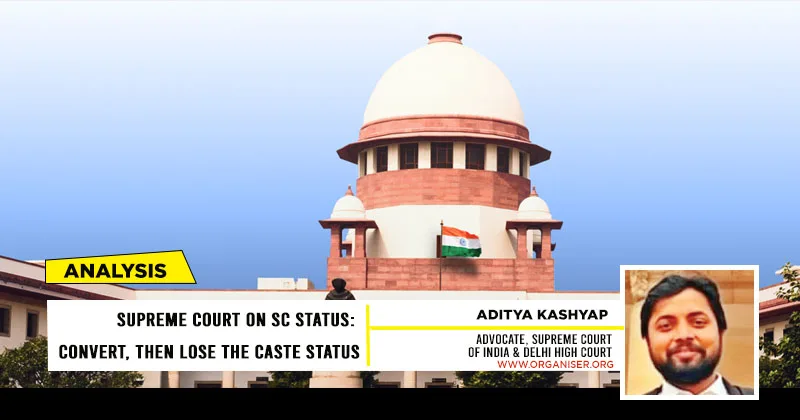
In a significant ruling (Chinthada Anand v. State of Andhra Pradesh — Criminal Appeal No. 1580 of 2026 (2026 INSC 283), delivered on March 24, 2026, a bench of the Supreme Court of India comprising Justice Prashant Kumar Mishra and Justice Manmohan has authoritatively settled the law on a question that has generated persistent litigation, political controversy, and sustained pressure from certain denominational and vested interests: whether a person who has voluntarily converted from Hinduism to Christianity can continue to claim Scheduled Caste status and invoke the protections of the Scheduled Castes and Scheduled Tribes (Prevention of Atrocities) Act, 1989. The answer, unequivocally, is no.
Genesis of the Case
The case arose from a criminal complaint filed by one Chinthada Anand, a resident of Guntur district in Andhra Pradesh, who claimed to belong to the Madiga community – a notified Scheduled Caste. He alleged that in January 2021, he was assaulted, abused with caste slurs, and intimidated by persons belonging to the Reddy community, while returning from Sunday prayers that he was conducting in his capacity as a Christian Pastor. An FIR was registered invoking provisions of the SC/ST Act alongside ordinary penal offences.
“Only Hindus, Buddhists, Sikhs can claim to be Scheduled Caste; conversion to any other religion scraps SC status” — Supreme Court on March 24
The Andhra Pradesh High Court, on a petition filed by the accused, quashed the proceedings, holding that the complainant, who had openly functioned as a Christian pastor for over a decade, could not invoke the SC/ST Act. The complainant appealed to the Supreme Court. The Supreme Court dismissed the appeal and upheld the High Court’s order in its entirety.
The Constitutional Framework
The judgement proceeds from first principles. The Constitution of India under Articles 341 and 342 vests the power to notify Scheduled Castes and Scheduled Tribes exclusively in the President of India. The Constitution (Scheduled Castes) Order, 1950, issued under this presidential power, contains a provision that is categorical and clear: no person who professes a religion other than Hindu, Sikh, or Bauddha shall be deemed to be a member of a Scheduled Caste.
The Court records the legislative history with precision. When the Order was first issued in 1950, only persons professing Hindu Dharma were covered. In 1956, persons professing Sikh Dharma were included. In 1990, Buddhists were added. Christianity has never been included despite decades of political pressure, and Parliament has consciously chosen not to do so. This is not an oversight rather it is a considered constitutional position.
The word “professes” was examined in depth. Drawing on a line of decisions going back to Punjab Rao v. D P Meshram (1964), Guntur Medical College v. Y Mohan Rao (1976), and continuing through M Chandra v. M Thangamuthu (2010) and the recent C Selvarani (2024), the Court held that “professes” means an open, public declaration or practice of a religion. A person who has openly and continuously functioned as a Christian pastor, conducting Sunday prayers, leading a congregation, serving as treasurer of a Pastors’ Fellowship — by that very conduct publicly and unambiguously professes Christianity.
The Court also made an important theological observation: Christianity, by its foundational doctrine, does not recognise the institution of caste. The distinctions within Bharatiya Christianity are denominational, not caste-based. A person cannot simultaneously claim that he suffers caste discrimination, while actively professing a faith whose very theology repudiates Hindu social order.
The most important contribution of this judgement is the set of authoritative postulates laid down for determining SC/ST membership in the context of religious conversion. These constitute binding law going forward.
For Scheduled Castes, the position is absolute. Conversion to any religion not specified in Clause 3 of the 1950 Order results in the immediate and complete loss of Scheduled Caste status from the moment of conversion, regardless of birth. No statutory benefit, protection, reservation, or entitlement flowing from Scheduled Caste membership, including the protection of the SC/ST Act, can thereafter be claimed. The bar is categorical and admits no exception.
The judgement also firmly closes the door on attempts to game the system through claimed reconversion. Where a person claims to have returned to Hindu Dharma after converting away, three cumulative and mandatory conditions must be established: clear proof of original membership of a notified caste; credible evidence of genuine reconversion with complete and unequivocal renunciation of the converted religion, total dissociation from it, and actual adoption of the customs and practices of the original caste; and satisfactory evidence of acceptance by the original caste community. Mere self-proclamation is explicitly held to be insufficient. All three conditions are mandatory and failure on even one is fatal.
This is significant. For years, a pattern has been observed where individuals convert to Christianity, avail the social and material benefits offered by missionary organisations, and then selectively claim Hindu caste identity when it comes to statutory benefits and reservations. The Supreme Court has put a decisive end to this practice.
For Scheduled Tribes, the Court draws an important distinction. The Scheduled Tribes Order of 1950 does not contain a religion-based exclusion. Accordingly, the determination of Scheduled Tribe status after conversion is fact-specific; so, it depends on whether the person continues to possess and is recognised for the essential attributes of tribal identity, including customary practices, social organisation, community life, and acceptance by the tribal community. Where conversion has resulted in complete severance from the tribal way of life over time, Scheduled Tribe status may be lost as a matter of fact. The assessment is left to competent authorities on a case-by-case basis.
AP Gov Order: Argument Repelled
The appellant placed considerable reliance on a Government Order issued by the Andhra Pradesh Government in 1977, which extended certain concessions to Scheduled Caste converts to Christianity and Bauddha. The Court examined this order carefully and rejected the argument with finality.
The Government Order itself, the Court noted, expressly limits its scope to non-statutory concessions ie – welfare schemes and economic support. It explicitly states that statutory benefits, including reservations and protections under central legislation, remain confined to those recognised under the Presidential Order of 1950. More fundamentally, no State Government executive order can override or expand upon a Presidential Order issued under the Constitution. The Union Government had also clarified this position authoritatively in a parliamentary reply in 2021, stating that benefits under centrally sponsored schemes and other statutory benefits cannot be extended to converted Christians from Scheduled Castes.
The Larger Significance
For decades, there has been a sustained and well-funded campaign — driven in large part by certain denominational interests and their political allies — to extend Scheduled Caste reservations and protections to converts to Christianity. The argument made is that caste-based discrimination persists regardless of religious identity. This argument, however attractive it may appear, misunderstands the constitutional design and, if accepted, would fundamentally subvert it.
The Scheduled Caste framework was designed to address disabilities arising within a specific social and religious order. The Presidential Order of 1950 reflects a conscious constitutional choice. Parliament alone, and not State Governments, not courts, and certainly not pressure groups, has the authority to claim or to modify the SC list. In the absence of such parliamentary action, extending SC benefits to Christian converts would amount to a fraud on the Constitution.
The judgement also has important implications for the integrity of the SC/ST Act itself. This is a powerful penal statute, and its invocation carries severe consequences. It cannot be set in motion unless the foundational requirement, that the victim be a bona fide Scheduled Caste member, is established as a matter of law and fact. The Court rightly recognises that allowing converted Christians to invoke this statute would be to weaponise it beyond its constitutional purpose.
It is also worth noting what this judgement does not prevent. A person who has converted to Christianity retains all ordinary civil and criminal remedies available to every citizen. The allegation of assault, intimidation, and wrongful restraint in this case was also independently examined by the Court under the Indian Penal Code, and found to be unsupported by the evidence on record. The witnesses did not corroborate the complainant’s version, and the medical evidence disclosed only simple injuries. The quashing was therefore also independently warranted on the facts.
The Supreme Court has correctly and firmly applied the Constitution as it stands. The settled position that Scheduled Caste status requires professing Hindu, Sikh, or Bauddha Dharma has been reaffirmed, clarified, and
fortified with binding postulates for future cases.