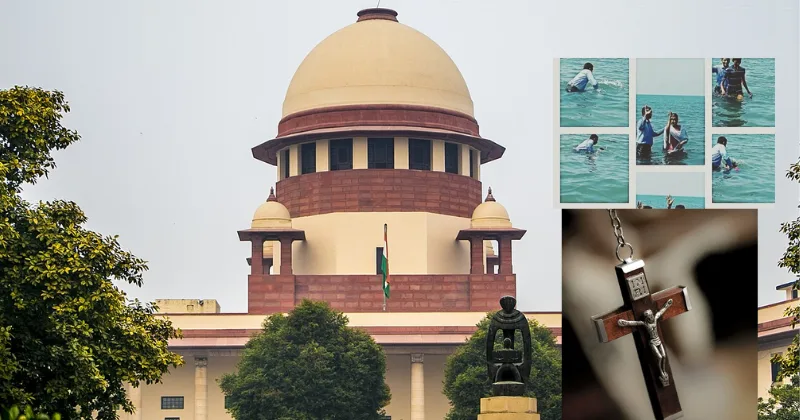
Following the Supreme Court judgement on March 24, clarifying that a person who converts from Hindu to another religion, such as Christianity, cannot retain Scheduled Caste (SC) status or seek protection under the SC/ST (Prevention of Atrocities) Act, 1989, as SC status is legally limited to Hindus, Sikhs, and Buddhists.
This is not the first time that the judiciary has taken this stand; the order copy of the judgment details every word, such as Scheduled Castes and Scheduled Tribes, and the benefits accorded as per the Constitution and their interpretation.
Andhra Pradesh High Court
This case dates back to April 2024, involving a Pastor Chinthada Anand, whose complaint under the SC/ST Act led to an FIR. The Andhra Pradesh High Court quashed it, noting that Anand had converted to Christianity and was practising as a pastor. It held that adopting a religion outside Hindu, Sikh, or Buddhist ends SC status in the legal sense, and merely holding an SC certificate does not entitle protection if religious identity has changed.
Upholding this, a Supreme Court bench of Justices P.K. Mishra and A.V. Anjaria observed that Anand had been practising Christianity for nearly a decade.
The court ruled he could not be considered part of the SC community for protections under the Act, stating that extending such benefits to those outside the legally defined SC framework would be inappropriate.
Andhra Pradesh HC quashes SC/ST case after complainant found to be Christian convert and pastor.
Court rules he can’t claim SC status based on faith and role in church.
By: Kunti Surender#AndhraPradesh https://t.co/LNXjmBlxyE
— Organiser Weekly (@eOrganiser) May 1, 2025
Andhra Pradesh High Court relied on earlier precedents, including Chinni Appa Rao vs. State of A.P. (2016), which bars Christian converts from invoking the Act.
The Supreme Court:
In November 2024, the Supreme Court rejected C. Selvarani’s claim for Scheduled Caste (SC) reservation benefits, calling it a “fraud on the Constitution” and stressing that conversion for quota benefits undermines affirmative action.
Selvarani, from Tamil Nadu, applied for an Upper Division Clerk post in Puducherry claiming SC status as a Hindu Valluvan, despite being a baptised Christian. Verification showed she was born into a Christian family, baptised in 1991, with no evidence of reconversion, leading to rejection of her SC certificate.
The Madras High Court in January 2023 upheld this, noting that a person cannot claim SC status after conversion to Christianity.
Affirming this, a bench of Justice Pankaj Mithal and Justice R. Mahadevan observed:
“The conferment of Scheduled Caste communal status to the appellant, who is a Christian by religion but claims to be still embracing Hinduism only for the purpose of availing reservation in employment, would go against the very object of reservation and would amount to fraud on the Constitution.”
Soosai vs. Union of India (1986): Established that the 1950 Order specifically excludes Christians from SC status.
Akkala Rami Reddy vs. State of A.P. (2025): A recent ruling confirmed that the basis for SC classification is nullified the moment one embraces a faith that does not recognise the caste system.
Madras High Court
In May 2025, the Madurai Bench of the Madras High Court reiterated that individuals who convert to religions other than Hindu, Sikh, or Buddhist cannot avail Scheduled Caste (SC) benefits under the Constitution. The Court remarked strongly that “It is a fraud on Constitution” to claim SC status after conversion.
Justice L. Victoria Gowri disqualified AIADMK functionary V. Amutha Rani as Chairperson of Theroor Town Panchayat, a post reserved for SC (General). The plea was filed by DMK member V. Iyyappan under the Tamil Nadu District Municipalities Act, 1920.
SC Status for Christian Converts: Madras HC says “It is a fraud on Constitution” to claim SC status after conversion
By: TS Venkatesan#Christian #Madras https://t.co/iknbADLH15
— Organiser Weekly (@eOrganiser) May 19, 2025
Rani, originally from the Hindu Pallar SC community, had married a Christian man in 2005 under the Indian Christian Marriage Act and embraced Christianity. Despite this, she filed nomination for the reserved post, leading to the dispute.
The petitioner argued that once a person converts to a religion outside Hindu Sikh, or Buddhist, they cannot claim SC reservation benefits — a position the court upheld.
Allahabad High Court:
In December 2025, the Allahabad High Court, in Jitendra Sahani vs. State of U.P., rejected the plea of a Christian missionary who claimed to be Hindu in court, drawing a clear line against “dual religious identity.”
The accused, Jitendra Sahani, was conducting prayer meetings as a “Padri” while filing an affidavit identifying as Hindu. Witnesses alleged he lured villagers with promises of jobs, financial aid, and healing, while criticising Hindu beliefs.
Allahabad HC’s Landmark Ruling: Conversion to Christianity while retaining SC/ST benefits is “Fraud on Constitution”
Reports: Jagdamba Mall#AllahabadHC #Christian #Conversion https://t.co/s8SrfzwwfS
— Organiser Weekly (@eOrganiser) January 6, 2026
Taking note of this, the court observed that such conversions are often driven by “greed” and material inducements, leaving individuals in a legal void where they lose ancestral rights.
Reaffirming the Constitution (Scheduled Castes) Order, 1950, the court stated: “No person who professes a religion different from the Hindu, the Sikh or the Buddhist religion shall be deemed to be a member of a Scheduled Caste.”
In Parliament:
In a written reply to the Lok Sabha on 3rd August, 2021, the Minister of State for Social Justice and Empowerment, A. Narayanaswamy, addressed this issue. The Press Information Bureau issued a press release titled “Benefit of Centrally Sponsored Schemes to Converted Christians” recording this parliamentary reply, which reads as follows:
Ministry of Social Justice & Empowerment Benefit of Centrally Sponsored Schemes to Converted Christians. No person who professes a religion different from the Hindu, the Sikh or the Buddhist religion shall be deemed to be a member of a Scheduled Caste. The benefits of Centrally Sponsored Schemes (CSS) meant for the welfare and development of Scheduled Castes can not be extended to Converted Christians from Scheduled Castes.
Stand of Judiciary:
The judiciary has also rejected such demands every time as illogical and unconstitutional.
Historically, the judiciary has rejected such kind cases every time as illogical and unconstitutional.
In the case of “Soosai Etc vs Union Of India And Others” on 30th September, 1985, the Supreme Court had clearly directed that the Constitution (Scheduled Castes) Order, 1950 and the amendments made to it were constitutional and this reservation could be given to none else other than Hindu, Sikh and Buddhist Scheduled Castes.
In the cases of R.C. Poudyal; Somnath Poudyal; Nandu Thapa; Roop Raj Rai, etc., these provisions of the Constitution (Scheduled Castes) Order, 1950 were considered appropriate and just.