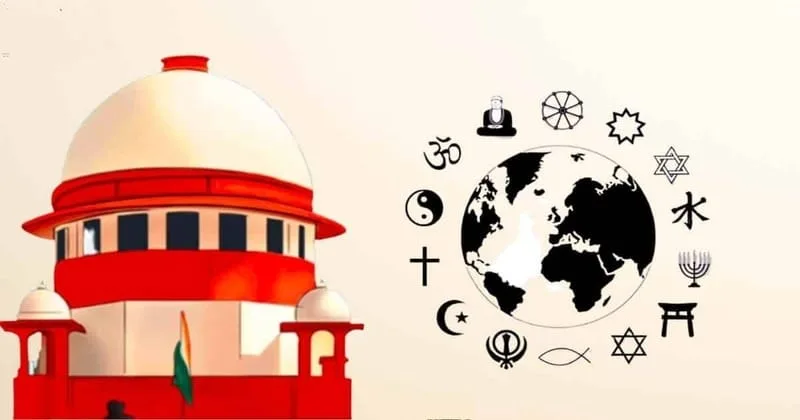
New Delhi: In a significant judgment, the Supreme Court has clarified that a person who converts from Hinduism to another religion, such as Christianity, cannot retain Scheduled Caste (SC) status or seek protection under the SC/ST (Prevention of Atrocities) Act, 1989. The ruling reiterates that SC status is legally linked to specific religions, Hinduism, Sikhism, and Buddhism, and is not applicable beyond them.
Background of the Case and High Court Decision
The case centred on Pastor Chinthada Anand, who had filed a complaint alleging caste-based abuse and atrocities under the SC/ST Act. Based on his complaint, the police registered an FIR against the accused.
However, the accused later approached the Andhra Pradesh High Court seeking to quash the FIR. The High Court ruled in their favour, observing that Anand had converted to Christianity and was actively practising the religion as a pastor. It held that once a person adopts and practices a religion outside the ambit of Hinduism, Sikhism, or Buddhism, they cease to be a member of the Scheduled Caste community in the legal sense.
The court further noted that merely possessing a Scheduled Caste certificate does not automatically entitle an individual to protection under the SC/ST Act if their religious identity has changed. It also observed that caste-based discrimination, as legally understood within the SC framework, does not extend in the same manner to Christianity.
Supreme Court’s Observations and Final Verdict
A bench comprising Justices P.K. Mishra and A.V. Anjaria upheld the High Court’s decision, reinforcing the legal principle that conversion to another religion results in the loss of Scheduled Caste status.
The Supreme Court carefully examined the facts and found that Anand had been practising Christianity for nearly a decade and had been conducting religious services as a pastor. Based on this, the court concluded that he could not be considered a member of the Scheduled Caste community for the purpose of legal protections under the SC/ST Act.
The bench stated that extending the benefits of the SC/ST (Prevention of Atrocities) Act to individuals who no longer belong to the SC community, as defined by law, would not be appropriate. It emphasised that SC status is not merely based on origin but is also tied to the religious framework recognised under the Constitution (Scheduled Castes) Order.
Overall, the judgment reinforces the long-standing legal position that Scheduled Caste status is religion-specific and is forfeited upon conversion to religions outside Hinduism, Sikhism, or Buddhism. It also clarifies the limits of legal protection under the SC/ST Act in cases involving religious conversion.