On March 24, 2026, the Supreme Court of India reaffirmed the constitutional position on religious conversion by upholding an earlier High Court ruling. In doing so, it once again clarified the legal and constitutional framework governing conversion and its implications.
The case traces back to an April 30, 2025 judgment of the Andhra Pradesh High Court, which held that a pastor who had converted to Christianity could not claim protection under the Scheduled Castes and Scheduled Tribes (Prevention of Atrocities) Act. Challenging this verdict, the complainant, Anand, approached the Supreme Court.
In its latest ruling, the Supreme Court upheld the High Court’s decision, delivering a significant observation: an individual cannot simultaneously profess and practice two religions. The Court emphasized that once a person converts to another religion, they cannot continue to claim affiliation with their original faith in a manner that allows dual religious identity.
The judgment further reiterated that individuals who convert to religions other than Buddhism, or Sikhism are not eligible for Scheduled Caste benefits, and extending such benefits would be unconstitutional.
This position is not new. In the landmark Soosai vs Union of India (1986) case, the Supreme Court had upheld the provisions of the 1950 Presidential Order, which excludes Christians from Scheduled Caste status. Similarly, in May 2025, the Madurai Bench ruled that claiming Scheduled Caste status after conversion constitutes constitutional fraud. In December 2025, the Allahabad High Court, in Jitendra Shane vs State of Uttar Pradesh, delivered a similar judgment.
Earlier, on August 3, 2021, the Union Minister for Social Justice and Empowerment, Narayanaswamy, clarified in Parliament that, except for Buddhism and Sikhism, conversions to other religions exclude individuals from the constitutional protections available to Scheduled Castes.
Taken together, these judicial pronouncements send a clear message regarding religious conversion, particularly warning against inducement-based conversions targeting vulnerable communities.
Ambedkar’s Warning, Revisited After 90 Years:
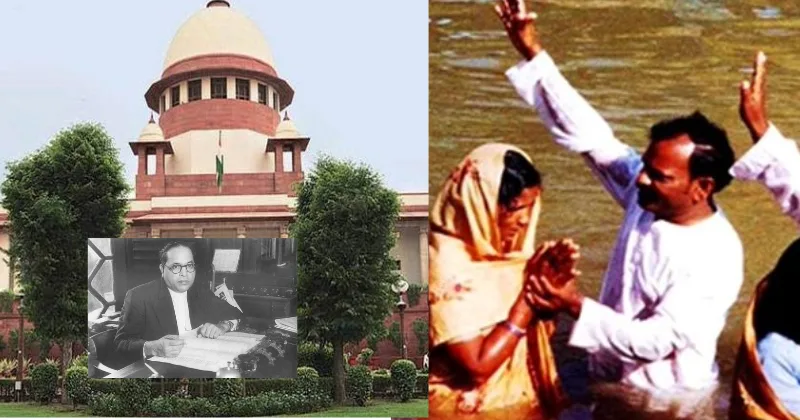
The Supreme Court’s observations today resonate strikingly with the warnings issued nearly nine decades ago by Dr. B.R. Ambedkar, the chief architect of the Indian Constitution.
Historical records indicate that Ambedkar had cautioned oppressed communities about the complexities and consequences of religious conversion. His views were shaped by extensive study of different religions and their social implications.
On May 11, 1936, during a visit to Wardha, Ambedkar addressed members of marginalized communities and engaged in detailed discussions with leaders such as Purushottam Kharpade, Shankar Rao Sonawane, and Gomaji Tembare. During this interaction, he offered nuanced guidance on the question of conversion.
Ambedkar clearly stated that while he had spoken about the need for conversion as a means of social emancipation, he had never recommended any specific religion. He cautioned that individuals should not be persuaded into adopting any religion based on external influence or inducement, warning that such decisions could lead to regret.
He is recorded as saying that he did not encourage anyone to join Islam or Christianity, and that those who follow such recommendations blindly might be misled. At the same time, he maintained that discussions on conversion as a broader social question should continue until a thoughtful and collective decision is made.
Notably, despite receiving offers and inducements from various religious groups following his announcement on conversion, Ambedkar declined to join Islam or Christianity. He famously remarked that converting to these religions would not merely be a change of faith, but could amount to a form of “national dislocation,” something he was unwilling to accept.
Contemporary Relevance:
The recent court rulings, when viewed alongside Ambedkar’s historical warnings, underline the continuing relevance of informed and conscious decision-making in matters of faith and identity.
They also highlight the need for clarity regarding the legal and constitutional consequences of religious conversion, particularly in relation to affirmative action policies.
For marginalized communities, these developments serve as a reminder to carefully evaluate both the social and legal dimensions of conversion. Ambedkar’s writings and speeches continue to provide a critical framework for understanding these issues in depth.