Why conversion erases Scheduled Caste (SC) status
June 16, 2026
  • Read Ecopy
  • Circulation
  • Advertise
  • Careers
  • About Us
  • Contact Us
Android AppiPhone AppArattai
Organiser
  • ‌
  • Bharat
    • Assam
    • Bihar
    • Chhattisgarh
    • Jharkhand
    • Maharashtra
    • View All States
  • World
    • Asia
    • Europe
    • North America
    • South America
    • Africa
    • Australia
  • Editorial
  • International
  • Opinion
  • RSS @ 100
  • More
    • Op Sindoor
    • Analysis
    • Sports
    • Defence
    • Politics
    • Business
    • Economy
    • Culture
    • Special Report
    • Sci & Tech
    • Entertainment
    • G20
    • Azadi Ka Amrit Mahotsav
    • Vocal4Local
    • Web Stories
    • Education
    • Employment
    • Books
    • Interviews
    • Travel
    • Law
    • Health
    • Obituary
  • Subscribe
    • Subscribe Print Edition
    • Subscribe Ecopy
    • Read Ecopy
  • ‌
  • Bharat
    • Assam
    • Bihar
    • Chhattisgarh
    • Jharkhand
    • Maharashtra
    • View All States
  • World
    • Asia
    • Europe
    • North America
    • South America
    • Africa
    • Australia
  • Editorial
  • International
  • Opinion
  • RSS @ 100
  • More
    • Op Sindoor
    • Analysis
    • Sports
    • Defence
    • Politics
    • Business
    • Economy
    • Culture
    • Special Report
    • Sci & Tech
    • Entertainment
    • G20
    • Azadi Ka Amrit Mahotsav
    • Vocal4Local
    • Web Stories
    • Education
    • Employment
    • Books
    • Interviews
    • Travel
    • Law
    • Health
    • Obituary
  • Subscribe
    • Subscribe Print Edition
    • Subscribe Ecopy
    • Read Ecopy
Organiser
  • Home
  • Bharat
  • World
  • Operation Sindoor
  • Editorial
  • Analysis
  • Opinion
  • Culture
  • Defence
  • International Edition
  • RSS @ 100
  • Magazine
  • Read Ecopy
Home Bharat

Understanding the March 24, 2026, Supreme Court Ruling: Why conversion erases Scheduled Caste (SC) status

India’s legal framework on caste-based protections has once again come into sharp focus following a significant ruling by the Supreme Court of India on March 24, 2026. In a judgment that reinforces decades of constitutional interpretation, the Court clarified that religious conversion has a direct and decisive impact on Scheduled Caste (SC) status and the legal safeguards attached to it

Adv. Ashish V. SonawaneAdv. Ashish V. Sonawane
Apr 1, 2026, 06:00 pm IST
in Bharat, Opinion, Law
Follow on Google News
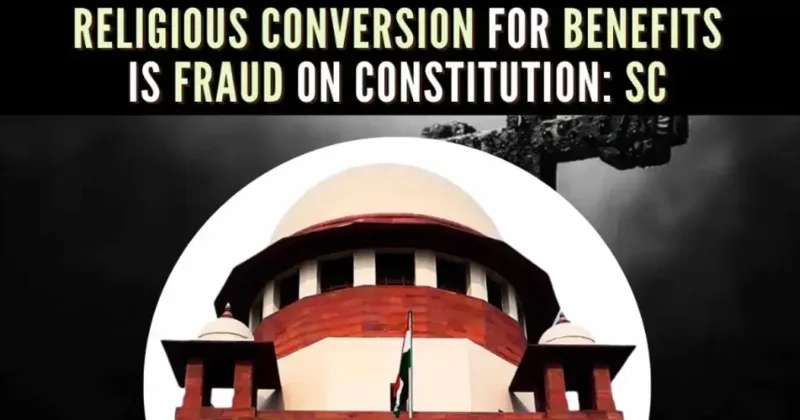
Representative Image

Representative Image

FacebookTwitterWhatsAppTelegramEmail

If you are wondering how religious conversion affects Scheduled Caste (SC) status and statutory protections such as the SC/ST Act or reservations, here is a breakdown of the nitty-gritty of the March 24, 2026, judgment and the broader legal history behind it.

The Core Principle: The Presidential Order of 1950

To understand the legal position, we must look at the foundation of SC reservations. The Constitution of India grants SC status strictly in accordance with the Constitution (Scheduled Castes) Order, 1950.

Clause 3 of this Presidential Order establishes an absolute and categorical rule: No person who professes a religion different from the Hindu, Sikh, or Buddhist religion shall be deemed to be a member of a Scheduled Caste. The moment a person converts from a religion other than Hinduism, Sikhism, or Buddhism to Christianity or Islam, the legal protections tied to their SC status are immediately lost.

Why Does Conversion Erase SC Status?

The Supreme Court has historically noted that the caste system and the severe social and economic disabilities it brings is predominantly a feature of orthodox Hindu society. Protective discrimination was created by the Constitution specifically to uplift those who suffer under these historical disadvantages.

Also Read: Keralam Assembly Polls 2026: CPI(M) & Congress bring PFI, Jamaat-e-Islami into mainstream politics to counter NDA

In contrast, religions like Christianity are theologically egalitarian and do not recognise caste classifications or hierarchies. Therefore, the law operates on the principle that once an individual ceases to be a Hindu and embraces Christianity or Islam, the social and economic disabilities inherent to the Hindu religion cease to exist, making the Constitutional protection cease as well.

The March 24, 2026 Judgment: Chinthada Anand v. State of A.P.

In this case, the appellant was born into the ‘Madiga’ community (a Scheduled Caste in Andhra Pradesh). However, he had been working as a Christian Pastor for the past ten years and was regularly conducting Christian religious services. Following an altercation with some villagers, he registered a criminal case under the SC/ST (Prevention of Atrocities) Act, primarily against respondents nos. 2 to 7, who belong to the Reddy community, and other villagers. After the investigation, a charge sheet was filed in this matter. Against this, the respondents filed a petition in the Hon’ble Andhra Pradesh High Court seeking to quash the criminal case and the trial proceedings. The main ground raised in the petition was that, since the said complainant belongs to the Christian community, he cannot be considered a member of a Scheduled Caste and, consequently, cannot file a case under the SC/ST (Prevention of Atrocities) Act. The Hon’ble Andhra Pradesh High Court accepted this argument and quashed the said crime and proceedings. Against that decision, the complainant filed an appeal before the Hon’ble Supreme Court. In that very petition, the Hon’ble Supreme Court delivered its judgment on March 24, 2026.

What the Hon’ble Supreme Court Ruled

“Professing” a Religion Matters: The Court held that by serving as a Pastor, leading a congregation, and publicly preaching the gospel for a decade, the appellant made an open and public declaration of his faith, meaning he legally “professes” Christianity.
Loss of Protection: Because he professes Christianity, he cannot be deemed a member of a Scheduled Caste under the 1950 Presidential Order. Consequently, his caste status was eclipsed, and he cannot legally invoke the statutory protections of the SC/ST Act.
State Orders Cannot Grant Statutory Benefits: The appellant tried to rely on a 1977 Andhra Pradesh State Order (G.O. Ms. No. 341) that gave certain non-statutory concessions to SC converts to Christianity. The Supreme Court clarified that State Governments can grant only non-statutory economic concessions; they have no power to grant statutory Constitutional benefits (such as SC/ST Act protection or public employment reservations) to Christian converts.

The Broader Picture: Key Pointers from Other Judgments

The March 24, 2026 ruling firmly aligns with the strict approach the Courts have taken regarding conversion and caste benefits:

Claiming SC Status after Conversion is a “Fraud on the Constitution”: In the 2024 case of C. Selvarani v. The Special Secretary, an individual actively practised Christianity (including baptism and regular church attendance) but claimed to be a Hindu just to secure a government job under the SC quota. The Hon’ble Supreme Court held that maintaining such a dual claim solely with the ulterior motive of deriving reservation benefits defeats the social ethos of the policy and amounts to a fraud on the Constitution.

Deemed Conversion via Marriage: In a 2025 Madras High Court case (V. Iyyappan), a woman born into the Hindu Pallan (SC) community married a Roman Catholic man under the Indian Christian Marriage Act, 1872. The Court ruled that voluntarily solemnising a marriage under the Christian Marriage Act operates as a “deemed renunciation” of the native Hindu religion and conversion to Christianity. Consequently, she lost her SC socio-legal identity and was disqualified from holding the post of local body Chairman reserved for SC candidates.

The Strict Rules for Reconversion: If a convert wishes to regain their SC status, they cannot simply self-proclaim a return to Hinduism. The Supreme Court has laid down a mandatory three-step test: (1) Clear proof they originally belonged to a notified SC, (2) Unimpeachable evidence of a bona fide reconversion to their original religion and complete renunciation of the new religion, and (3) Actual acceptance and assimilation back into the original caste community. Without satisfying all three conditions, merely possessing an old caste certificate is of no legal benefit.

Hence, from the above judgments, it becomes clear that the Scheduled Caste status is not based solely on birth but is linked to the Hindu religion. Upon conversion, the concerned person will not be able to avail themselves of the special constitutional and legal benefits available to that caste.

The Hon’ble Supreme Court has also postulated the effect of conversion of the Scheduled Tribes as well. We will be analysing that aspect in a separate article.


Topics: Supreme CourtSCConversionScheduled Caste
ShareTweetSendShareSend
✮ Subscribe Organiser YouTube Channel. ✮
✮ Join Organiser's WhatsApp channel for Nationalist views beyond the news. ✮
Previous News

Breaking the backbone of Red Terrorism: Know how rehabilitation and development defeated the sinister plans of Maoists

Next News

Red Terrorism: From policy paralysis under UPA to strategic containment in the Modi era

Related News

Supreme Court of India

‘RTI activism has become business’: SC denies anticipatory bail, questions activist’s authority to monitor road project

The AMU Judgment: Why the Supreme Court must revisit Article 30

Tamil Nadu Assembly (File Photo)

Tamil Nadu speaker drops action against 21 rebel AIADMK MLAs after EPS withdrawal, targets 4 who joined TVK

Supreme Court remarks have revived the UAPA bail debate, with supporters citing national security concerns

UAPA Bail Debate: Striking a delicate balance between individual liberty and national security

Supreme Court invokes Article 142, issues strict timelines to curb delay in High Court judgments

Supreme Court invokes Article 142, orders strict timelines for High Court judgments to end delays in justice delivery

SIR and Article 324: Supreme Court strengthens the constitutional spine of Indian Democracy; Reaffirms ECI’s authority

Load More

Latest News

Addressing the Samapan Samahroh of 15-day Sangh Shiksha Varg, RSS Akhil Bharatiya Sah Prachar Pramukh Pradeep Joshi

Dehradun | Anti-national forces & foreign conspiracies seeking to weaken Bharat: Pradeep Joshi askes people to be alert

Akal Takht panel declares Punjab CM Bhagwant Mann ‘anti-Guru’

Akal Takht declares Bhagwant Mann ‘anti-Guru’, summons Punjab cabinet over controversial Sikh legislation

Strong demand across Asia, Africa and Europe drove India's highest-ever monthly export performance

India’s exports hit record high in May 2026 despite global uncertainties; Trade deficit narrows

DRDO successfully tests Long-Range Precision Missile

India’s ‘Tomahawk’ Takes Flight: DRDO successfully tests long-range precision cruise missile

Tamil Nadu Education Minister Rajmohan (file photo)

Tamil Nadu Education Minister Rajmohan takes U-turn on religious symbols in schools after severe public backlash

A representative image generated via AI

MP: Mohd Sameer booked under POCSO for raping minor Hindu girl for years, forcing abortions and conversion to Islam

Bangladesh Dhaka University Hindu students demand arrests after Islamists desecrate Bhagwan Ram’s murti in Gaibandha

Bangladesh: Dhaka University Hindu students launch protest over Islamist desecration of Bhagwan Ram’s murti

Bhaurao Bhuskute

Bhaurao Bhuskute: A silent architect of nation-building and an exemplary karmayogi

United States: Life-size statue of Swami Vivekananda unveiled in Chicago; Resonates the message of service & harmony

NTA welcomed the centre's decision to impose temporary restrictions on Telegram platform in India ahead of the NEET-UG 2026 re-examination

NEET-UG 2026 Re-Exam: NTA welcomes government’s temporary restrictions on Telegram to curb paper leak and fraud

Load More
  • Privacy
  • Terms
  • Cookie Policy
  • Refund and Cancellation
  • Delivery and Shipping

© Bharat Prakashan (Delhi) Limited.
Tech-enabled by Ananthapuri Technologies

  • Home
  • Search Organiser
  • Bharat
    • Assam
    • Bihar
    • Chhattisgarh
    • Jharkhand
    • Maharashtra
    • View All States
  • World
    • Asia
    • Africa
    • North America
    • South America
    • Europe
    • Australia
  • Editorial
  • Operation Sindoor
  • Opinion
  • Analysis
  • Defence
  • Culture
  • Sports
  • Business
  • RSS @ 100
  • Entertainment
  • More ..
    • Sci & Tech
    • Vocal4Local
    • Special Report
    • Education
    • Employment
    • Books
    • Interviews
    • Travel
    • Health
    • Politics
    • Law
    • Economy
    • Obituary
  • Subscribe Magazine
  • Read Ecopy
  • Advertise
  • Circulation
  • Careers
  • About Us
  • Contact Us
  • Policies & Terms
    • Privacy Policy
    • Cookie Policy
    • Refund and Cancellation
    • Terms of Use

© Bharat Prakashan (Delhi) Limited.
Tech-enabled by Ananthapuri Technologies