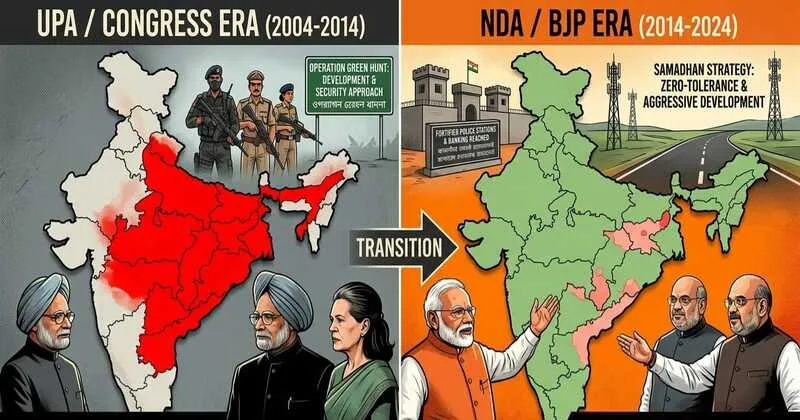
The trajectory of Maoism in India is not merely a question of internal security; it is a test of governance, political will, and institutional coherence. During the tenure of the United Progressive Alliance led by the Indian National Congress, with Sonia Gandhi as a central figure, India witnessed a phase where the writ of the State weakened across vast regions, allowing parallel systems of authority to emerge. To understand the present claim of controlling Maoism, it is essential to revisit how lapses in both policy and execution during that period contributed to its expansion and how a coordinated approach in recent years has helped contain it.
When the presence of the State is reduced to paperwork, and a parallel authority begins to function on the ground, the issue ceases to be merely one of security; it becomes a failure of governance. This is precisely what unfolded during the peak years of Maoism under the Congress-led regime, when both policy direction and implementation appeared inconsistent and weak.
At its height, Maoism had spread across what came to be known as the “Red Corridor,” encompassing large parts of Chhattisgarh, Jharkhand, Odisha, Maharashtra, Andhra Pradesh and Bihar. In many of these regions, the State’s presence was minimal, and administrative structures existed largely in form rather than substance. Real control often lay in the hands of Naxalite groups.
The Bastar region of Chhattisgarh exemplified this failure. Infrastructure development was obstructed, schools could not function, healthcare systems collapsed, and formal judicial mechanisms were rendered ineffective. Local disputes were frequently resolved in so-called Naxalite courts, which lacked transparency and due process. Government schemes could only be implemented with their approval, and contractors were often compelled to pay hefty sums to operate.
This situation was not merely an administrative weakness; it was a direct challenge to the sovereignty of the State. Naxalite groups evolved beyond armed insurgents into operators of a parallel governance structure. Villages were gripped by fear, with people unable to rely fully on either the State or to resist the insurgents.
One of the gravest concerns was the lack of a clear and consistent response from the government. While some states adopted a strict approach, others initiated operations only to halt them midway. In Bastar, for instance, security forces had once pushed back insurgents effectively, but the discontinuation of operations allowed them to regroup and regain strength.
This inconsistency stemmed not only from administrative issues but also from political and ideological pressures. Certain intellectual and activist groups portrayed Maoism as a socio-political movement, creating hesitation within the government. As a result, decisive action was often delayed or diluted.
Compounding the problem was the weakness of the intelligence and security framework. Despite operating in significant numbers, Naxalite groups were not effectively monitored or countered in time. This highlighted deeper institutional shortcomings beyond the ground-level challenges.
A comparison with other regions further underscores this gap. In areas like Punjab and the Northeast, the State maintained sustained pressure and presence to counter insurgency. In contrast, Maoist-affected regions often reflected a withdrawal or inconsistency in state control, exacerbating the crisis.
However, the situation today presents a markedly different picture. In recent years, there has been a clear strategic shift in addressing Maoism. Under the Bharatiya Janata Party, led by Narendra Modi with key strategic leadership from Amit Shah, the approach has transformed from reactive containment to proactive control.
Improved coordination between the central and state governments, enhanced capacity of security forces, and strengthened intelligence networks have played a critical role in reversing the trend. The geographical spread and influence of Maoism have significantly reduced. What was once a widespread challenge across numerous districts has now been confined to limited pockets. Continuous operations by security forces have weakened the insurgent infrastructure, while administrative control has been gradually restored.
Strategically, the approach now emphasises planned, coordinated action, combining security measures with development initiatives and community engagement. This integrated model has addressed the root causes and reduced the operational space for Naxalite groups.
It would not be an exaggeration to say that Maoism today is in its final phase, though not entirely eliminated. Its scale, influence, and operational capacity have diminished considerably. From controlling large territories, insurgents are now confined to isolated areas, struggling to sustain relevance.
Viewed in a broader perspective, the contrast is stark. There was a time when the State appeared to retreat, policies were unclear, and responses were inconsistent. Today, there is a defined strategy, institutional coherence, and sustained action aimed at restoring full control.
Ultimately, this journey offers a crucial lesson: internal security challenges cannot be resolved by force alone. They require clear policy direction, strong institutions, and consistent execution. Where these elements are absent, crises deepen. Where they align, even the most complex threats can be effectively contained. The contrast between the Congress-led UPA era and the BJP-led present underscores a deeper truth of governance: clarity, continuity, and conviction are the cornerstones of national security.