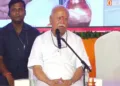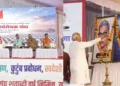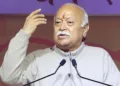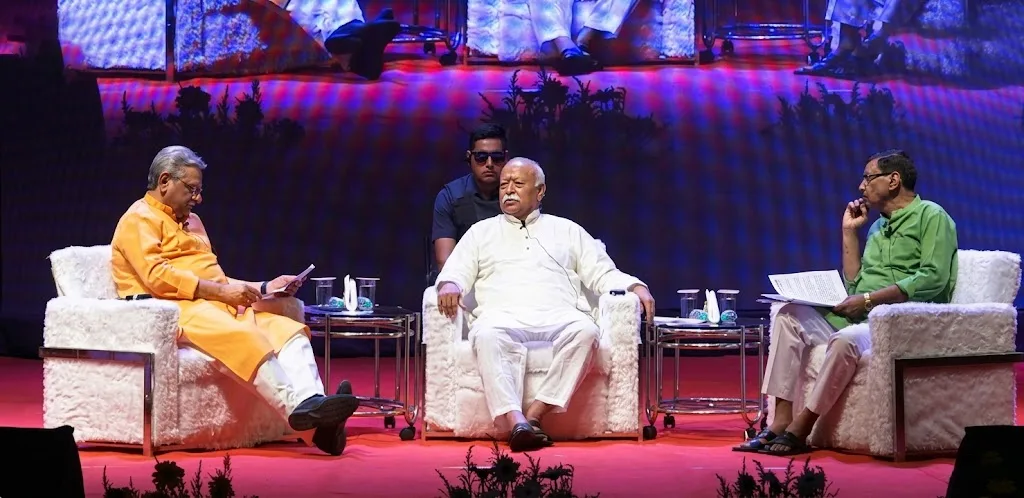
Dr Mohan Bhagwat, Sarsanghchalak of the Rashtriya Swayamsevak Sangh, in a candid conversation with Ganesh Pande, Editor of Tarun Bharat, and Ravindra Deshpande, author and former Mahanagar Pracharak, spoke at length on the evolving organisational structure of the Sangh, the expanding role of Swayamsevaks in societal transformation, the growing relevance of Panch Parivartan, engagement with media and technology, and the challenges of navigating both adversity and favourable times in the Sangh’s journey. The interaction took place in Nagpur on March 19 on the occasion of the centenary of the Nagpur-based daily Tarun Bharat
How would you evaluate the overall societal response to the concept of Panch Parivartan?
The concept of Panch Parivartan has found universal acceptance. People have responded with tremendous enthusiasm, from the grassroots level to the global stage. We recently had programmes attended by individuals from all five continents, including stalwarts from governance, administration, and the economic sector. All of them demonstrated keen interest, recognising this as an essential programme for humanity’s overall well-being. Consequently, there is unanimous agreement on this issue — regardless of whether one subscribes to the Sangh’s thought or not, whether one is Hindu or not, or whether one is Bharatiya or not.
However, while the concept has been widely accepted in the mind and intellect, the real challenges will arise during implementation. Panch Parivartan is fundamentally action-oriented; it is not merely a philosophical thought. It requires small, consistent actions from every individual, every family, and society at large. Behavioural changes gradually transform the broader environment, but everyone’s capacity to act varies. Often, people accept a thought but fail to act on it. Despite this, our experience shows that Panch Parivartan is universally acceptable. Notably, the women in our society are already two steps ahead of the men in embracing and implementing this.
How is it possible to simultaneously balance strict organisational building, focusing on character development, with the broader task of awakening and transforming society?
A: In fact, it is only possible if both happen simultaneously. If those setting out to transform society lack discipline, they risk being swept away by societal currents, ultimately corrupting themselves and society. Organisation is essentially the preparation for those who wish to bring about social change. Once organised, that collective strength must not remain confined to the organisation itself; it must be consistently applied in daily life for the benefit of society. That is the essence of public awakening.
Building the organisation is the starting point of the Sangh’s work. However, once the organisation reaches a certain strength, a Swayamsevak naturally begins to work with deep social consciousness. It is only possible to habituate society to these acts of transformation, to awaken them, and to teach through personal example if the Swayamsevaks take the lead. This process has already begun. Consequently, you are seeing an added dimension—a greater involvement and visible manifestation in our working style. The core idea was always there, but a seed only bears fruit when it reaches a certain stage of growth.
The current state of the Sangh naturally manifests in this societal work. Swayamsevaks are expected to bring about this transformation by maintaining their discipline and values, leading by example, and fostering a sense of belonging within society.
What is the underlying thought behind the significant structural and geographical changes that are taking place within the Sangh, and what direction will they provide for the future?
The scale of our work has expanded immensely. The volume of the Sangh’s core task of character building is now vast. Furthermore, as societal expectations from the Sangh have grown, the responsibilities shouldered by the Swayamsevaks have increased proportionately. Therefore, decentralisation is essential. We need smaller units so that tasks previously managed centrally can be handled at local levels, while the higher tiers can focus on emerging needs. This is why the Sambhag structure has been introduced.
Regarding the term Prant, our work now frequently involves interactions with governance and administration. To manage these relationships effectively without exposing everyone to potential administrative pitfalls, a separate state-level entity, termed Pradesh, will handle coordination and relations.
However, the Karyapaddhati (core working methodology) of the Sangh — build friendships, set a silent example, and watch the transformation unfold — remains completely unchanged. It is foundational, singular and permanent. What changes is merely the outward form or expression of our work, adapting to the times.
Similarly, departments that require extensive societal outreach, such as Seva (Service), Prachar (Publicity), and Sampark (Public Relations), now naturally involve women in their broader, informal outreach teams, as engaging with society means engaging with both men and women. These are stylistic adaptations. The Sangh will continue to evolve its form in response to the needs of the time and the stage of our work.
The Sangh’s perspective has rarely been presented accurately or comprehensively in the media. What is the Sangh’s current stance, understanding, and future direction regarding the mass media?
Mass media is an indispensable part of public life. Therefore, an organisation like the Sangh must consider all facets of public life, including the media. And we certainly do. The media holds a vital place in society. It is a crucial instrument. So, everyone must consider it, and there must be a system for it. As long as the Sangh’s work was strictly confined to character-building (Manushya Nirman), there was not a great need for media management. Character-building is highly focused, intensive work, so media relations simply weren’t on our radar.
However, as the Sangh grew, the public’s desire to understand us grew alongside it. In the past, the prevailing urge was simply to oppose the Sangh. Today, there is a genuine curiosity to know the Sangh. Consequently, even if we occasionally fall short in reaching out, the media bridges that gap. They manage to reach us one way or another. So, that is no longer an issue. We recognised the need, established the Prachar Vibhag, and they have gradually built a robust mechanism. I believe it is in a very good state now.
Often, your statements are twisted. You are quoted out of context, and a huge uproar is created. How do you feel when this happens?
Honestly, I don’t feel much. I mostly just feel pity and amusement. This is bound to happen. The truth is, our critics don’t have much of substance left to use against the Sangh anymore. Yet, they feel compelled to say something. So they resort to these tactics.
Actually, I feel it serves as a learning experience for us. We learn how people can misinterpret or extract multiple meanings from our words. It teaches us how we ought to speak and articulate our thoughts better. So, it’s ultimately a good thing. No matter how the Sangh is scrutinised or targeted, it ends up being an educational experience for us. That is exactly how we look at it.
How did an organisation manage to grow so exponentially amidst such intense adversity?
There is a general assumption that publicity and propaganda are the ‘lifeblood’ of any organisation, and that they fuel its growth. But the Sangh’s lifeblood is entirely different. The Sangh does not grow through these external instruments.
The Sangh grows because of the immense mutual affection among our karyakartas (volunteers) and their deep-seated, genuine concern for society. It is the work born out of this earnestness that drives our expansion. Whether there is favourable publicity, a total lack of it, or even fierce opposition, no one can stop this organic growth. Take the example of the bans imposed on the Sangh. We were all active during the Emergency.
During that time, nothing really stopped. Yes, there was a slight disruption initially, but we sorted that out within the first three months. The Sangh continued. The formal Shakha (daily gathering) wasn’t taking place, but as Swayamsevaks, our Karyakartas would proudly say in discussions, “As long as two individuals can still meet, the Sangh cannot be shut down.” All of this happened, but it didn’t affect us negatively. We were mentally prepared; we knew we had to go through this crucible, but we also knew it wouldn’t break us. Amidst all these challenges, we kept growing by connecting with people, one individual at a time.
It is the faith, trust, and mutual affinity (Aatmiyata) of the Swayamsevaks that brings people of all temperaments and backgrounds together to work tirelessly. When the Sangh was attacked, people shielded it by taking the blows on their own chests. It is this very character that fuelled the Sangh’s growth. We expanded despite the adversity, and having grown through it, we are now gradually seeing a more favourable environment emerge. That is how the journey has unfolded.
To ensure the social media platforms are used positively and appropriately for the benefit of the Sangh and the nation, is there a need to train Swayamsevaks on how to express themselves?
There is absolutely a need, and it is already happening. Identifying media influencers and YouTubers, making lists, organising meetings with them, explaining our perspective, and providing them with accurate material — all of this has been initiated by the Prachar Vibhag. It will eventually be fully streamlined.
Regarding Swayamsevaks on social media: new technologies and tools are constantly emerging. The defining characteristic of social media is its openness; no one can exert absolute control over it, as it is in everyone’s hands. Recognising this, one must exercise Vivek (deep discretion). If something needs to be said, it must be articulated properly.
There is an ancient discipline: “Satyam bruyat priyam bruyat, na bruyat satyam apriyam, priyam cha nanrutam bruyat” (Speak the truth, speak pleasantly; do not speak an unpleasant truth, nor a pleasant lie). This discipline must be strictly adhered to. We will have to conduct training for all of this.
You mentioned that misunderstandings are created when four people who claim to be Swayamsevaks write something erratic online. That happens. However, when we engage with society on a larger scale, our official statements carry true authority. While, technically, every Swayamsevak has the right to speak—and I say this as a Swayamsevak myself—I have been entrusted with the responsibility of Sarsanghchalak. Therefore, what I say is considered authentic. Our official communication is what dispels these misunderstandings.
It is the responsibility of our karyakartas to clear the air through direct dialogue. But simultaneously, preparations have begun to train Swayamsevaks on how to handle these platforms. You cannot stop technology. Constructively utilising emerging technology is in our hands, and we must do it.
Is the ‘Gen-Z’—those born roughly between 1997 and 2012 — being drawn to the Shakhas, and is the Sangh making any specific efforts to engage them?
Within this demographic, there is a strong desire to see Bharat grow into a great nation and a deep respect for our heritage. You can call it Hindu or Bharatiya; some view it through a religious lens, others don’t—those are ideological nuances. But the acknowledgement of that heritage, and the desire to see it elevated, is very present. Furthermore, the ideals of authenticity (Pramanikata) and service (Seva) hold immense appeal for Gen-Z.
Because of this, they naturally connect with our thoughts quite quickly. However, attending a physical Shakha every day is sometimes challenging in today’s environment. They have numerous tuitions, and those living in certain socio-economic strata often remain isolated from broader societal realities — they live in a different world altogether.
So, wherever we can approach them directly, and where it is easily accessible, they certainly come to the Shakha. But we also want them to engage even if they can’t attend daily. Therefore, the Sangh is establishing intermediate touchpoints to gradually bring them towards the Shakha.
We have added new strategies to our methodology: How do we work in high-rise buildings? How do we engage gated communities? We are planning alternative activities like ‘Bal Gokulam’. To ensure the number of Gen-Z participants actively increases, we will soon start tracking this data and discussing it in our All-India meetings. We are actively thinking about this. But I must say, in terms of their ideological receptiveness, there is currently a very favourable environment among them for our work.
Do you feel the very texture or fabric of the Swayamsevak has changed? And does this era of favorability present its own unique challenges for the Sangh?
Favourable times are absolutely a challenge. Because the descent usually begins during times of comfort. There is a saying: “He who climbs, falls.” It applies here in a different sense, but it is true. Only those who rise high can fall, and the process of falling begins right at the peak. So, yes, it is definitely a challenge.
While publicity has become easier for the Sangh’s Swayamsevaks, I wouldn’t say the organisation as a whole has become “publicity-oriented.” Now, no one can guarantee the behaviour of every single individual in a large collective, and some individuals are undoubtedly affected by this ease of fame. But as a collective entity, the Sangh has not become publicity-hungry, and active efforts are underway to ensure it doesn’t happen.
For the past five to seven years, the topics in our Bauddhik Varg have shifted. Just as we previously discussed “How to work during periods of neglect?” or “How to work amidst opposition?”, we now deliberately discuss “How to conduct ourselves in favourable times?”
Today, resources are available. There is no shortage of funds or means. We may not have immense, overflowing wealth, but we have enough for our needs. Despite this, how do we maintain the mindset that resources are meant for the work, and that we do not exist merely to accumulate resources? These are the discussions happening now.
Through meetings, symposiums, personal conversations, and the concluding addresses I have to give at various gatherings, these topics are consistently being raised. The karyakartas down to the district level are now highly aware of this pitfall. At the Prant and Vibhag levels, they are actively taking precautions to prevent this mindset from taking root, and this awareness will soon filter further down.
We want to ensure that ‘favourability’ does not become an affliction. We are confident that we will administer whatever “vaccination” is necessary to prevent it. But it is true that favourable times have their consequences. Favourability is a test in itself. We must pass this test to move forward and ultimately achieve our Preyas (higher goals).
There is the ideological core from which a Swayamsevak is shaped, and then there are times at the grassroots level when this thought finds a rather bizarre or distorted expression. Is there a need to address this ‘grey area’ in the middle? Are there obstacles in the percolation of the core thought down to the ground?
Look at it this way: the core thought is singular and accepted by everyone. The thought is absolutely clear — Hindustan is a Hindu Rashtra. However, in the early days when the Sangh began, what was the most glaring problem facing the Hindu society? It was riots. One issue was the struggle for independence, and the other was the aggressiveness of certain sections of Muslims. Consequently, the Sangh’s thought had to be expressed in society in a manner suited to those times.
That era has passed. Today, the challenges are different. Therefore, the expression must also change. This shift has to start from the top and percolate downwards. We are already in the process of making this shift.
Today, there are lakhs of Swayamsevaks. Suppose out of those, two thousand are highly active. Among those two thousand, maybe two hundred fail to grasp the nuanced shift, while the rest understand it perfectly. This is an occupational hazard. You have to accept it and move forward. It is a continuous, dual process: the Sangh’s reputation is sometimes tarnished by the mistakes of a few Swayamsevaks, while simultaneously, its reputation is elevated by the excellent work of the vast majority.
We have to manage this dynamic. While managing it, we continuously work to refine the mindsets and perspectives of those two hundred individuals. We are constantly doing this.
However, the general impression of the Sangh in society today is not negative. Those who stand to gain politically or otherwise will always try to create a ruckus. But we meet everyone. During this centenary period alone, we have engaged with people across diverse political spectrums — from those with Communist leanings to various other ideologies. There are vast numbers of people who clearly state, “We are not from the Sangh; we may even be political opponents of the Sangh, but we acknowledge that the Sangh is doing good work.”
Furthermore, everyone is with us on the ‘Panch Parivartan’ initiative. They have told us this verbally and stated it publicly. So, that is not an obstacle. The work happens there, albeit gradually.
For instance, if I make a statement here regarding the Hindu society, tailored for Hindus, the context might be entirely different in Bengal, raising questions about what needs to be said there, given their specific situation. Aligning all these expressions takes time, but it is happening.
For the talented, capable youth who truly want to serve society, should they exclusively choose politics, or should they prioritise social work?
No matter where you go or what field you choose, you must engage in social work. Whatever work we do, we do it for ourselves, for our own inner satisfaction. We do it for our family and for society. Our work must encompass all three of these dimensions. When it does, the work becomes truly excellent.
So, if a young person is thinking about their path, doing social work is an absolute given. Whatever career you choose, it must be done with the welfare of society in mind. Even if you take up a salaried government job and perform your duties with excellence and remain people-oriented, that, too, is social work. ‘Social work’ isn’t just limited to a few specific public welfare activities. When we do any work honestly, selflessly, with excellence, and with complete dedication of mind, body, and wealth (Tan, Man, Dhan), it naturally yields incredibly positive results for society’s health. Keeping this in mind, everyone should simply strive to do their chosen work exceptionally well.