Keralam and Tamil Nadu have been the Final Frontiers for Bharatiya Janata Party (BJP) since they have had minimal impact and the results have not been encouraging for years together. There were a lot of expectations from both these States in the 2024 Lok Sabha elections.
For the first time in history, Keralam had sent an MP but Tamil Nadu flattered to deceive since the saffron party drew a blank in spite of the party having invested heavily which brought about deep disappointments amongst the party leadership, stakeholders and supporters. Both the States would be going for elections in a matter of weeks and the results are being watched with lots of curiosity.
Cynosure of All Eyes
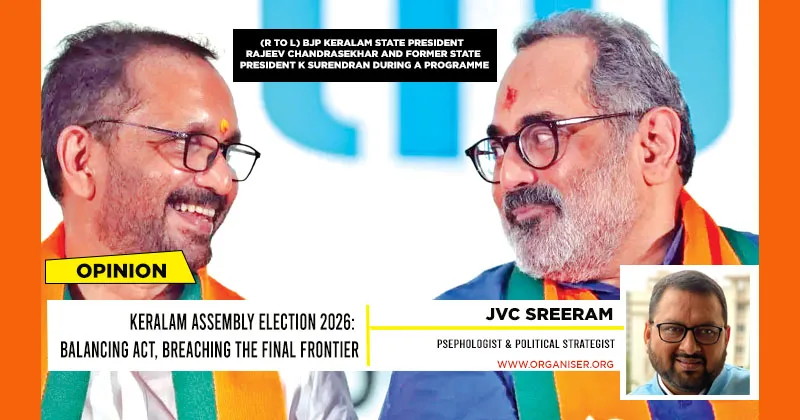
Keralam goes to election before Tamil Nadu. After failing to win from Thiruvananthapuram Lok Sabha seat, Rajeev Chandrasekhar was appointed as the President of the State unit of BJP. His tenure in the last one year has been marked with reasonable achievements. He gained acceptance amongst the local leaders. He built a team which was his first major task. He was seen as more of a soft Hindutva man who started to gain credibility amongst sections of Christians.
Issues shaping the elections
- Sabarimala Dilemma: Sabarimala continues to remain a sensitive and politically significant issue in Kerala—whether it is the debate over women’s entry or incidents like theft of temple assets. It remains a difficult challenge for the LDF and has worked against it electorally, contributing to setbacks in the last Parliament and local body elections
- Rising Anti-Incumbency: After two consecutive terms in power, the government faces visible fatigue among voters, with growing dissatisfaction over governance, unemployment, and cost of living.
- Health Sector Crisis: Repeated incidents of alleged medical negligence, sh Pala ortage of essential medicines, and systemic gaps in public healthcare have raised concerns about administrative oversight. The amputation of a 9-year-old’s hand in Palakkad, surgical scissors left in Harsheena’s abdomen for five years, and patients dying in locked emergency centers add to it.
- Education Policy Backlash: Policy decisions in the education sector, including curriculum changes and institutional management issues, have triggered criticism from multiple stakeholders.
- Corruption Cloud: A series of allegations—from cooperative bank frauds to financial controversies involving government-linked entities—have dented the credibility of the ruling dispensation. Alleged improper financial transactions between Chief Minister Pinarayi Vijayan’s daughter, Veena Vijayan, her company, and the mining firm CMRL have further put the LDF under scrutiny.
- State vs National Narrative: The election is shaping into a contest between state-level governance issues and national narratives centred on development, central schemes, and leadership.
- Minority Appeasement Debate (Reservation, Hijab, Creamy Layer, Samastha Links) : Controversies around reservation policies in IAS/KPSC coaching centres, Communist government’s hijab directive in certain institutions, allegations of benefits bypassing the “creamy layer” principle, and the Chief Minister’s proximity to Samastha leaders have fuelled a broader debate on whether policy decisions are being influenced by vote-bank considerations.
Rajeev Chandrasekhar’s biggest success was the victory at Thiruvananthapuram Municipal Corporation and that enabled the BJP Mayor to capture the South West corner of the nation. There were also marked improvements in winning wards in various districts.
Muslim Appeasement Politics: LDF–UDF’s Vote-Bank Game
It is important to note that while the UDF is attempting to consolidate minority votes in its bid to return to power, the LDF is seen as pursuing a parallel strategy aimed at reshaping traditional religious alignments—particularly within the Muslim community.
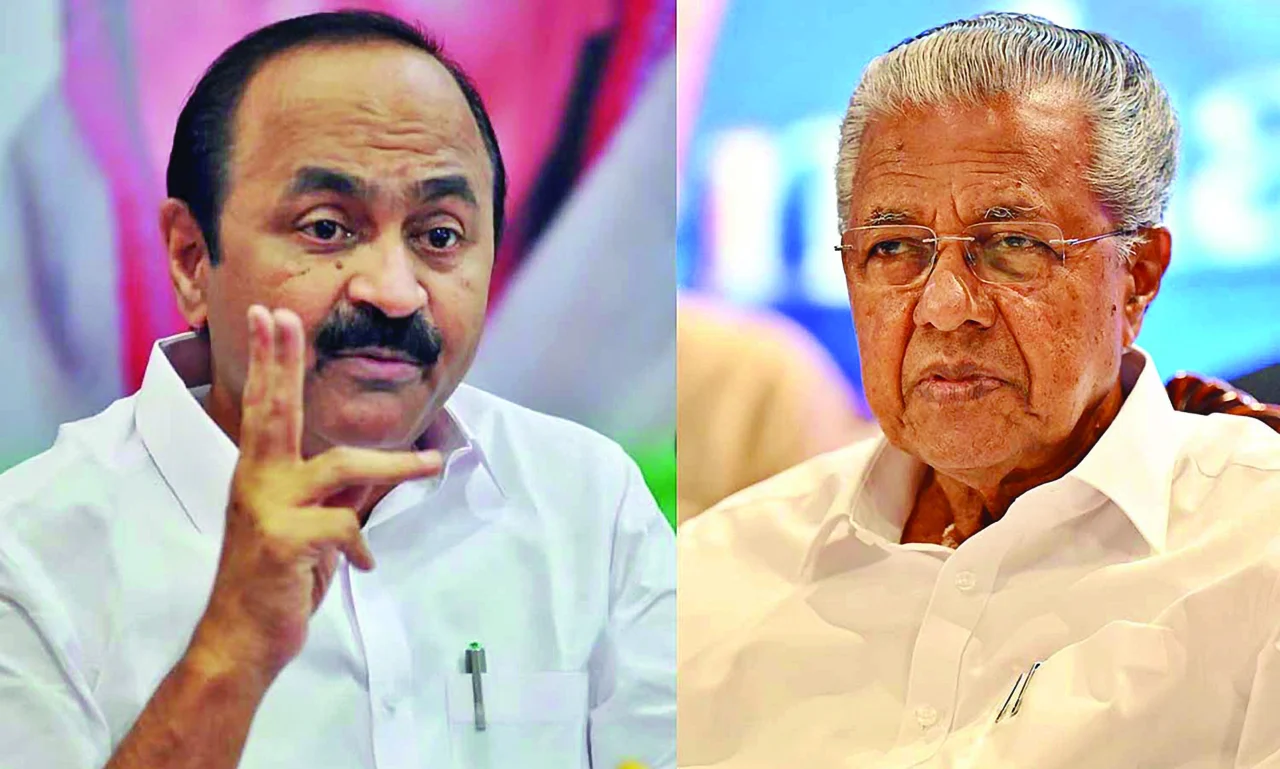
Leader of Opposition V.D. Satheesan has publicly defended the UDF’s understanding with Jamaat-e-Islami, arguing that the organisation has moved away from its earlier hardline positions. The Congress has also maintained that Jamaat-e-Islami no longer advocates its original idea of a theocratic state.
However, concerns persist. Statements and writings by leaders such as Jamaat-e-Islami’s Dr. Koottil Mohammedali, which criticise nationalism, democracy, and secularism while placing Islamic principles at the centre, have raised questions among sections of the UDF’s secular support base.
The Congress’s engagement with such groups has already triggered unease among certain voter segments, including sections of the Christian community. Adding to this is the lingering shadow of the ‘fifth minister’ controversy. There are also indications that, in the event of a UDF victory, IUML leader P.K. Kunhalikutty could emerge as Deputy Chief Minister—further intensifying political debate.
Recent developments suggest that the Welfare Party of India, the political arm of Jamaat-e-Islami Hind, has decided not to contest the Kerala Assembly elections, but is expected to extend support to the Congress-led UDF.
At the same time, the CPI(M)-led LDF appears to be adopting a tactical approach to weaken the Indian Union Muslim League (IUML) from within. In Mankada, a Muslim-majority constituency, the LDF withdrew its official candidate to back IUML rebel Kunnath Mohammed—an indication of evolving electoral strategies.
Meanwhile, in Kasaragod’s Manjeshwaram constituency, a high-stakes contest is unfolding. With BJP candidate K. Surendran in the fray, the SDPI has withdrawn its candidate as part of a strategic understanding aligned with the UDF to prevent a split in anti-BJP votes. This is to prevent ragmentation of minority votes to defeat BJP leader Surendran.
Manjeshwaram remains a tightly contested seat. Surendran had lost by just 745 votes in 2021 and a mere 89 votes in 2016—figures that underline how even minor shifts in vote consolidation could determine the outcome.
The challenge now is in facing the forthcoming Assembly elections where the expectations of the party are pretty high. In 2021, BJP failed to win even a single Assembly seat. The reason for the same was the collusion between LDF & UDF by coming together and sabotaging the chances of the BJP. The victory in the December local body elections has boosted the local cadres and they are betting big in increasing the vote share and also in converting votes into seats. Rajeev Chandrasekar had been able to convince the Twenty20 party to join the NDA. This move has helped in gaining more Christian votes in Ernakulam district where the party is emerging into a decent enough unit after having won certain crucial wards in the local body elections.
Keralam BJP has suffered with an untouchability tag amongst the minority voters whose support is crucial to convert votes into seats. Expanding the NDA was the biggest obstacle faced by the local BJP unit for decades and Rajeev has successfully overcome that obstacle with this single move.
LDF is suffering from a huge anti-incumbency factor and a faction-ridden UDF is unable to fully consolidate that into anger and win the elections in a huge manner. The anti-incumbency votes are being divided between UDF and NDA; thereby helping LDF to put up a decent performance. Most things indicate that the gap between UDF & LDF would be around two to four per cent, which is very small and this indicates that even if UDF manages to win it may be like 2011 when UDF just went past the magic number of 71 seats by just 1 seat.
In such a tight election, the adjustment politics between UDF & LDF to deny BJP winning chances could actually result in a fractured and hung Assembly. Hence we are expecting NDA to up the ante and start converting votes into seats.
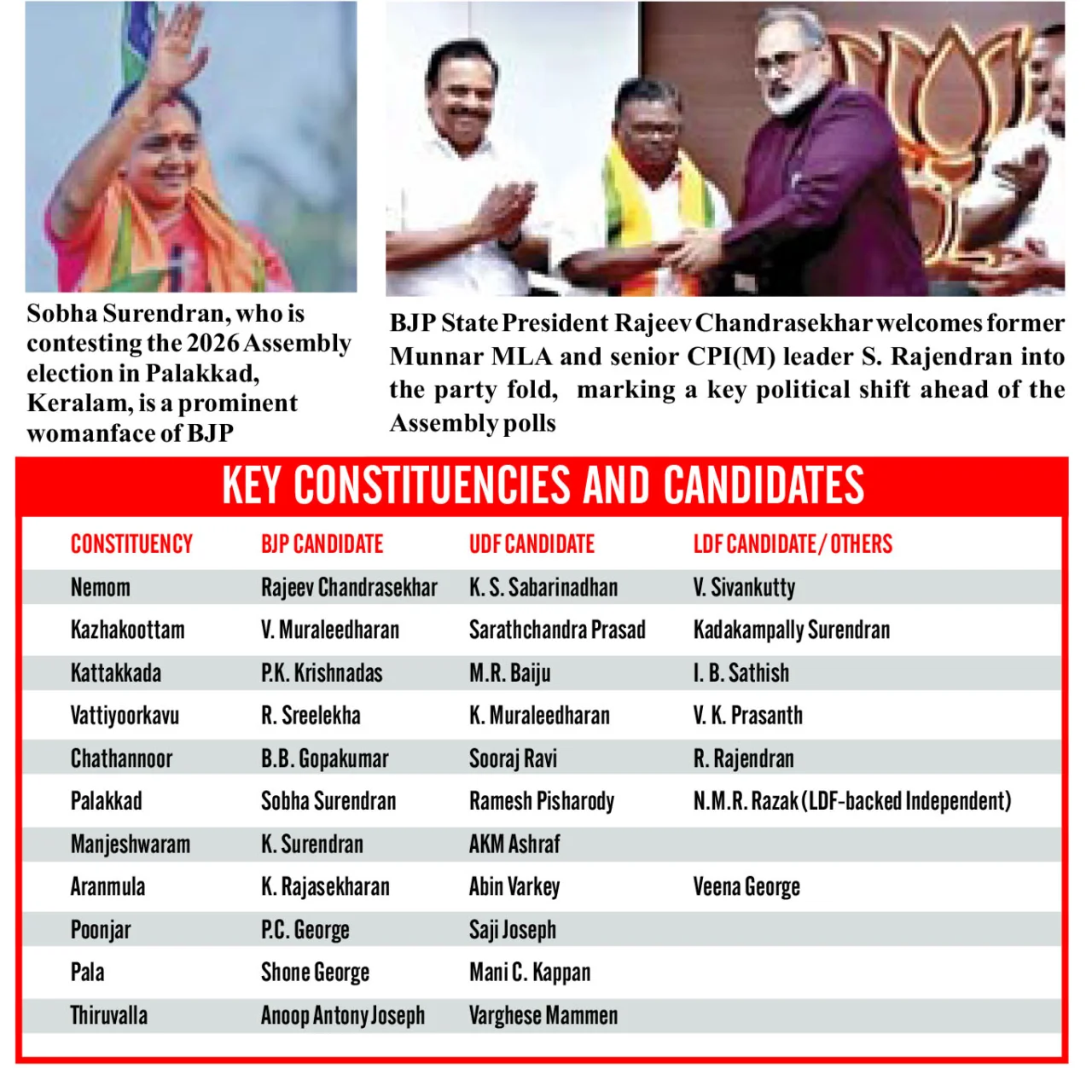
In the Northern Keralam, IUML is the force multiplier in UDF and they actually ensured that at seats like Manjeshwar the BJP had lost by margin as little as 87 votes in 2016 and 855 votes in 2021. This time BJP can be expected to romp home in this highly polarised seat.
In Central Keralam, BJP is expected to see a surge in vote share at Palakkad and Thrissur districts. Candidate selection has also been excellent with Padmaja Venugopal expected to put up a tough fight at Thrissur City and Shoba Surendran is expected to put up a good fight at Palakkad constituency. One should not be surprised if TTP wins at least 1 seat from Ernakulam district. Traditionally, it is the Ernakulam district which has been tough to penetrate for BJP. If NDA can pocket at least 1 seat particularly if they are able to win the reserved seat of Kunnathunad that would send shock waves in both the UDF & LDF camps.Southern Keralam had embraced BJP with both arms in the past. The party would be bolstered with its recent success in the local body elections and the party is expected to win 1 to 2 seats from the Thiruvananthapuram district.
Overall, we expect the NDA to score around 18 per cent, which would be a big gain from the 12 per cent that they scored in 2021. In a very conservative estimate, NDA is expected to win from 2 to 5 seats. The gain in seats is expected to come from all the three regions which would make BJP a pan-Keralam party gaining acceptance from various social groups including Christian minority groups.
Gains in Tamil Nadu
While BJP leads the NDA in Keralam, it is a minor partner in Tamil Nadu where the AIADMK is the main driver. Having completed the seat sharing formalities, BJP is contesting in 27 seats. The Lotus symbol is going to be used by the TMC party taking its tally to 32 seats which marks a significant jump of 12 seats. The party is expected to increase its MLA’s from 4 seats to double digits MLA’s which could be a morale booster for the party.
Gains are expected at Kongu or Western region and in the Southern region. These are the areas where the party performed well in the 2024 Lok Sabha polls.The main theme and narrative around the Assembly elections are going to revolve around the farmers’ anger since the policies of the DMK Government has brought only exasperation amongst the agrarian community. Some of the promises that the AIADMK made in its manifesto include procuring paddy at Rs 3,500 per quintal, sugarcane gets fair & remunerative price of Rs 4,500 per tonne, small & marginal farmers to get Rs 15,000 per year for purchase of seeds & fertilizers, waiver of farm loans at cooperative banks. If the AIADMK Government was to be elected then the Government would bear three per cent of the crop insurance premium with farmers only having to bear just two per cent of the same. These have been some of the demands from the farmers which have been accommodated in their promises. Apart from these, the manifesto as usual promises a refrigerator for Rice Ration card holders, one time mercy payment of Rs ten thousand per family, Rupees two thousand per month for women.
Cutting DMK Votes
The election is going to be a close one with actor Vijay cutting deep into the core DMK votes in the urban areas and NDA performing well in the rural areas. Historically, DMK had never returned to power ever since 1971 after having served as an incumbent. As the dust settles one needs to see if DMK can buck that trend or history repeats itself.