BHUBANESWAR: The Odisha government has approved a comprehensive new excise policy introducing stricter regulations on liquor sales, public health measures, and enhanced monitoring mechanisms. The policy, set to take effect on April 1, 2026, will remain in force for three years, until March 31, 2029, marking a shift from the earlier annual framework.
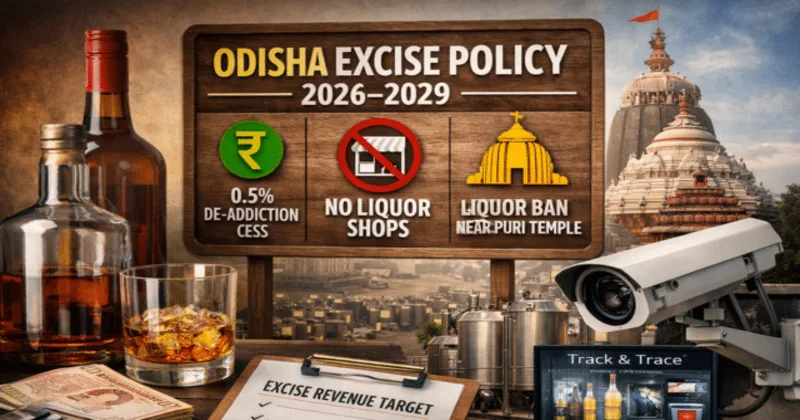
One of the most notable features of the policy is the imposition of a 5 per cent de-addiction cess on excise duty. Officials said the move is aimed at discouraging alcohol consumption and formally recognising liquor as a “sin good.” Revenue generated from this cess will be directed toward establishing and strengthening model de-addiction centres across the state, reinforcing the government’s focus on public health.
In a significant cultural and religious measure, the government has announced a complete ban on liquor shops in the vicinity of the Puri Jagannath Temple and along the 3-km Grand Road (Badadanda) in Puri. The decision covers all types of outlets, including ON, OFF, and country liquor shops. Officials stated that the move responds to long-standing public demands and aims to preserve the sanctity of one of Hinduism’s most revered pilgrimage sites. The Grand Road holds particular importance during the annual Rath Yatra, when deities are ceremonially taken to the Gundicha Temple.
The policy also introduces tighter restrictions on the expansion of liquor outlets. No new OFF shops, country liquor (CL) shops, or out still (OS) units will be permitted across the state. Additionally, the opening of new ON shops in rural areas has been prohibited, with limited exceptions for 3-star and above hotels and clubs located within industrial townships. Home delivery of liquor has also been banned under the revised framework.
Excise Secretary Bhaskar Jyoti Sharma said the transition to a three-year policy cycle is intended to bring stability and predictability to the sector while allowing flexibility for mid-term adjustments. “The triennial structure will help balance revenue generation with regulatory discipline and social responsibility,” he noted.
To strengthen revenue assurance and reduce sales-driven pressure on retailers, the government has replaced the Minimum Guaranteed Quantity (MGQ) system with a Minimum Guaranteed Excise Revenue (MGER) model. This shift is expected to curb the practice of forced or informal liquor sales, commonly referred to as “kuchia” sales, while safeguarding government earnings.
Financial provisions under the policy include a 10 per cent increase in excise licence application fees and a phased annual increase of 10–20% in licence fees. Excise duties on Indian Made Foreign Liquor (IMFL) and country liquor have also been revised upward. Odisha currently generates approximately Rs 12,000 crore annually from excise revenue, making it a significant contributor to the state’s finances.
The policy places a strong emphasis on transparency and on technology-driven enforcement. A comprehensive “track and trace” system will be introduced to monitor the movement of Extra Neutral Alcohol (ENA) from distilleries to bottling plants and enable bottle-level tracking up to the point of retail sale. This system will be integrated with digital platforms to streamline compliance and oversight.
Further, all manufacturing units and retail outlets will be brought under CCTV surveillance, with live feeds connected to the offices of the Excise Commissioner and district authorities. The government also plans to upgrade excise chemical laboratories with modern equipment and trained personnel to enhance testing capabilities and ensure product quality.