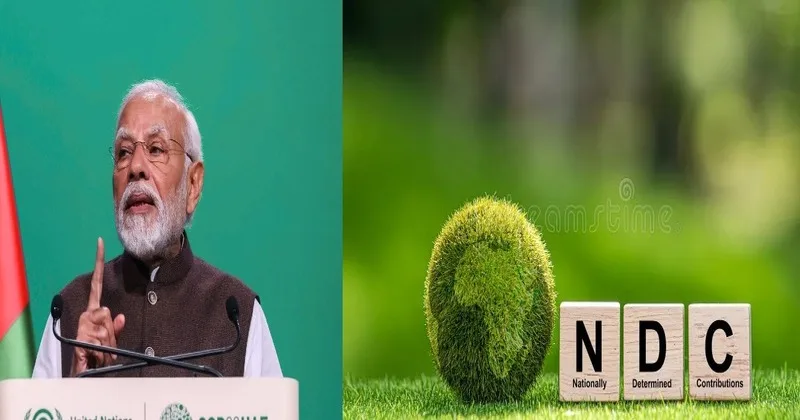
In the path to mitigate the adverse impact of escalating global warming and to contain climate catastrophes, the Union Cabinet under the chairmanship of Prime Minister Narendra Modi has upgraded the Nationally Determined Goals(NDCs) as per the Paris Agreement under the United Nations Framework Convention on Climate Change(UNFCCC). With the latest set of goals, India enhances its commitment for climate action in the path to carve a greener and healthier planet.
The latest set of Nationally Determined Goals(NDCs) will operate from 2031 to 2035. The NDCs will give further momentum to India’s actions towards sustainable development and climate justice. The NDCs align with the Viksit Bharat vision of the Government of India, said the Union Cabinet. Thus, the latest climate action agenda as per the UNFCCC protocols helps to carve a climate resilient Bharat for the future generations. The Union Cabinet further noted that the previous NDCs have been achieved ahead of the scheduled time limit. This shows India’s consistent efforts towards building a healthy Bharat and healthy planet.
The qualitative commitments of India towards climate action
India’s climate goals are embedded with the principles of bringing sustainability into everyday life and governance systems, promote climate-resilient developmental pathways and enable a just and inclusive transition for all sections of the society without compromising the developmental goals. As per the latest upgradation to the NDCs,
- India aims to reduce emissions intensity upto 47 per cent of its GDP by 2035 compared to 2005 levels
- India aims to achieve 60 per cent of installed capacity of cumulative electric power from non-fossil fuel energy sources by 2035
- India aims to create a carbon sink of 3.5 to 4 billion tonnes. This carbon sequestration is aimed to be achieved by enhancing forest and tree cover by 2035 compared to the 2005 levels.
- To build and promote climate-resilient infrastructure specifically in vulnerable sectors such as agriculture, water, health etc.
- Promoting LiFE-Lifestyle for Environment through people-driven mass movements thus accelerating behavioural change to adopt sustainable lifestyle
- Capacity building and innovation in climate governance, thus advancing cutting-edge climate technologies, innovation ecosystems and global collaboration
- Espousing an integrated climate action framework with a whole-of-government approach
As mentioned, India’s climate commitments are an integral part of the Viksit Bharat vision. Thus, the dream of a developed India will be incomplete without achieving a climate resilient, sustainable and greener earth.
Approaches to achieve NDCs
India also has a roadmap to achieve these Nationally Determined Contributions(NDCs) without compromising on the developmental priorities. For example, India has a people-centric approach. Under the Lifestyle for Environment(LiFE) initiative people are encouraged to adopt sustainable and simple lifestyle practices that helps in the long-run. The aim is to bring a behavioural change among the masses, thus aid them to acknowledge climate resilient lifestyle.
Similarly, to fulfill the latest NDCs, the government has considered the outcomes of the first Global Stocktake under the Paris Agreement. Accordingly, the collective effort of all the nations towards reducing greenhouse gases and climate action is considered. Additionally, India also accelerates climate action by accounting the Common but Differentiated Responsibilities-Respective Capabilities(CBDR-RC). Thus, as a developing country and an emerging economy India aims to fulfill the climate goals without compromising its developmental priorities, national realities, energy security etc. India seeks to gain a balanced approach between green commitments and economic agenda.
India achieves climate targets ahead of time
Analysing the track record of India with respect to fulfilling the Nationally Determined Contributions (NDCs) illustrates that India is always ahead of time in reaching the climate goals. For example, in the NDCs submitted in 2015 India mentioned that it will reduce GHG emissions intensity by 33 to 35 per cent of the GDP by 2030. It was also stated that installed capacity of non-fossil fuel sources of electric power will be 40 per cent by 2030. Both of these targets were met ahead of the time limit, thus representing a credible and swift action oriented climate governance prevailing in India.
As per the latest NDCs, the emission intensity has to be reduced by 47 per cent of GDP by 2035 and non-fossil fuel sources also have to be spiked. In this direction, India’s current share of non-fossil fuel sources of energy is 52. 57 per cent. Thus, India has successfully met the target five years ahead of the timeline. Now, the latest goal is to extract 60 per cent of energy requirements or installed electric power capacity from the non-fossil fuel sources by 2035. Apart from reducing the Greenhouse Gases emission, India’s afforestation and ecosystem restoration efforts are also continuous. India has created a carbon sink equivalent to 2.29 billion tonnes of Carbon Dioxide. As per the upgraded NDCs India aims to create a carbon sink of 4 billion by 2035 compared to 2005 levels.
India, thus with strong leadership, visionary climate policies and unhindered actions is marching in the path of crafting a climate-resilient nation without compromising the other developmental goals and economic priorities. The climate action journey towards the goals set for 2035 adds greater momentum to the green goals of India and acts as a catalyst to craft a net-zero Bharat by 2070, which is the apex goal. In an era, where climate catastrophes are spiking at an uncontrollable rate and world nations are hanged to irresponsible anti-ecosystem actions, India’s climate governance and commitments set a global example regarding how responsible actions nations should take to nourish a greener earth and healthier life for its people.