In 2010, following the devastating Dantewada attack that killed 76 CRPF personnel, then Prime Minister Manmohan Singh described the Naxalite-Maoist movement as “the single biggest internal security threat” facing India.
Sixteen years later, the landscape has dramatically transformed. What once spread across a vast swathe of India’s mineral-rich hinterland has now shrunk to a handful of districts. The so-called “Red Corridor,” which once symbolised the reach of Left Wing Extremism (LWE), is today a shadow of its former self.
The transformation did not happen overnight. It is the result of sustained counter-insurgency operations, improved intelligence coordination, infrastructure development, and a parallel focus on governance in remote tribal regions.
HM Amit Shah’s Deadline
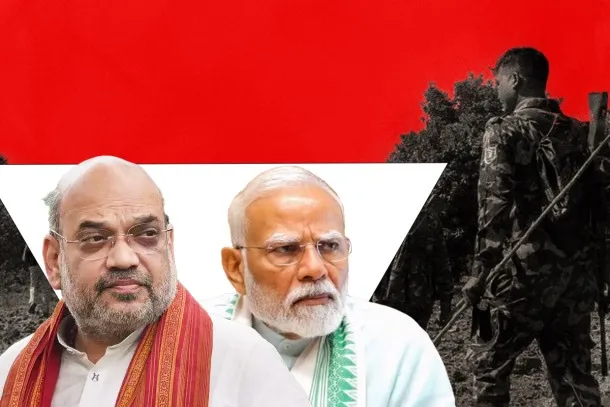
In 2024, Amit Shah set an ambitious deadline: complete eradication of armed Naxalism by March 31, 2026. The declaration was both a political commitment and a reflection of growing confidence within India’s security establishment.
As the deadline nears, the question is no longer whether Naxalism can be defeated, but whether it can be eliminated within a fixed timeframe.
Government data suggests significant progress. According to official figures, 2025 alone saw 317 Naxals neutralised, over 800 arrested, and nearly 2,000 surrendering. Between 2023 and 2025, more than 3,500 insurgents laid down arms.
These numbers point to an organisation under immense pressure, militarily, structurally, and ideologically.
From Naxalbari to the Red Corridor
The Naxalite movement traces its roots to Naxalbari, where a peasant uprising in 1967 sparked a radical left-wing insurgency. Over decades, the movement spread across multiple states, forming what came to be known as the Red Corridor.
Far from being the “revolutionary messiahs” they often projected themselves as, Maoist insurgents entrenched their influence through a calculated mix of fear, coercion, and exploitation in some of India’s most vulnerable and remote regions. Operating deep within mineral-rich forest belts, they systematically terrorised local populations, extorted money from contractors, looted public resources, and imposed illegal levies on villagers struggling for survival.
Under the guise of championing tribal rights and resisting state neglect, these groups built a parallel regime, complete with kangaroo courts, armed enforcement units, and shadow taxation systems, that directly challenged the sovereignty of the Indian state. Villagers were often forced to provide shelter, food, and even recruits, with dissent brutally crushed through public executions and intimidation.
They capitalised on genuine grievances, land alienation, displacement, and lack of development but instead of resolving them, entrenched cycles of violence that kept these regions underdeveloped and isolated. Infrastructure projects, schools, roads, and communication networks were frequently targeted and destroyed, ensuring that governance and progress remained absent.
Security forces, elected representatives, and civilians alike became targets of deadly ambushes, landmine blasts, and assassinations. The objective was clear: to destabilise democratic institutions and eventually seize control over resource-rich territories, effectively carving out zones of insurgent dominance.
In reality, rather than liberators, Maoist groups functioned as armed power centres, holding local populations hostage to an ideology sustained by violence, fear, and economic exploitation.
At its peak, Left Wing Extremism affected nearly 180 districts across states such as Chhattisgarh, Odisha, Maharashtra, and Telangana.
One of the most decisive blows to the Maoist movement in recent years has been the systematic targeting of its leadership.
In May 2025, top Maoist leader Nambala Keshava Rao, also known as Basavaraju, was killed in an encounter in Abujhmad, a long-time Maoist stronghold in Chhattisgarh.
Later in November 2025, Madvi Hidma, the mastermind of the Dantewada attack was eliminated. These operations struck at the core of the Communist Party of India (Maoist)’s command structure.
Further encounters in early 2026 led to the killing of several key leaders, including Prabhakar Rao and others, significantly weakening operational coordination.
Parallel to these eliminations has been a surge in surrenders. Senior leaders like Mallojula Venugopal Rao alias Sonu and Malla Raji Reddy laid down arms, signalling a loss of faith within the movement’s top ranks.
The cumulative effect has been the near collapse of the Maoist leadership hierarchy, leaving only a few active members in the Central Committee and Politburo.
Sharp decline in affected districts
Perhaps the most telling indicator of the decline of Left Wing Extremism is the shrinking geographical footprint.
In the early 2000s, over 180 districts were affected. By 2014, this number had dropped to 126. A decade of sustained operations further reduced it to just 18.
By 2025, only 11 districts were officially classified as LWE-affected. As of early 2026, the number has fallen further to just seven districts.
These include regions in Chhattisgarh such as Bijapur, Sukma, Dantewada, Narayanpur, and Kanker, along with West Singhbhum in Jharkhand and Kandhamal in Odisha.
This dramatic reduction reflects not only military success but also improved governance and development outreach in previously neglected areas.
Beyond territorial control, the Maoist movement is also facing a severe manpower crisis.
Reports suggest that the number of armed cadres has dropped from over 2,000 in 2024 to just around 220 in 2026. In states like Odisha, the number of active cadres has reportedly fallen to as low as 15.
Such figures indicate a movement struggling to sustain itself. Recruitment has slowed, morale has declined, and logistical networks have weakened.
Statements from surrendered leaders further underscore this shift. Many have acknowledged that the conditions that once sustained armed struggle no longer exist.
Some have even indicated that top leaders themselves were considering abandoning violence in favour of dialogue, recognising the changing ground realities.
Development push: The other half of the strategy
While security operations have played a critical role, the decline of Naxalism cannot be understood without examining the government’s development initiatives.
Road construction, mobile connectivity, banking access, and welfare schemes have significantly improved the quality of life in previously isolated regions. The integration of tribal areas into mainstream governance has reduced the appeal of insurgent ideology.
The government’s dual strategy, “security and development” has been central to weakening the Maoist narrative.
As roads reached remote villages and administrative presence increased, the space for parallel Maoist governance shrank.
Despite the remarkable progress, reports caution against declaring total victory prematurely.
Residual pockets of Maoist activity continue to exist in dense forest areas, particularly in Bastar. The terrain remains challenging, and small groups of insurgents can still carry out sporadic attacks.
Moreover, the ideological roots of the movement, issues related to land, inequality, and tribal rights, have not entirely disappeared. If left unaddressed, these could potentially give rise to new forms of unrest.
Another challenge lies in ensuring that surrendered cadres are successfully rehabilitated and reintegrated into society. Without proper support, there is always a risk of relapse.
Is the March 31 deadline achievable?
As the March 31, 2026 deadline approaches, it appears unlikely that Naxalism will be completely eradicated in absolute terms. However, the larger goal, dismantling it as a significant internal security threat has largely been achieved.
What remains is a residual challenge, confined to a few districts and limited in scale. The days when Maoists could mount large-scale coordinated attacks or control vast territories appear to be over.
In that sense, the deadline may be less about literal eradication and more about marking the end of Naxalism as a major national security concern.
India’s fight against Naxalism has been long, complex, and often costly. From the violent peaks of the early 2000s to the near-collapse of the movement today, the journey reflects a combination of military resolve and developmental outreach.
As Amit Shah’s deadline draws near, the country stands at a deciding moment. While complete eradication may still require time, there is little doubt that the Maoist insurgency is on its last legs.
Whether this marks the definitive end of “Red Terror” or a transition into a low-intensity challenge will depend on how effectively India consolidates its gains in the years ahead.