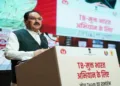
In a major development from Chhattisgarh, Deputy Chief Minister and Home Minister Vijay Sharma has asserted that the state is now completely free from “armed Naxalism,” marking what he described as a historic turning point in India’s long battle against Left-Wing Extremism.
Speaking in an exclusive interview to News18, Sharma said that sustained efforts over the past two years have dismantled the operational capabilities of Maoist insurgents in the state. Calling it the “last chapter of Naxalism,” he emphasised that the achievement was the result of coordinated action between political leadership, intelligence agencies, and security forces.
‘A Collective Mission’
Sharma highlighted that the success was not sudden but the outcome of a carefully executed roadmap. Referring to Union Home Minister Amit Shah’s 2024 announcement on intensifying anti-Naxal operations, he said:
“It feels like a mission that we all collectively fought. Today, I can proudly say my state is 100% free from armed Naxalism after two years.”
He lauded the role of paramilitary forces and local police, highlighting their sacrifices in reclaiming territories once dominated by insurgents.
Explaining why previous efforts had not yielded similar results, Sharma pointed to a decisive shift in strategy under the current administration. According to him, enhanced intelligence gathering and targeted operations played a critical role.
He noted that identifying high-risk zones through precise intelligence inputs enabled focused action, while the surrender of senior Maoist leaders significantly weakened the insurgent network.
“The turning point was when top leaders surrendered, creating a domino effect,” Sharma said, indicating that this encouraged lower-rung cadres to abandon violence.
Bastar Transformed: From conflict zone to hope
Highlighting the transformation in Bastar, once considered the epicentre of Maoist activity, Sharma said residents can now live without fear.
He emphasised that areas previously inaccessible, even during daytime, are witnessing a gradual return to normalcy, with governance and development initiatives reaching the grassroots.
In a politically charged remark, Sharma criticised previous Congress governments, alleging that the absence of decisive leadership prolonged the insurgency.
“The system and officials were always there. What changed was the government’s willpower,” he said.
He credited the current administration’s resolve, asserting that strong political intent can tackle even the most entrenched security challenges, drawing parallels with issues like terrorism and constitutional changes.
Warning on ‘Urban Naxalism’
Despite declaring an end to armed insurgency, Sharma cautioned against the persistence of extremist ideology in urban spaces.
He alleged that so-called “urban Naxals” had historically influenced and misled tribal populations into joining violent movements, while remaining distant from the ground realities.
“They sit in cities but pushed innocent villagers into violence,” he said, adding that democratic processes would ultimately counter such ideologies.
Looking ahead, Sharma outlined an ambitious vision for rapid development in former Naxal-affected areas, particularly along the Indravati River belt.
He promised that regions once synonymous with fear would soon become hubs of normal civilian life and economic activity.
“A time will come when people will peacefully sit and have tea on the banks of Indravati—something unimaginable earlier,” he said.