Beyond Politics: The deep roots of Shri Ram in Bengali life
July 17, 2026
  • Read Ecopy
  • Circulation
  • Advertise
  • Careers
  • About Us
  • Contact Us
Android AppiPhone AppArattai
Organiser
  • ‌
  • Bharat
    • Assam
    • Bihar
    • Chhattisgarh
    • Jharkhand
    • Maharashtra
    • View All States
  • World
    • Asia
    • Europe
    • North America
    • South America
    • Africa
    • Australia
  • Editorial
  • International
  • Opinion
  • RSS @ 100
  • More
    • Op Sindoor
    • Analysis
    • Sports
    • Defence
    • Politics
    • Business
    • Economy
    • Culture
    • Special Report
    • Sci & Tech
    • Entertainment
    • G20
    • Azadi Ka Amrit Mahotsav
    • Vocal4Local
    • Web Stories
    • Education
    • Employment
    • Books
    • Interviews
    • Travel
    • Law
    • Health
    • Obituary
  • Subscribe
    • Subscribe Print Edition
    • Subscribe Ecopy
    • Read Ecopy
  • ‌
  • Bharat
    • Assam
    • Bihar
    • Chhattisgarh
    • Jharkhand
    • Maharashtra
    • View All States
  • World
    • Asia
    • Europe
    • North America
    • South America
    • Africa
    • Australia
  • Editorial
  • International
  • Opinion
  • RSS @ 100
  • More
    • Op Sindoor
    • Analysis
    • Sports
    • Defence
    • Politics
    • Business
    • Economy
    • Culture
    • Special Report
    • Sci & Tech
    • Entertainment
    • G20
    • Azadi Ka Amrit Mahotsav
    • Vocal4Local
    • Web Stories
    • Education
    • Employment
    • Books
    • Interviews
    • Travel
    • Law
    • Health
    • Obituary
  • Subscribe
    • Subscribe Print Edition
    • Subscribe Ecopy
    • Read Ecopy
Organiser
  • Home
  • Bharat
  • World
  • Operation Sindoor
  • Editorial
  • Analysis
  • Opinion
  • Culture
  • Defence
  • International Edition
  • RSS @ 100
  • Magazine
  • Read Ecopy
Home Bharat

Beyond Politics: The deep roots of Shri Ram in Bengali life

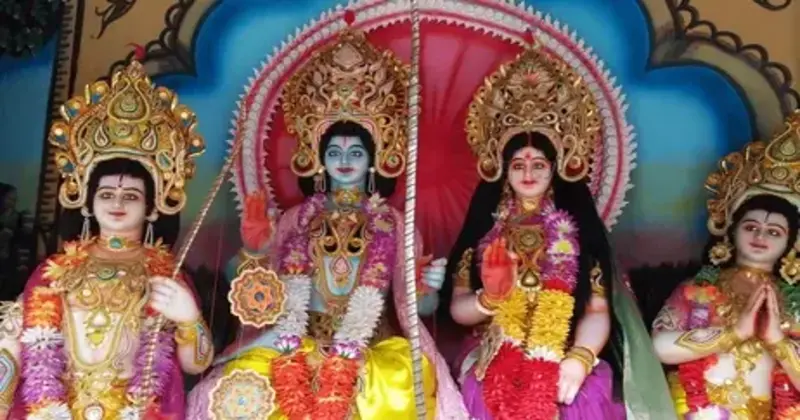
It can be firmly stated that Rama as Purushottam shares a deep and inseparable bond with West Bengal and Bengali culture. This connection, expressed through literature, rituals, architecture and everyday life, remains enduring and undeniable

Diganta ChakrabortyDiganta Chakraborty
Mar 22, 2026, 08:30 pm IST
in Bharat, Analysis, Opinion, Culture, West Bengal
Follow on Google News
FacebookTwitterWhatsAppTelegramEmail

In West Bengal, if you say ‘Jai Shri Ram,’ you are often labelled as a BJP supporter or a communal person. However, if you are a Hindu and attend an Iftar, or eat beef, you are praised as truly secular. Though ironic, this reflects the current situation in Bengal. Apparently, for the ruling party in West Bengal, Rama is an “invader”, while Babur seems more like the friendly uncle next door. No wonder they were almost heartbroken when the Ram Mandir was reinstated. And during every Ram Navami, they try to push the narrative that Ram is an invader and has nothing to do with Bengalis. But the actual truth is that Bengali culture and literature have a strong connection with Shri Ram.

For Swami Vivekananda, a global icon from Bengal, Shri Ram was not merely a mythological figure but the very embodiment of ideals and justice. He described Ram as “the ancient idol of the heroic ages—the embodiment of truth and morality, the ideal son, the ideal husband, the ideal father, and above all, the ideal king”. For such an eminent thinker, the Ramayana served as a profound source of inspiration.

On January 31, 1900, during a lecture on the Ramayana, delivered at the Shakespeare Club, Pasadena, California, Vivekananda referred to the construction of Ram Setu. He narrated how, after learning about Sita from Hanuman, Ram marched southward with his army, where the vanara sena built the bridge—Setubandha—connecting India to Ceylon. He even remarked that in shallow waters, traces of this connection could still be perceived. (Ref: Vivekananda, Swami. “The Ramayana.” Address delivered at the Shakespeare Club, Pasadena, California, January 31, 1900. In The Complete Works of Swami Vivekananda. Vol. 4.)

In the pre-independence era, when Bharat was under British rule and its people were grappling with a loss of self-confidence, Vivekananda invoked the legacy of great spiritual figures to awaken national consciousness. He urged people to revere icons such as Shri Ramachandra, Sri Krishna, Mahavira and Ramakrishna Paramahamsa. Through such calls, he sought to instil self-respect and inspire the youth to rise for the nation. He believed that centuries of subjugation had weakened the Indian spirit and therefore emphasized the need to revive courage, strength and devotion—particularly through the worship of Ram and the cultivation of Shakti.

It is also well known that from his childhood, Vivekananda had a deep fondness for listening to Ramayana songs. He once stated that “Rama and Sita are the ideals of the Indian nation”, underscoring their enduring cultural and moral significance. In his words, “Where there is Rama, there is no Kama; where there is Kama, there Rama is not; just as night and day cannot coexist”. Once again, the deep imprint of the Ramayana in Bengali cultural consciousness is evident in the personal writings of Subhas Chandra Bose, long before he came to be revered as Netaji.

Around 1912–1913, in a letter to his mother, the young Subhash reflected on the beauty of India’s landscape and its spiritual resonance. Describing the serene flow of the Godavari, he was reminded of the Ramayana, vividly imagining Rama, Lakshmana, and Sita living in quiet contentment along its banks—having renounced royal comforts, yet immersed in a higher joy beyond worldly suffering. Through this intimate reflection, Bose not only reveals his personal engagement with the epic but also underscores how naturally the narrative of Rama was woven into the emotional and cultural fabric of Bengali thought. (Translated by the author from the original Bengali letter)

This deep-rooted connection becomes even clearer when we look closer at Bengal’s cultural life. Rabindranath Tagore frequently invoked Sri Ramachandra and episodes from the Ramayana, reflecting how deeply he admired Rama’s ideals and character. This connection is not limited to literature alone but is also embedded in Bengal’s religious practices. It is widely believed that Sri Ramachandra was the first to perform the Akaal Bodhan of Maa Durga during autumn, whereas earlier the worship was primarily conducted in spring. This tradition continues even today, with Durga Puja in autumn becoming one of the grandest and most defining festivals of Bengali identity.

The imprint of Shri Ram is also visible across the geography of Bengal. Numerous places in West Bengal bear his name; such as Srirampur, Ramrajatala and Rampurhat; reflecting his enduring cultural presence. Beyond places, the name ‘Ram’ is deeply embedded in personal and spiritual identities. Sri Ramachandra was the family deity of Ramakrishna Paramahamsa, which is why the names within his family carried the association of Rama. Similarly, the family deity of Rani Rashmoni was Raghuvir; another form of Lord Rama as the hero of the Raghu dynasty.

Also Read: India achieves 93 per cent online LPG bookings as govt ensures smooth supply & promotes cleaner PNG transition

The legacy continues with figures like Raja Ram Mohan Roy, whose very name reflects this cultural linkage. Even in more recent spiritual traditions, this continuity persists. In the household of Premananda Maharaj (Baburam Ghosh) of Antpur, Hooghly; one of the guru brothers of Swami Vivekananda, it remains a tradition for names to begin or end with “Ram”, symbolising an unbroken thread of devotion and cultural memory. This deep-rooted connection extends even to Bengal’s temples and daily life. The terracotta temples across the region still narrate scenes from the Ramayana, preserving the legacy of Shri Ram in art and architecture. Even in village homes, sacred chants like “Hare Ram… Ram Ram…” echo his enduring presence.

For Bengalis, as for the people of India at large, Sri Ramachandra represents the ideal human being, Maryada Purushottam. His presence is not merely theological but profoundly cultural and emotional. Parents aspire for their children to embody the virtues of Rama, while the ideal of a righteous and devoted husband is often shaped around his character. From revered sages to ordinary individuals, there exists a shared sense of respect, devotion and emotional connection with Sri Ramachandra. In conclusion, it can be firmly stated that Rama as Purushottam shares a deep and inseparable bond with West Bengal and Bengali culture. This connection, expressed through literature, rituals, architecture and everyday life, remains enduring and undeniable.


Topics: West BengalCultureSwami Vivekanandasubash chandra boseGod Ram
ShareTweetSendShareSend
✮ Subscribe Organiser YouTube Channel. ✮
✮ Join Organiser's WhatsApp channel for Nationalist views beyond the news. ✮
Previous News

The Dhurandhar Strike: Unmasking the selective ‘propaganda’ outrage and the liberal hypocrisy in Bharat’s cinema

Next News

Al for Equal Change: Levelling the playing field

Related News

Train collides with school van at railway crossing, three students killed

Murshidabad Train Accident: Three students killed, several injured after train hits school van at railway crossing

Chief Minister Suvendu Adhikari

‘No one will dare repeat this’: West Bengal CM Adhikari blames political instigators for Baraipur unrest

Bharat's timeless civilisation continues to transcend borders through its enduring culture, values, and soft power

Beyond Borders: Why Bharat’s ancient civilisational legacy still influences nations across Asia and beyond

Editor of Organiser Weekly Prafulla Ketkar and West Bengal Governor R N Ravi at the Narad Jayanti Udjapan & Narad Samman 2026

Whether my reporting is in the interest of nation or not is a litmus test for journalist: West Bengal Governor R N Ravi

West Bengal: Reclaiming the legacy for reshaping the future

Reawakening of Bengal

Load More

Latest News

RSS Sanghik held at the Parvathi Kalyana Mandapam in Chandranagar

Keralam: Kanchi Shankaracharya calls for societal upliftment and cultural preservation at Sangh Sanghik

CM Dhami Announces Special Agniveer Cell, 10% Reservation in State Jobs for Retired Agniveers

Uttarakhand: CM Dhami unveils first dedicated Agniveer cell, homestay grants and job benefits for ex-servicemen

Amid rising Gulf tensions, DGMA has advised shipping firms to avoid deploying Indian seafarers through Strait of Hormuz until further orders

Strait of Hormuz Tensions: DGMA advises shipping firms to avoid deploying Indian seafarers until further orders

Female Toppers of NEET 2026 Exam

Re-NEET 2026 Result: Women lead success rate, UP records highest number of qualifiers

Prime Minister Modi addresses public gathering in Punjab

Punjab: Centre committed to the development of state despite no BJP government, says PM Modi

A glimpse of Rathyatra in Varanasi

Banaras Rath Yatra: The 200-year-old tradition that brought Bhagwan Jagannath’s chariot to Shiva’s sacred city

EU Parliament raises questions about abduction of minor girls in Pakistan

EU Parliament raises questions about abduction of minor girls, forced conversions in Pakistan & complicity of judiciary

1,668 MT mega cargo reaches Bihar via National Waterway-1, Sonowal hails Ganga logistics milestone

The Story Behind Ramayana Masam in Keralam: The 1982 movement that changed the meaning of Karkidakam forever

Madrasa sealed in Bongaigaon

Assam: Madrasa sealed in Bongaigaon after sexual exploitation of girl students by Maulavi

Load More
  • Privacy
  • Terms
  • Cookie Policy
  • Refund and Cancellation
  • Delivery and Shipping

© Bharat Prakashan (Delhi) Limited.
Tech-enabled by Ananthapuri Technologies

  • Home
  • Search Organiser
  • Bharat
    • Assam
    • Bihar
    • Chhattisgarh
    • Jharkhand
    • Maharashtra
    • View All States
  • World
    • Asia
    • Africa
    • North America
    • South America
    • Europe
    • Australia
  • Editorial
  • Operation Sindoor
  • Opinion
  • Analysis
  • Defence
  • Culture
  • Sports
  • Business
  • RSS @ 100
  • Entertainment
  • More ..
    • Sci & Tech
    • Vocal4Local
    • Special Report
    • Education
    • Employment
    • Books
    • Interviews
    • Travel
    • Health
    • Politics
    • Law
    • Economy
    • Obituary
  • Subscribe Magazine
  • Read Ecopy
  • Advertise
  • Circulation
  • Careers
  • About Us
  • Contact Us
  • Policies & Terms
    • Privacy Policy
    • Cookie Policy
    • Refund and Cancellation
    • Terms of Use

© Bharat Prakashan (Delhi) Limited.
Tech-enabled by Ananthapuri Technologies