
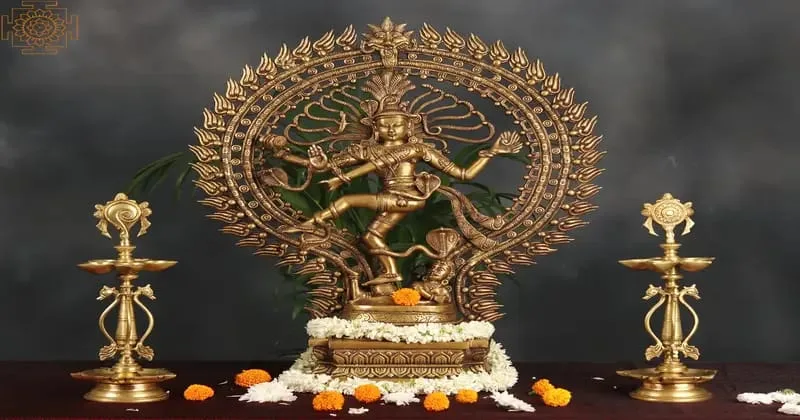
At the heart of Bharatanatyam lies the eternal image of Nataraja, the cosmic dancer, a form of Bhagwan Shiva, whose rhythmic movements symbolise the cycle of creation, preservation, and dissolution. His dance, known as the Ananda Tandava, is not merely an artistic expression but a cosmic phenomenon.
🕉️The Divine Geometry of Bharatanatyam. 🙏
The 18 hands of Nataraja are said to symbolically give rise to 81 mudras through countless permutations and combinations. Each gesture becomes a language of devotion, storytelling, and cosmic rhythm.
Bharatanatyam, one of the oldest… pic.twitter.com/iUrfwKMVys
— JIX5A (@JIX5A) March 16, 2026
Tradition speaks of the 18 hands of Nataraja giving rise to 81 mudras through infinite permutations. These gestures are not random; they are deeply structured, almost mathematical in their precision. Each mudra becomes a unit of meaning, forming a divine language through which the dancer communicates stories of gods, nature, and human emotions.
Language of Mudras
In Bharatanatyam, mudras (hand gestures) are the alphabet of expression. Rooted in the principles laid out in the Natya Shastra, these gestures transform the dancer into a storyteller.
A single hand movement can represent:
The blooming of a flower
The flow of a river
The valour of a warrior
The tenderness of love
When combined, mudras create layered narratives, almost like poetry in motion. The geometry of these gestures, their angles, symmetry, and flow, reflects an underlying order that connects the human body to universal patterns.
Bharata Muni and the Science of Performance
The origins of Bharatanatyam trace back to the sage Bharata Muni, who composed the Natya Shastra, a comprehensive guide to drama, dance, and music. This ancient text is not merely artistic, it is scientific and philosophical.
It defines:
Rasa (emotion): The essence of expression
Bhava (feeling): The emotion conveyed by the performer
Tala (rhythm): The mathematical structure of time
Anga (body movements): The physical articulation of expression
Through this framework, Bharatanatyam becomes a perfect blend of art and structure, emotion guided by discipline, devotion shaped by precision.
The Body as a Living Mandala
Every posture in Bharatanatyam is deliberate. The araimandi (half-sitting posture), the straight lines of the arms, the precise placement of the feet, all create geometric patterns in space. These patterns resemble sacred diagrams, much like mandalas, where symmetry and balance reflect cosmic harmony. The dancer becomes a moving sculpture, embodying both stillness and motion simultaneously. The geometry is not just visual; it is energetic. Each movement aligns the body with rhythm, breath, and intention, creating a meditative experience for both performer and audience.
Rhythm as the Pulse of the Universe
The rhythmic cycles in Bharatanatyam mirror the rhythms of the cosmos, the beating of the heart, the cycles of nature, and the movement of celestial bodies. Footwork (adavus) strikes the ground in intricate patterns, producing sound that resonates like a sacred chant. These rhythmic sequences are deeply mathematical, yet they evoke profound emotional responses.
Dance as Devotion: Beyond Performance
Bharatanatyam is not merely an art form; it is an offering. Traditionally performed in Mandirs, it was a medium through which dancers expressed devotion to the divine.
Each performance becomes:
A prayer, offered through movement
A story, told through expression
A connection, bridging the human and the divine
The dancer does not just perform; they surrender. In that surrender, the ego dissolves, and the dance becomes sacred.
In Bharatanatyam, the human body transforms into a Mandir and every gesture becomes an act of worship. The dancer channels stories that have been passed down for centuries, carrying forward a living tradition. The divine geometry of Bharatanatyam lies in this harmony between structure and freedom, discipline and devotion, movement and stillness. Every mudra tells a story. Every step echoes tradition. Every performance becomes an offering.