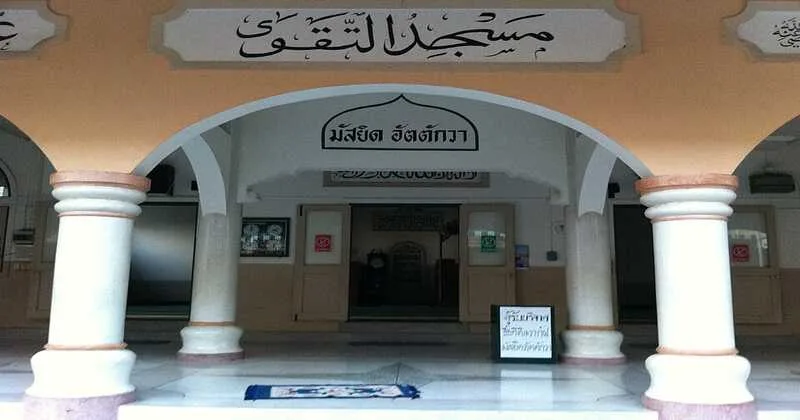
New Delhi: French administrative authorities ordered the temporary six-month closure of the Chanteloup mosque in Aulnay-sous-Bois, a suburb located northeast of Paris within the Seine-Saint-Denis department, following official determinations that its religious leaders and guest speakers disseminated radical Islamist ideology.
The official order, issued on July 27 by the local prefecture, the regional administrative arm of the French state, cited sermons and social media publications that authorities contend glorified terrorism, legitimised armed jihad, and actively provoked violence, hatred, and discrimination. The administrative action takes place amid broader nationwide debates regarding the expansion of Islam and the state’s security apparatus designed to counter religious extremism.
Radical rhetoric and state enforcement under anti-terror laws
The closure was formally executed under an administrative security provision enacted in October 2017. This legislation grants local prefects the direct authority to shutter places of worship where preaching, statements, or activities are found to incite hatred or violence, promote terrorism, or provoke acts of terror.
According to a communique released by the Seine-Saint-Denis prefecture, both the regular imams officiating at the Chanteloup mosque and visiting guest speakers consistently articulated views aligned with militant doctrine. State administrators asserted that these discourses directly echoed the rhetoric of international terrorist organisations, legitimised holy war, and exalted martyrdom. Given the repeated nature and severity of these statements, the prefecture concluded that the risk of inciting terrorist acts warranted immediate state intervention.
في فرنسا أيدت محكمة مونتروي الإدارية قرار إغلاق مسجد شانتلوب قرب باريس 6 أشهر، بعد اعتراض السلطات على خطب تناولت آيات قرآنية وعذاب القبر، فيما أعلن محامي المسجد الطعن على القرار أمام مجلس الدولة #مزيد pic.twitter.com/1pZyTo58tF
— مزيد – Mazid (@MazidNews) August 9, 2026
Specific evidence highlighting the atmosphere at the venue included a video widely shared on the social media platform X earlier in the year. The recording featured an imam who had previously lectured at the Chanteloup mosque instructing worshippers to physically strike their children aged 11 and older if they failed to perform daily prayers.
State officials emphasised that such public pronouncements constituted a direct provocation to physical violence and discrimination, reinforcing the decision to impose the six-month administrative shutdown.
Legal challenges, past closures, and state anti-separatism measures
The leadership association managing the Chanteloup mosque has strongly contested the prefecture’s allegations and initiated legal proceedings to reverse the directive. Defence attorney Rafik Chekkat announced via social media that the association filed an emergency appeal with the Montreuil administrative court, arguing that the closure relied on vague, insufficient, and unverified evidence stemming from a flawed misinterpretation of Islamic scripture.
Chekkat noted that the prefect specifically faulted an imam for reciting verses from Surah Al-Baqara during services. He cautioned that if the court upholds the administrative order, reading directly from the Quran could effectively be treated as grounds for shutting down religious facilities.
The defence further disclosed that mosque authorities had preemptively dismissed two imams who were responsible for approximately 90 per cent of the specific grievances cited by the government. Chekkat added that mosque representatives requested a formal meeting with the prefect prior to the issuance of the closure order, but the request was turned down.
In addition to challenging the closure itself, regional outlet Ici Paris IIe-de-France reported that the managing association is contesting a judicial freeze placed on its bank accounts alongside a concurrent administrative effort by the state to permanently dissolve the organisation.
Following an emergency hearing held before the Montreuil court on August 4, the mosque was permitted to remain temporarily operational pending a formal judicial ruling expected shortly. This intervention represents the second time the Chanteloup facility has faced administrative enforcement. In 2019, municipal and departmental officials ordered the premises closed after a routine safety inspection revealed critical failures to comply with public building safety standards.
The enforcement action aligns with a broader pattern of state supervision over religious venues in the department and across France. In 2020, authorities enforced a similar six-month closure against a major mosque in Pantin, also located in Seine-Saint-Denis, after its online platforms amplified public criticism against history teacher Samuel Paty, who was subsequently beheaded by an extremist after displaying caricatures of Muhammad in a classroom lesson on freedom of expression.
Statistics show that within the first two years of the October 2017 anti-terrorism law alone, the French government closed seven houses of worship. These measures built upon 19 mosque and prayer-hall shutdowns executed under the 2015–2017 state of emergency instituted following the November 2015 Paris attacks, with additional closures following the passage of the 2021 law reinforcing respect for the principles of the Republic and combating Islamist “separatism.”
Demographic shifts and the shadow of past terror attacks
The legal battle in Aulnay-sous-Bois highlights long-standing national discussions regarding demographic changes and the growth of Islamic institutions in France. Official state data indicates that the number of Muslim places of worship, comprising both purpose-built mosques and smaller local prayer rooms, reached approximately 2,600 nationwide in 2024, a significant expansion from roughly eight registered mosques in 1975.
Demographic estimates regarding the total Muslim population vary based on research methodologies. Survey data linked to the National Institute of Statistics and Economic Studies (INSEES) indicates that Muslims represent approximately 10 per cent of the metropolitan population, corresponding to between 6 and 7 million people.
Additionally, a widely cited study published in November 2025 by the polling organisation IFOP calculated that adult Muslims accounted for 7 per cent of the population in 2025, compared to 0.5 per cent recorded in 1985.
Today France commemorates the deadliest terror attack ever to strike it 🕯🇫🇷
Over 130 people, mostly youngsters, were mercilessly slaughtered in a suicide bombing near a stadium & a mass shooting in restaurants, bars & a theatre carried out by ISIS in Paris & its suburbs in… pic.twitter.com/o4kdYfyJw2
— Frankie™️🦅 (@B7frankH) November 13, 2025
The Chanteloup closure order was delivered just one day after the tenth anniversary of the July 26, 2016 terrorist attack in Saint-Etienne-du-Rouvray, where two Islamic State-inspired assailants murdered 85-year-old Catholic priest Father Jacques Hamel inside his church during morning Mass.
The assault marked the first time in modern French history that a terrorist attack directly targeted worshippers inside a Christian place of worship during a religious service.
To mark the decade since the tragedy, the Diocese of Rouen and the municipality of Saint-Etienne-du-Rouvray hosted two days of commemorative events on July 25 and July 26.
Cardinal Jean-Marc Aveline, president of the French Bishops’ Conference, celebrated a memorial Mass, while Rouen Archbishop Dominique Lebrun delivered a homily centred on interreligious dialogue and communal reconciliation rather than security measures.
The commemoration included a public roundtable discussion titled “Muslims and Catholics: Educating Young People to Encounter One Another,” highlighting the personal friendship between Roseline Hamel, the slain priest’s sister, and Nassera Kermiche, the mother of one of the perpetrators, as a symbol of dialogue amid ongoing counter-terrorism enforcement.