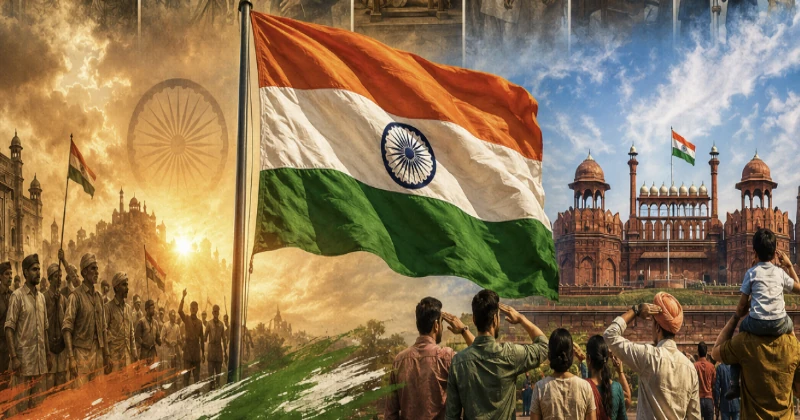
New Delhi: Every time the Tricolour rises above the Red Fort, government buildings, schools or homes across India, it carries with it far more than three colours and a wheel. The Tiranga is a living chronicle of India’s freedom struggle a symbol shaped by decades of resistance, sacrifice, self-reliance and the dream of a sovereign nation.
As India prepares to celebrate its 80th Independence Day on August 15, 2026, the National Flag once again takes centre stage. On July 22, 1947, exactly 79 years ago, the Constituent Assembly adopted the design of the National Flag for independent India, less than a month before the country finally broke free from British rule.
Since then, the Tricolour has become the foremost visual expression of India’s freedom, unity, sovereignty and constitutional values.
Tracing the Evolution of the Tiranga 🇮🇳
🔸From the earliest flags of India’s freedom movement to the Tricolour adopted as our National Flag in 1947, every colour, symbol and design tells a story of sacrifice, courage, unity and hope.
🔸Discover the remarkable journey of the… pic.twitter.com/gbVOtLW9ZL
— PIB India (@PIB_India) August 11, 2026
The Tiranga that India knows today was not created overnight. Its evolution mirrors the political awakening of the country and the changing aspirations of the freedom movement.
One of the earliest known attempts to create a distinctly Indian national flag dates back to 1904, when Sister Nivedita, a disciple of Swami Vivekananda, designed a flag featuring yellow and red, along with a Vajra and a white lotus. The design reflected the cultural and spiritual dimensions of India’s emerging nationalism.
Two years later, another significant flag appeared during the Swadeshi Movement. Designed by Sachindra Prasad Bose and Hemchandra Kanungo, it was hoisted at Parsee Bagan Square in Calcutta in 1906. The flag featured eight lotus flowers, the words Vande Mataram, and representations of the sun and crescent moon. At a time when resistance to colonial rule was gaining momentum, the flag became an expression of national unity and defiance.
In 1907, freedom fighter Madam Bhikaji Cama carried India’s aspirations beyond its shores when she unfurled an Indian flag at the International Socialist Congress in Stuttgart, Germany. Later associated with the name Saptarishi Flag, it became an important symbol of India’s demand for freedom on an international platform.
The movement for self-government produced yet another design in 1917, when Annie Besant and Bal Gangadhar Tilak introduced a flag during the Home Rule Movement. It featured red and green stripes, the Union Jack, seven stars and a crescent with a star, reflecting the demand for self-government within the British Empire.
Pingali Venkayya and the birth of the Tricolour
The decisive stage in the evolution of the present-day National Flag came in 1921, when freedom fighter Pingali Venkayya presented a flag design to Mahatma Gandhi at an All India Congress Committee meeting in Bezwada, present-day Vijayawada.
Gandhi proposed changes to the design, including the addition of a white band and the Charkha, or spinning wheel. The spinning wheel was not merely an emblem; it represented self-reliance, Swadeshi and resistance to the economic structures imposed by colonial rule.
The tricolour that emerged from this process became increasingly associated with India’s freedom struggle.
In 1931, the Indian National Congress formally adopted a tricolour consisting of saffron, white and green, with the Charkha at its centre. It became one of the most recognisable symbols of the independence movement and the immediate predecessor of the National Flag adopted after Independence.
July 22, 1947: The Tiranga becomes the flag of a free India
With Independence approaching, the question of what would represent the new nation became increasingly important.
In June 1947, the Constituent Assembly appointed an ad hoc committee to recommend the design of India’s National Flag. The committee supported retaining the tricolour that had been adopted in 1931, but recommended replacing the Charkha with the Ashoka Chakra.
The change was significant.
The Charkha had been deeply associated with the freedom movement and Mahatma Gandhi’s philosophy of Swadeshi. The Ashoka Chakra, by contrast, connected the new Republic to the deeper civilisational and ethical ideals represented by Emperor Ashoka’s Dharma.
On July 22, 1947, the Constituent Assembly formally adopted the present design of the Indian National Flag. At its centre was the navy blue Ashoka Chakra, a 24-spoke wheel derived from the Dharma Chakra depicted on the Lion Capital of Ashoka at Sarnath. Less than a month later, on August 15, 1947, the Tricolour became the flag of independent India.
The Tiranga’s three horizontal bands have come to embody values that lie at the heart of the Indian national imagination.
- Saffron represents courage, sacrifice and selflessness.
- White signifies peace, truth and integrity.
- Green represents prosperity, growth and harmony with nature.
At the centre of the white band stands the Ashoka Chakra, whose 24 spokes symbolise Dharma, justice, progress and continuous movement. The wheel is perhaps the most powerful reminder that a nation cannot stand still. Progress requires movement, while justice and ethical governance provide the direction.
Together, the colours and the Chakra transform the flag from a mere national emblem into a representation of the ideals and responsibilities of the Indian Republic.
The reverence attached to the National Flag is also reflected in India’s constitutional and legal framework. Under Article 51A(a) of the Constitution, it is a Fundamental Duty of every citizen to abide by the Constitution and respect its ideals and institutions, the National Flag and the National Anthem.
The display and use of the Tiranga are governed by the Flag Code of India, 2002, along with the Emblems and Names (Prevention of Improper Use) Act, 1950, and the Prevention of Insults to National Honour Act, 1971.
These provisions establish rules intended to protect the dignity of the National Flag and prevent its improper or disrespectful use. The Flag Code was amended in 2022, including provisions allowing the National Flag to be flown both during the day and at night, provided it is displayed in the open and occupies a position of honour.
The changes also expanded the permissible materials for manufacturing flags, including machine-made flags and flags made from materials such as polyester, cotton, wool and silk, alongside khadi.
The National Flag is not simply a symbolic object; it is also governed by precise specifications.
The flag follows a 3:2 length-to-height ratio, with three equal horizontal bands. The Ashoka Chakra is placed at the centre of the white band and consists of 24 equally spaced navy blue spokes. The Bureau of Indian Standards prescribes specifications relating to dimensions, colours and manufacturing standards to ensure uniformity.
Traditionally, the flag was closely associated with hand-spun and handwoven khadi, reflecting the Swadeshi philosophy that was central to the freedom movement. Subsequent changes to the Flag Code have widened the range of materials permitted for its manufacture.
The relationship between citizens and the National Flag has also been strengthened through initiatives such as Har Ghar Tiranga. Launched by the Government of India under the Azadi Ka Amrit Mahotsav programme, the campaign sought to encourage citizens to hoist the Tricolour at their homes, workplaces and institutions.
Its broader objective has been to transform the National Flag from a symbol seen primarily at official ceremonies into a more visible expression of people’s connection with the nation.
The campaign has also helped renew public interest in the history, meaning and proper display of the Tiranga. Ahead of the 80th Independence Day celebrations, the Department of Youth Affairs has also launched the National Flag Quiz 2026 on the MY Bharat Portal, encouraging young Indians to learn more about the history and significance of the National Flag.
For nearly eight decades, the Tiranga has witnessed the transformation of India from a newly independent nation confronting enormous challenges to one of the world’s largest democracies.
It has flown over Parliament, courts, schools, battlefields, sporting arenas and the homes of ordinary citizens. It has accompanied Indian soldiers into conflict, represented the country at international events and become a source of pride during moments of national achievement and resilience.
Yet its deepest significance lies in the journey that preceded August 15, 1947. The flags of the freedom movement were born from a country searching for a political identity. The Tricolour that emerged in 1947 represented the arrival of that hard-won freedom.
The saffron, white and green are therefore not merely colours. The Ashoka Chakra is not merely a wheel. Together, they carry memories of resistance, sacrifice, self-reliance, unity and the responsibility of building a just and progressive nation.