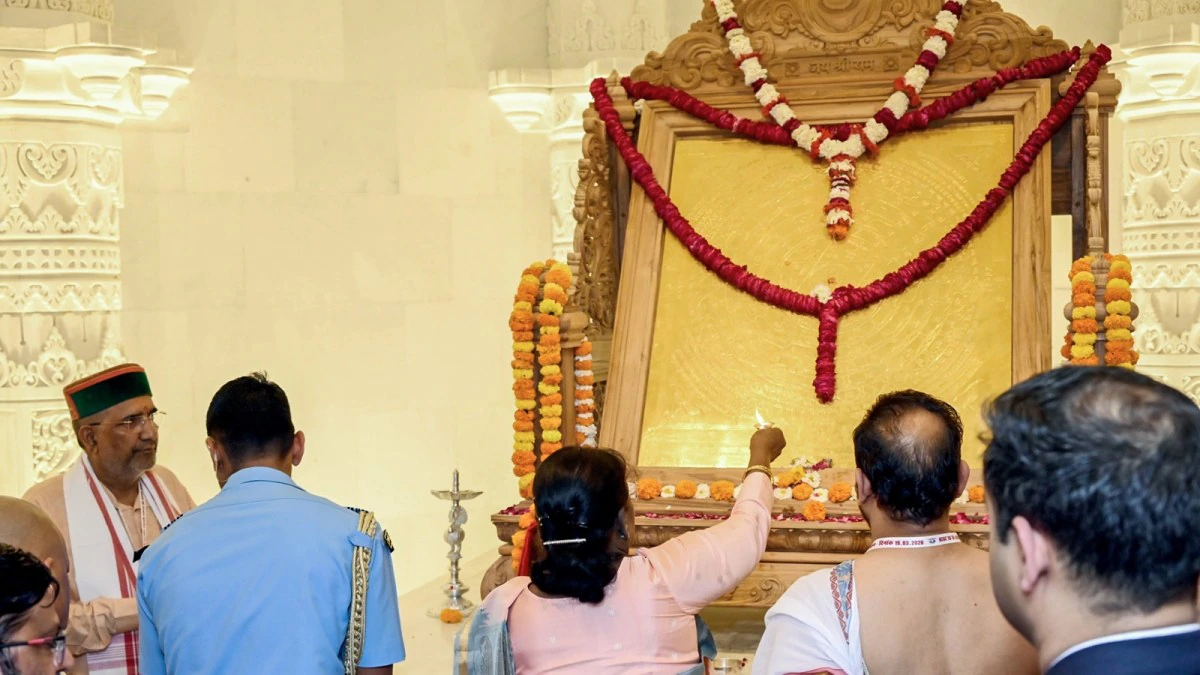
In a deeply symbolic and spiritually charged ceremony, the Ram Yantra, a revered Vedic geometric instrument, was installed at the Ram Temple in Ayodhya on the first day of Navratri. The occasion gained further prominence with the presence of President Droupadi Murmu, who participated in the rituals and offered prayers at the temple.
Arriving from New Delhi around 10:30 am, President Murmu was received by Anandiben Patel and Chief Minister Yogi Adityanath. The President described her visit as a moment of deep spiritual fulfilment.
“It is a great fortune for me to set foot on the sacred land where Lord Ram was born. Witnessing the installation of the Ram Yantra and being part of this historic moment is spiritually uplifting and deeply fulfilling,” she said.
What is the Ram Yantra and Why is it significant?
The Ram Yantra is not merely a decorative or symbolic artefact, it is a complex Vedic structure designed according to precise geometric patterns and sacred mantras. In traditional Hindu belief systems, Yantras are considered powerful instruments that channel divine energies and create spiritually charged environments.
According to scholars, the Ram Yantra embodies the divine qualities associated with Bhagwan Ram – dharma (righteousness), courage, wisdom, and moral integrity. Its installation is believed to enhance the sanctity of the temple and deepen the spiritual experience for devotees visiting the shrine.
Ayodhya’s chief astrologer Raghunath Das Shastri explained the deeper significance: “The Ram Yantra is a precise arrangement of sacred patterns and mantras that embodies the energies of Lord Ram and other deities. It radiates auspicious vibrations, sanctifying the temple premises and enhancing the spiritual experience of devotees.”
The physical attributes of the Ram Yantra further underline its importance. Weighing approximately 150 kilograms and coated with gold, the Yantra was meticulously crafted at a monastery in Kanchipuram—a city long regarded as a centre of Hindu learning and temple traditions.
From Kanchipuram, the Yantra was transported via Tirupati before reaching Ayodhya. Its journey was marked by a ceremonial procession that lasted nearly ten days, with devotees participating along the route, turning the movement of the Yantra into a spiritual event in itself.
This elaborate process reflected not just ritualistic adherence but also the emotional and cultural investment of communities across regions in the consecration of the Ram Temple.
Installation within the temple structure
The Ram Yantra has been installed on the second floor of the Ram Temple complex, alongside other sacred elements that form part of the temple’s spiritual architecture. The placement is considered strategically significant, as Yantras are often positioned in locations that maximise their perceived ability to channel cosmic energies.
Temple authorities and Vedic scholars have indicated that the inclusion of the Yantra aligns with ancient temple-building traditions described in scriptures, where geometry, astronomy, and spirituality intersect.
The installation ceremony was not just a religious event but also a cultural statement. Chief Minister Yogi Adityanath emphasised this aspect, linking the development to India’s broader civilisational narrative.
“While the world faces unrest and conflict, India remains a land of peace. The Ram Yantra reflects devotion, tradition, and faith, reminding us of our cultural roots. Those who once dismissed faith as superstition now witness the revival of India’s spiritual heritage through monuments like the Ram Temple,” he said.
His remarks reflect a growing discourse that positions the Ram Temple as a symbol of India’s cultural resurgence and civilisational continuity.
Ayodhya’s emergence as a global spiritual hub
Governor Anandiben Patel highlighted Ayodhya’s transformation into an international centre of faith. Over the past few years, the city has witnessed a massive influx of pilgrims, infrastructure development, and global attention.
“The installation of the Ram Yantra highlights the city’s spiritual significance and reinforces the timeless message of devotion, peace, and righteousness that India represents,” she noted.
With events like the consecration of the Ram Temple and now the installation of the Ram Yantra, Ayodhya is increasingly being positioned not just as a dharmic destination but as a global spiritual landmark.
Vedic scholars quoted in media note that Yantras function as conduits for cosmic energy. Rooted in ancient Indian knowledge systems, these geometric diagrams are believed to harmonise the environment, aid meditation, and establish a connection between the devotee and the divine.
The Ram Yantra, in particular, is said to resonate with the ideals of Maryada Purushottam Ram, encouraging individuals to lead lives based on righteousness, discipline, and moral clarity.
Such installations are often seen as an attempt to integrate metaphysical beliefs with physical spaces, transforming temples into centres of both spiritual and psychological upliftment.
Why this installation is being called ‘Historic’
Several factors contribute to the Ram Yantra installation being termed historic:
Timing: Conducted on the first day of Navratri, an auspicious festival symbolising divine Shakti and renewal.
Presence of the President: The participation of the country’s highest constitutional authority added national significance to the event.
Cultural Context: It comes in the backdrop of the Ram Temple’s construction, a project with deep historical and emotional resonance.
Pan-India Participation: From Kanchipuram to Tirupati to Ayodhya, the Yantra’s journey symbolised a cultural and spiritual unification.
Revival of Traditions: The installation reflects a renewed emphasis on Vedic practices and temple traditions in contemporary India.
Blending faith, tradition and national identity
The installation of the Ram Yantra represents more than a ritual, it stands at the intersection of faith, tradition, and national identity. It reflects how ancient practices continue to find relevance in modern India, shaping both cultural discourse and public consciousness.
For millions of devotees, the Yantra is not just an object of reverence but a symbol of hope, discipline, and spiritual awakening. For the nation, it marks another step in reclaiming and celebrating its civilisational heritage.