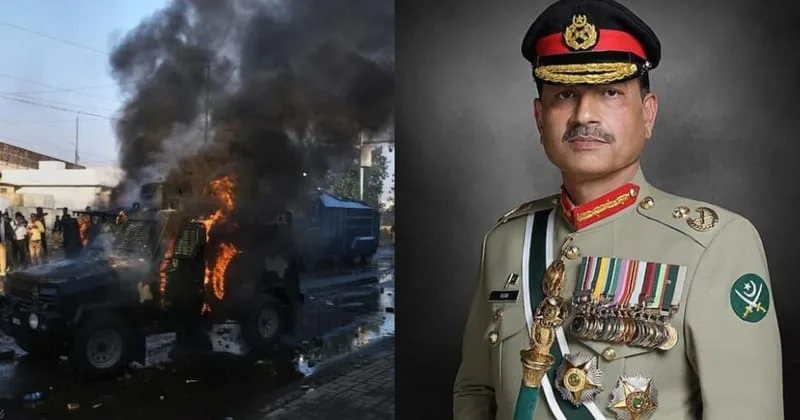
Islamabad: Pakistan Army Chief General Asim Munir has issued a stern warning against internal unrest, as tensions in West Asia continue to escalate. He emphasised that violence within Pakistan will not be tolerated under the pretext of developments in neighbouring regions. Munir was addressing a gathering of religious scholars in Rawalpindi, amid violent pro-Iran protests reported in several Pakistani cities following military actions by the United States and Israel against Iran, as well as the reported death of Iran’s former Supreme Leader Ayatollah Ali Khamenei.
Internal stability a top priority
Reiterating the military’s position, Munir stated that no individual or group would be allowed to destabilise Pakistan due to external developments. He underlined that maintaining internal security remains the country’s foremost priority.
A statement released by the Inter-Services Public Relations (ISPR), the media wing of the armed forces, reinforced this stance, asserting that shedding blood within one’s own country over events occurring elsewhere was unacceptable.
Munir also highlighted Pakistan’s ongoing diplomatic efforts aimed at easing tensions in West Asia, acknowledging that the current situation presents a serious challenge for the country. The unrest has already resulted in significant casualties. In Karachi, at least 22 people were killed during violent clashes between protesters and security forces after demonstrators marched towards the US consulate. Similarly, in the Gilgit-Baltistan region, protesters attacked United Nations offices, leading to a deadly gunfight that reportedly claimed 12 lives. These incidents have intensified concerns within the military establishment over the potential spillover effects of the regional conflict.
Regional conflict raises strategic concerns
The Pakistani military is increasingly apprehensive that the escalating Iran-Israel confrontation could evolve into a wider regional war, directly impacting Pakistan’s security and strategic commitments. A key concern stems from the defence agreement signed with Saudi Arabia last year, which obligates Pakistan to provide military assistance in the event of an attack on the kingdom.
This commitment places Pakistan in a delicate position, balancing its diplomatic efforts to de-escalate tensions while also preparing for potential military obligations. Despite these complexities, the military leadership has made it clear that preventing sectarian and political divisions within the country remains a top priority.
Quoting Munir, the ISPR reiterated that violence in Pakistan could not be justified based on events in another country. Reports, including those published by Dawn, indicate that the Army Chief outlined Pakistan’s diplomatic engagement to defuse tensions in West Asia amid the ongoing US-Israeli confrontation with Iran.
While signalling readiness to support Saudi Arabia if required under the bilateral defence pact, Pakistan is simultaneously working to prevent the conflict from widening. The leadership appears determined to ensure that external geopolitical tensions do not translate into internal instability, even as the region faces an increasingly uncertain security landscape.