The ongoing conflict in West Asia escalated sharply after Iran launched coordinated drone and missile strikes on vital energy infrastructure across several Gulf countries, including Saudi Arabia, Qatar, Kuwait, and the United Arab Emirates (UAE). These attacks have increased fears of a long global energy crisis as markets struggle with disruptions caused by tensions in the Strait of Hormuz.
Apart from the looming clouds of uncertainty over energy supplies, another important question these strikes pose is the growing “Cracks in Ummah.” Since the day Iran’s Supreme Leader was killed in coordinated U.S.-Israel strikes, the brunt has been borne by Saudi Arabia and the UAE. Despite being part of a larger Ummah, these nations now find themselves under direct attack.
The developments not only crack open the idea of a unified Ummah but also raise serious questions about the sectarian divide within Islam. What is often projected as a united front stands exposed with deep internal fractures during moments of crisis, revealing visible and widening cracks in Ummah. Whether the UAE will respond to these attacks remains to be seen, but the cracks in Ummah are becoming increasingly difficult to ignore.
Multiple energy facilities targeted across the Gulf
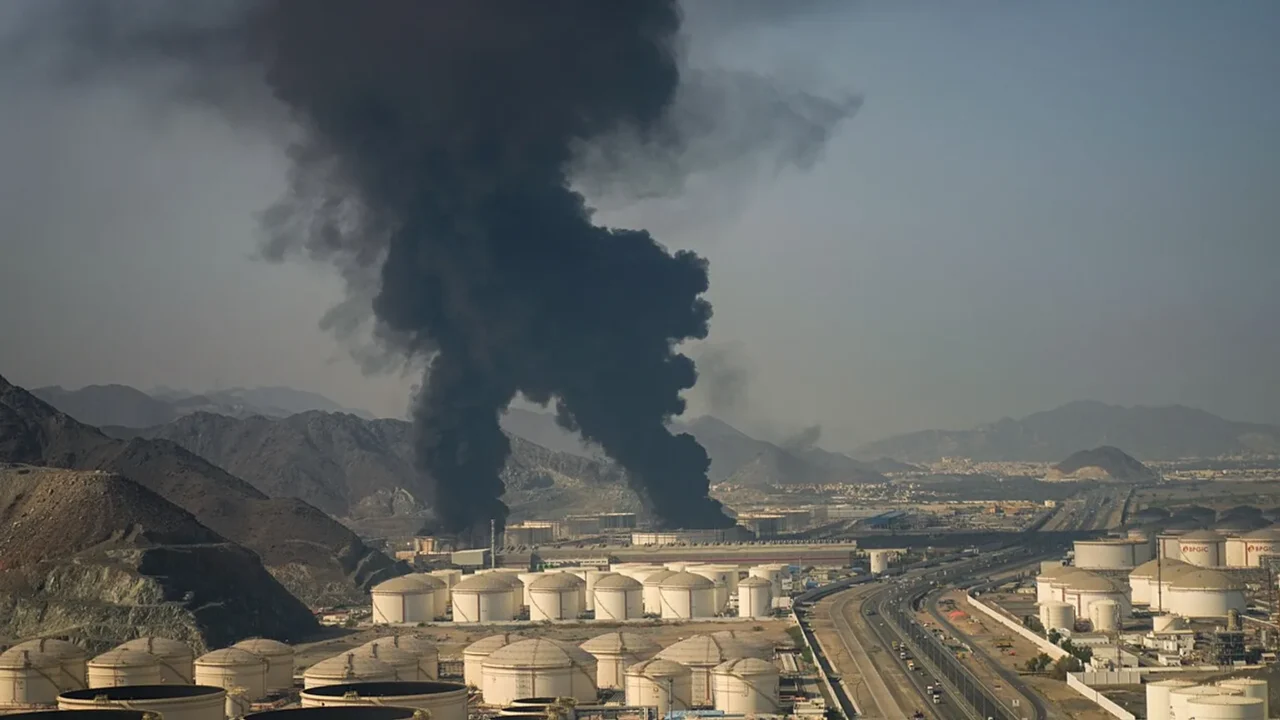
One of the most notable targets was Saudi Arabia’s Red Sea port city of Yanbu, where an aerial strike reportedly hit the SAMREF refinery complex, a joint venture between Saudi Aramco and ExxonMobil. Reports indicated that this strike caused little operational damage, but it raised serious concerns about the security of Saudi Arabia’s alternative oil export route, which has become crucial amid disruptions in the Strait of Hormuz.
Iranian strikes also ignited fires at Qatar’s Ras Laffan liquefied natural gas facilities, one of the world’s largest LNG export hubs. Authorities confirmed that production had already stopped after earlier attacks. The latest missile strike caused further damage and significant fires. Analysts warn that lasting disruptions at Ras Laffan could delay global LNG supply even after hostilities end.
QatarEnergy Statement on Missile Attacks on its LNG Facilities
In addition to the previous attack on Ras Laffan Industrial City on Wednesday 18 March 2026 that resulted in extensive damage to the Pearl GTL (Gas-to-Liquids) facility, QatarEnergy confirms that in the early hours…
— QatarEnergy (@qatarenergy) March 19, 2026
In Kuwait, drone attacks set two major refineries, Mina Al Ahmadi and Mina Abdullah, on fire. Both are key to the country’s petroleum production capacity. While no casualties were reported, officials acknowledged that the attacks disrupted operations and increased security alerts across the energy sector.
Meanwhile, in the United Arab Emirates, authorities temporarily shut down operations at the Habshan gas facility and the Bab oil field following Iranian strikes and interceptions. Maritime risks rose as ships sustained damage or caught fire near Gulf waters, highlighting the vulnerability of shipping routes already stressed by tensions around Hormuz.
Retaliation after strike on Iran’s south pars field
The Iranian offensive followed Israeli and U.S. strikes on Iran’s South Pars gas field, the country’s most important natural gas facility, which is part of the world’s largest gas reserve shared with Qatar. This attack significantly expanded the conflict’s reach, directly threatening Iran’s domestic electricity generation and heating supplies.
Iranian leadership condemned the strike, warning of serious consequences and indicating that energy infrastructure across the region could become valid targets in retaliation. However, the scale and spread of retaliation across multiple Islamic nations has intensified debate about internal divisions, once again bringing the cracks in Ummah into sharper focus.
Saudi Arabia’s strong reaction
Saudi Arabia sharply condemned the Iranian attacks, calling them a dangerous escalation that threatens regional stability and global energy markets. The kingdom’s top diplomat stated that attacks on Saudi territory meant that any remaining trust has completely vanished, indicating a potential shift in Riyadh’s strategic stance.
Saudi Foreign Minister said: “I don’t know how they claim to be fighting for Islamic causes while attacking Islamic countries. They are not attacking a single nation. Saudi Arabia, Bahrain, Kuwait, Qatar, UAE, Oman, Lebanon, Jordan, Azerbaijan, Turkey. All these countries are Islamic countries, yet Iran attacks them. And even before this war, what was Iran’s contribution in the issues related to the Islamic world? They support the Houthi militia in Yemen. They supported the popular militia in Iraq, who are and now they are attacking Iraq. They are attacking Iraq territories, Hezbollah and Lebanon, who didn’t suffice by hijacking the political decision in Lebanon, but rather was an effective arm to perform sabotaging actions in the region and in Saudi Arabia.”
📹WATCH: Saudi Foreign Minister Prince Faisal bin Farhan Al Saud criticizes Iran, questioning how it claims to defend Islamic causes while targeting multiple Muslim-majority countries, including Saudi Arabia, Bahrain, Kuwait, Qatar, UAE, Oman, Lebanon, Jordan, Iraq, and Türkiye.… pic.twitter.com/udiFAMMZQi
— Mossad Commentary (@MOSSADil) March 19, 2026
He added, “And the biggest example is Iran and Hezbollah’s role in Syria. So where is such support or so-called support in the Muslim world when they commit such crimes supporting the former Syrian regime, when, how do they support the Islamic world when they assassinate politicians in Lebanon? How do they support the Muslim world’s issues and causes when they empower the popular mobilisation forces in Iraq, rendering the development efforts in Iraq.”
Saudi air defence forces reportedly intercepted several incoming drones aimed at natural gas facilities in Riyadh and the Eastern Province. Authorities confirmed that damage assessments were underway at the Yanbu refinery, while officials emphasised that oil exports continued.
The attacks prompted Saudi Arabia to boost diplomatic engagement with regional partners and international stakeholders, warning that continued targeting of energy infrastructure could lead to wider military responses.
Strait of Hormuz crisis deepens
The strikes occurred amid a near-blockade of the Strait of Hormuz, a narrow maritime chokepoint through which roughly one-fifth of the world’s oil supply usually transits. Iran’s tightening control over shipping movements has trapped a significant portion of Gulf crude and refined products, sending shockwaves through global fuel markets.
More than twenty vessels have reportedly been damaged since the conflict escalated. Insurance premiums and freight costs have surged. Some tankers have attempted to transit under naval escort, but maritime traffic remains severely limited.
Global benchmark Brent crude briefly surpassed 118 dollars per barrel, reflecting market fears of sustained supply shortages.
Saudi Arabia turns to Yanbu as emergency outlet
Anticipating lasting disruptions in Hormuz, Saudi Arabia has increased shipments through its East-West pipeline, connecting oil fields in the kingdom’s east to Yanbu on the Red Sea. This infrastructure provides a vital backdoor for exports, allowing crude shipments to bypass the contested strait.
However, reports warn that the pipeline’s theoretical capacity of about five million barrels per day falls short of the approximately 7.2 million barrels Saudi Arabia exported daily before the conflict intensified. Additionally, the port’s loading and storage capabilities are believed to be less than the pipeline’s throughput, creating logistical bottlenecks.
The longer maritime route from the Red Sea to Asian markets also raises shipping costs and extends delivery times, adding pressure on already strained global supply chains.
Global economic and political implications
The effects of the crisis are felt across continents. Chinese refiners have reportedly reduced processing activity amid supply uncertainty, while Japan has begun using its strategic petroleum reserves. European markets also face reduced cargo availability and fluctuating prices.
At the same time, uncertainty about the future role of the United States in ensuring Gulf maritime security has added to regional anxiety. Statements from Washington emphasising energy independence and shared responsibilities among allies have been seen as indications of a possible rethinking of long-standing security commitments.
An uncertain energy future
Reports agree that while alternative routes like Yanbu offer temporary relief, they cannot fully offset disruptions at Hormuz. The Iranian strike on the Red Sea export hub highlights the fragility of contingency plans and the larger strategic battle over control of energy corridors.
As hostilities continue, the global economy faces the likelihood of a prolonged supply squeeze. Targeting multiple energy facilities across the Gulf shows that the conflict now affects economic lifelines, with impacts that could reach far beyond West Asia.
At the same time, the crisis has gone beyond geopolitics and economics, it has laid bare internal contradictions, ideological tensions, and sectarian divisions, making the cracks in Ummah more visible than ever before.