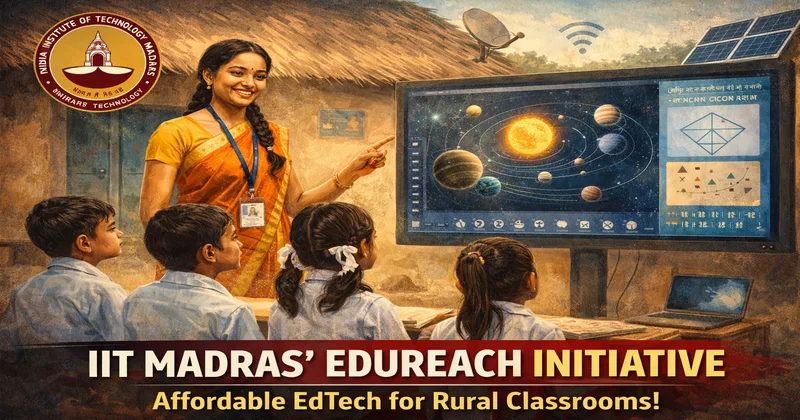
CHENNAI: To bridge the digital divide in India’s education system, the Indian Institute of Technology Madras has developed an innovative edtech initiative, EduReach, specifically for schools with limited infrastructure. The programme shows a growing recognition that while digital education is expanding rapidly, many schools, particularly in semi-urban and rural regions, still face challenges such as poor internet connectivity, a lack of devices, and limited technical capacity.
Developed by the Wadhwani School of Data Science and Artificial Intelligence, EduReach is a flexible, modular platform. Unlike many conventional digital education systems that require full-scale implementation, EduReach allows schools to adopt individual components based on their immediate needs. This approach significantly reduces costs and makes it easier for institutions to gradually transition toward digital learning without overwhelming their existing resources.
At its core, EduReach aims to democratise access to quality educational technology. Schools can choose from a range of tools, including course content management systems, assessment modules, and analytics dashboards. These features are supported by web-based templates and role-based access controls, ensuring that teachers, administrators, and students can interact with the system in a structured and secure manner. By providing such flexibility, this platform acknowledges the diverse realities of India’s education landscape, where a one-size-fits-all solution often fails to deliver results.
A key highlight of the initiative is its integration with artificial intelligence (AI). EduReach is set to be expanded under the Centre of Excellence in Artificial Intelligence for Education, known as Bodhan AI, which was recently recognised by the Ministry of Education. This expansion directs a strategic push to embed AI-driven solutions into public education systems. By leveraging AI, the platform will enhance personalised learning, automate assessments, and generate actionable insights to improve users’ learning outcomes.
The programme has also received support from BACI as part of its corporate social responsibility efforts. This collaboration underscores the increasing role of public-private partnerships in strengthening educational infrastructure and promoting innovation in the sector.
EduReach has already demonstrated its potential through its deployment in Tamil Nadu. A customised version of the platform was developed for the state’s School Education Department and implemented during the previous academic year. It was used to conduct weekly evaluations in smart classrooms across approximately 3,860 schools, benefiting over 19 lakh students.
One of the standout features of EduReach is its automated assessment toolbox. This tool eases the process of making and managing question papers by enabling features such as versioning, allocation, and offline question creation. With this, the teachers can design assessments efficiently, while students will benefit from instant quiz evaluations and digitally provided question papers. This will not only save time but also ensure consistency and transparency in the overall evaluation process.
In addition to assessments, the platform offers comprehensive performance dashboards. These dashboards provide insights at multiple levels: state, district, school, and individual student, allowing administrators and policymakers to track academic trends in real time. Such data-driven decision-making is crucial for identifying learning gaps, optimising resource allocation, and improving overall educational outcomes.
To further strengthen its reach, EduReach has partnered with Vidya Shakti, an initiative focused on the last-mile delivery of educational technology. Vidya Shakti has already deployed the solution in 250 schools across two states and is working toward an ambitious expansion to 11,000 schools. This expansion is expected to impact around 11 lakh students by the end of the current financial year, significantly amplifying the programme’s footprint.
Recognising that technology adoption requires awareness and training, IIT Madras is also planning to organise workshops for educators, administrators, and policy stakeholders. These workshops will serve as platforms to demonstrate EduReach’s capabilities, provide hands-on training, and encourage wider adoption of the system. Such efforts are essential to ensure that technology is not only introduced but also effectively utilised in classrooms.