Selective narrative & bias against Bharat in the reports of USCIRF
June 4, 2026
  • Read Ecopy
  • Circulation
  • Advertise
  • Careers
  • About Us
  • Contact Us
Android AppiPhone AppArattai
Organiser
  • ‌
  • Bharat
    • Assam
    • Bihar
    • Chhattisgarh
    • Jharkhand
    • Maharashtra
    • View All States
  • World
    • Asia
    • Europe
    • North America
    • South America
    • Africa
    • Australia
  • Editorial
  • International
  • Opinion
  • RSS @ 100
  • More
    • Op Sindoor
    • Analysis
    • Sports
    • Defence
    • Politics
    • Business
    • Economy
    • Culture
    • Special Report
    • Sci & Tech
    • Entertainment
    • G20
    • Azadi Ka Amrit Mahotsav
    • Vocal4Local
    • Web Stories
    • Education
    • Employment
    • Books
    • Interviews
    • Travel
    • Law
    • Health
    • Obituary
  • Subscribe
    • Subscribe Print Edition
    • Subscribe Ecopy
    • Read Ecopy
  • ‌
  • Bharat
    • Assam
    • Bihar
    • Chhattisgarh
    • Jharkhand
    • Maharashtra
    • View All States
  • World
    • Asia
    • Europe
    • North America
    • South America
    • Africa
    • Australia
  • Editorial
  • International
  • Opinion
  • RSS @ 100
  • More
    • Op Sindoor
    • Analysis
    • Sports
    • Defence
    • Politics
    • Business
    • Economy
    • Culture
    • Special Report
    • Sci & Tech
    • Entertainment
    • G20
    • Azadi Ka Amrit Mahotsav
    • Vocal4Local
    • Web Stories
    • Education
    • Employment
    • Books
    • Interviews
    • Travel
    • Law
    • Health
    • Obituary
  • Subscribe
    • Subscribe Print Edition
    • Subscribe Ecopy
    • Read Ecopy
Organiser
  • Home
  • Bharat
  • World
  • Operation Sindoor
  • Editorial
  • Analysis
  • Opinion
  • Culture
  • Defence
  • International Edition
  • RSS @ 100
  • Magazine
  • Read Ecopy
Home World North America USA

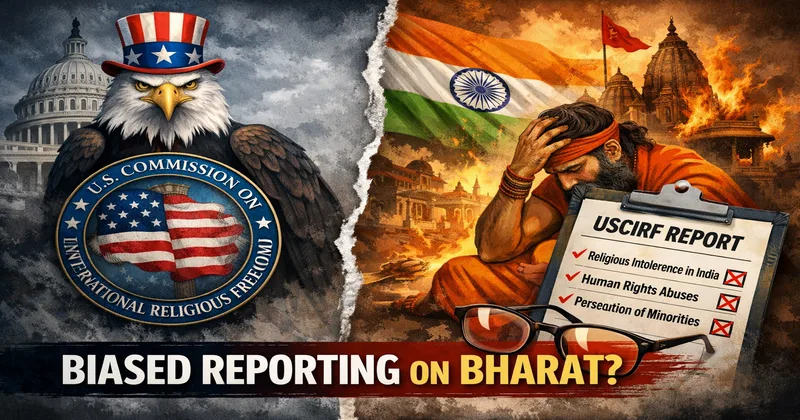
Selective narrative and bias against Bharat in the reports of USCIRF

Critics argue that the USCIRF reports present a narrowly framed narrative, relying heavily on selective incidents and secondary sources while overlooking the country’s complex socio-cultural and constitutional landscape. The absence of on-ground verification and the perceived generalisation of localised events into national trends have further intensified doubts about the credibility of the findings

Ashish BahugunaAshish Bahuguna
Mar 17, 2026, 07:00 pm IST
in USA, Bharat, World, Opinion
Follow on Google News
Representative Image (Image generated from AI)

Representative Image (Image generated from AI)

FacebookTwitterWhatsAppTelegramEmail

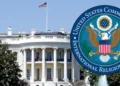
The United States Commission on International Religious Freedom (USCIRF) is an autonomous U.S. entity tasked with overseeing global religious freedom and offering policy recommendations. It was established in 1998 under the International Religious Freedom Act (IRFA) to monitor the state of religious freedom worldwide. It advises the U.S. government, especially the State Department, the President, and Congress, by publishing annual reports and suggesting policy actions, such as naming certain countries as “Countries of Particular Concern (CPC)” for serious violations of religious freedom. While it plays a significant role in shaping US foreign policy, it has been criticised by many countries, notably Bharat, for being biased and selective in its reporting and for applying a Western view of religious freedom.

The recent USCIRF report on Bharat has sparked considerable debate, particularly due to its suggestion to classify Bharat as a CPC. This has resulted in accusations of a biased, politically motivated and selective narrative. A primary critique is the incessant, uniform negative framing of Bharat in its reports over the last five years. Since 2020, USCIRF has consistently advocated for CPC designation for Bharat, highlighting concerns such as communal violence, anti-conversion legislation, and purported discrimination against minorities by presenting distorted facts. It is often criticised for highlighting minority grievances without equal attention to majority concerns and framing issues in a way that appears one-sided. Critics contend that this repetition signifies a predetermined judgment, rather than a dynamic assessment attuned to evolving circumstances.

Also Read: Why target RSS and R&AW? India questions USCIRF report and its sources, points to attacks on Hindus in US

Critics also say that USCIRF reflects US foreign policy interests rather than advocating for religious freedom. Its suggestions align with the US’s geopolitical goals rather than with objective evaluations of religious freedom. USCIRF report lacks sufficient on-ground verification, especially in complex societies such as Bharat. The major issue is the selective utilisation of incidents in its annual report. The USCIRF reports frequently emphasise particular instances of violence, hate speech, or the destruction of religious properties by using social media reports, distorted facts and without on-ground verification of incidents. The government of Bharat say that the commission often generalises localised or irregular occurrences into a national pattern, thus fostering a distorted picture of our nation. The USCIRF lacks direct investigative authority and relies significantly on media reports and contributions from non-governmental organisations. The problem is often linked with overdependence on secondary sources in data collection. This raises concerns about verification, representativeness, and potential ideological bias in the source material, which largely influence the objectivity of the conclusions.

A further aspect is the implementation of a Western normative framework on religious freedom. The socio-religious fabric of Bharat is intricate, influenced by historical, cultural, and constitutional elements. Critics contend that USCIRF assesses Bharat through a monolithic lens, inadequately accounting for local conditions such as federal governance, legal protections, and community dynamics. This pattern often results in normative bias and an insufficient analysis of on-ground situations. Furthermore, USCIRF is alleged to exhibit geopolitical partiality and engage in selective international comparisons. It is often observed that nations aligned with U.S. strategic objectives receive more lenient inspections, whereas others, such as Bharat, China, and Iran, face more rigorous assessments. The suggestion of policy measures, including penalties or the conditionality of bilateral relations on religious freedom issues, has been perceived as invasive and politically driven.

In summary, accusations of bias in USCIRF reports over the last five years regarding Bharat arise from selective evidence, normative frameworks, and suspected geopolitical reasons. The organisation is well-known for using coercive methods to push Westernised, Christianized, and white supremacist ideas on countries in the Global South. It targets governments or organisations in the Global South with sanctions that link them to the US government’s arms trade and trade policies. The group has repeatedly shown it is unaware of how people live in other regions of the world, which is why many governments call it an “organisation of concern.” The current structure of the USCIRF consists of two catholic activists, two Muslims, and two Jewish people. Even the Chair of the commission, Vicky Hartzler, herself is an evangelical Christian. Therefore, it becomes easy for a caucus of Abrahamic people to target the organisations working for the unity of Sanatana Bharat and the upliftment of Bhartiya society.


Topics: United States Commission on International Religious FreedomUSCIRFInternational Religious Freedom Act
ShareTweetSendShareSend
✮ Subscribe Organiser YouTube Channel. ✮
✮ Join Organiser's WhatsApp channel for Nationalist views beyond the news. ✮
Previous News

Centre unveils CAPF Administration Bill 2026 to strengthen the internal security framework and combat the urban naxals

Next News

Developement Paradigm of selfhood

Related News

Behind America’s church walls, a historic faith crisis is unfolding amid empty pews, fading pulpits and rapid unchurching.

Religious Paradox of US: Policing global faith while Christianity erodes at home; Inside the great unchurching crisis

USCIRF’s India Report: India rejects findings, calls report ‘biased and motivated’

India questions USCIRF’s credibility amid diplomatic concerns

USCIRF’s biased attitude is reflected in the fact that it has placed Bharat in the same tier of condemnation as China & North Korea

USCIRF: Weaponising religious freedom

Ex-bureaucrats & judges debunk biased USCIRF report; Hail India’s religious freedom & role of RSS in nation-building

Representative Image (This image is generated by AI)

Assault on India’s Sovereignty: The misleading and false narrative of USCIRF

Load More

Latest News

Cabinet approves Rs 9,585 crore scheme to replace old trucks and buses in Delhi-NCR

Delhi-NCR gets major pollution relief push as centre clears Rs 9,585 cr vehicle replacement scheme for trucks and buses

A representative image generated using AI

BHAVYA Scheme to transform India’s Manufacturing Landscape: DPIIT secretary calls for investment-ready industrial parks

Keralam: Madrasa Ustad Shemeer Asari sends Obscene video to Girls in WhatsApp Group, asks if they can do the same

Keralam: Madrasa Ustad Shemeer Asari sends Obscene video to Girls in WhatsApp Group, asks if they can do the same

Board outside the office of Karnataka Lokayukta

Karnataka government accused of shielding tainted officials as Lokayukta probes remain stalled

Ritabrata Banerjee Claims LoP Post as Revolt Rocks Mamata Banerjee's Party

TMC vs TMC in Bengal: Expelled leader Ritabrata Banerjee stakes claim to LoP post, deepening crisis in Mamata’s party

DRDO, IAF successfully flight-test indigenous RudraM-II air-to-surface missile

DRDO, IAF conduct successful RudraM-II Missile trials under extreme conditions, boosting India’s defence self-reliance

India receive the fourth squadron of the Russian-made S-400 air defence system

India receives fourth S-400 missile squadron from Russia, bolstering air defence

Union Minister Shivraj Singh Chouhan

Union Minister Shivraj Singh Chouhan pushes farmer-first reforms at national kharif campaign 2026 meet

Firhad Hakim Seeks Resignation as Kolkata Mayor Amid Growing Crisis in Mamata Banerjee's TMC

Another Shock for TMC? Mamata Banerjee’s trusted lieutenant Firhad Hakim seeks to quit as Mayor amid crisis

TCS Nashik Case: Former AIMIM MP Imtiaz Jaleel Mentioned in 1,500-Page Chargesheet; Admits Meeting Nida Khan’s Family

TCS Corporate Jihad Case: Imtiaz Jaleel met Nida Khan’s family while she was absconding, says 1,500-page chargesheet

Load More
  • Privacy
  • Terms
  • Cookie Policy
  • Refund and Cancellation
  • Delivery and Shipping

© Bharat Prakashan (Delhi) Limited.
Tech-enabled by Ananthapuri Technologies

  • Home
  • Search Organiser
  • Bharat
    • Assam
    • Bihar
    • Chhattisgarh
    • Jharkhand
    • Maharashtra
    • View All States
  • World
    • Asia
    • Africa
    • North America
    • South America
    • Europe
    • Australia
  • Editorial
  • Operation Sindoor
  • Opinion
  • Analysis
  • Defence
  • Culture
  • Sports
  • Business
  • RSS @ 100
  • Entertainment
  • More ..
    • Sci & Tech
    • Vocal4Local
    • Special Report
    • Education
    • Employment
    • Books
    • Interviews
    • Travel
    • Health
    • Politics
    • Law
    • Economy
    • Obituary
  • Subscribe Magazine
  • Read Ecopy
  • Advertise
  • Circulation
  • Careers
  • About Us
  • Contact Us
  • Policies & Terms
    • Privacy Policy
    • Cookie Policy
    • Refund and Cancellation
    • Terms of Use

© Bharat Prakashan (Delhi) Limited.
Tech-enabled by Ananthapuri Technologies