While reading an article on economics, a common reader is often confused as to what he experiences or observes in his everyday life is not reflected in these ‘erudite’ articles. Therefore, before we begin, I want to underline the Bharatiya premise of economics – it is distinctively society driven, and not Government driven. It rests on native, instinctive, practical and ethical aspects of life. And not on Western or other alien theories.
We are still taught that Adam Smith was the ‘father of economics’. His law of demand and supply is among the first one to be taught to a student of economics even at the school level. The poor boy believes it as a gospel truth and his entire learning of economics revolves around this dictum. But in everyday life, he sees practices which are just opposite to this law of Adam Smith and Alfred Marshall. He sees his friends offering cold water to thirsty passengers in trains in Rajasthan or Madhya Pradesh and elsewhere. In the scorching heat of May, when the demand for water is at its peak, and supply is scarce, these boys are a soothing sight holding buckets going from one train coach to another or at the bus stands, offering water to people who would have to shell out hefty sums for the same, if the society followed Adam Smith’s law of demand and supply.
In Bharat, we have communities which have a knack for minting money out of nothing. This is a ubiquitous sight everywhere in the country, ingrained in the Bharatiya society. The same spirit can be seen behind several lakhs of water bodies across the country which were constructed by the affluent for the entire village. Often, these were made in times of distress – droughts in particular. Those who built them could have invested their hard-earned money in their businesses, but their sense of social responsibility – voluntary, not the Corporate Social Responsibility made compulsory by law – motivated them to invest into creating social wealth, instead.
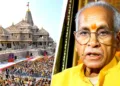
Our seers made a social order for providing essentials/necessities to everyone in sprite of affordability. Similarly, the temple economics in the country bears testimony. Recently, the Andhra Pradesh Chief Minister Chandrababu Naidu told an international convention that the temple economy in Bharat is close to Rs 6 lakh crores! This figure is almost one sixth of the budgeted receipts for the year 2026-27 which were pegged at Rs 36.52 lakh crores in the recent Budget. Or more than the combined Budget for railways and roads in the ensuing financial year. There are several temples in the country whose budgets are much more than the municipalities they are part of. This is despite the fact that an anti-religious atmosphere was created by the Britishers and Mughals. But the temple economy could not be unnerved.
This is not all about revenue. Their spendings on social causes are also to this tune. Besides creating an invaluable and intangible spiritual and social consciousness among the society, these temples are engaged in several other activities, foremost among them, the food and nutritional security. It is through annakshetras, langars, bhandaras, etc. Now of course, the present Government has also stepped in to ensure food security.
Culture Patronised by Mandirs
Even today temples are in vogue in several parts of the country. We all know that Odishi dance is still patronised by Jagannath Mandir and this art is perfected in the temple premises. Many Jain Mandirs in Gujarat and other temples and mathas in Maharashtra, Karnataka and Tamil Nadu are at the forefront of supporting art in its various forms. Manipuri dance celebrating Raaslila of Radha-Krishna is a regular feature in the Govind Dev Mandir in Imphal. Pleasing Gods by Rangoli in Maharashtra and floral decorations in Banke Bihari Mandir in Vrindavan are other manifestations of art. Promoting architecture through Mandirs, forts and palaces is said to have been an innate practice among the affluent society in Rajasthan. Folk performances and promotion of goods produced in the villages were all sold through the haats in the peripheries – parikrama margs – of Mandirs.
In its new avatar, Shramdaan, an initiative by a Jain sant in Madhya Pradesh, is taking the fashion market by storm. Basically a movement started by his disciples gives employment to hundreds of weavers and women who spin, weave and stitch clothes and then they organise marketing through temple premises. Similarly, a temple store in the sprawling premises of Shankheshwar in Gujarat excels in innovation in artefacts and other useful items. They are the epitome of holistic models of development that have been intrinsic in the Bharatiya mindset.
One can see markets around mandirs throughout the country. Besides economic activities, these markets also were a real manifestation of local needs and the consumption culture.
Charity was another name for welfare economics. Hundreds of years ago, much before the CSR was made mandatory by the statute, it was voluntary, a part of Dharma, virtuous, and a result of self-imposed practices. Munimji of a Sethji would collect Dharmada, a tax imposed by the society, on the society, for the society. Goshalas were run with these ‘taxes’ and so would hospitals and educational institutions. Dharmashalas were the order of the day and so were free meal services there. All these would generate revenue in a subtle manner, without any profit motive. But these necessarily economic activities never found a place in the definition of alien economics.
Providing Succour to Deprived
You may have seen sprawling havelis in the neighbourhood in your village. And wondered why such a huge mansion was made in an inhospitable place where nobody lives. One would bite one’s nails at the intricate carvings on the walls or the doors or the pillars holding enthralling ceilings. Evergreen colours still shining even after 300 years would make one wonder with awe. Why all this ‘extravagance’? No, it was not extravagance. It was the selfless service rendered by the so called kanjoos(miser) sethji during drought or a natural calamity. So as to provide employment and succour to the deprived. The so-called kanjoos seth would make a haveli and give raw food to the labourers. The womenfolk would cook it and the menfolk would sweat to earn it. No money! No economics!
Children would watch their parents building intricate structures, etc, discussing the intricacies of soil in the region, the wood, the metal, textiles, how to treat it, etc, and learn the art perfected by them. That will be their apprenticeship. But there won’t be any direct money involved. So, no economics! But can there be more economics than this? In the present day world, we can dub it as child labour and force them to learn ABCD, which won’t help them earn.
Nutrition to Poorest of People
Lotus stem was called by different weird names in different parts of the country so that the rich would look at it with disdain. But it was available to the poor for no price since it is a wonderful source of nutrition. Apparently no economics involved, but it was the Bharatiya way of making a social provision for food to the poor. In modern days, it could be dubbed as a form of welfare economics! It can perhaps be likened to providing wheat at Re.1 per kg or rice at Rs. 2 to the poor. Similarly, pumpkins would never be sold in the golden era. It would be left on the merch between two fields for anybody to feed his family. Because it had aurum, the chemical name of gold. Bathua, the richest form of iron, was damned as weed or feed for the cattle. So that the rich will ‘contemptuously’ leave it for the poor. The ‘Vitamin C bomb’, Kaachri was also looked down with disdain. A food for animals once, now selling for Rs100 a kg in Delhi. There was a time when we could boast of savings by every household. Because, we believed that saving is earning too. And, therefore, pure economics. That is the core of Bharatiya economics. Its soul. The dabbas in each kitchen is still the ‘hard earned saving’ of every woman in the country. Remember the most recent depression of 2008? Entire world reeled under its weight. But we remained unaffected, thanks to our savings!
There are so many dimensions of the real desi economics that cannot be counted or monetised. It is so because the Bharatiya economy is a feminine economy. Basically shy in nature. It is the naani economics, not the nanny economics! Though in the urban India, the ubiquitous maid is the ‘most wanted’, adds thousands of crores to the GDP. But a housewife doesn’t. Now she is known as homemaker. In the rural Bharat, a woman works from dawn to dusk, nay, late evening. She looks after her family, cattle, kitchen, agriculture, everything. But alas, her contribution is not counted in the GDP! While it doesn’t need any evidence that her contribution to agriculture is sometimes upto 80 per cent.
Narendra Modi was mocked for being a tea vendor in his childhood. Today, he is the Prime Minister of the world’s most populous country and the largest democracy. Today, in common parlance, the Bharatiya economy ranks as the fourth largest economy. If all the tea, pakora vendors in the country, all its stri shakti, its temple economy, et al are taken into consideration, we would be ranked number one. Even today, a halwai on every nukkad selling jalebi, kachori is contributing much more than the KFC and Dominos. There is naani or daadi in every family looking after her grandchildren without seeking monetary compensation, as against a nanny leaving her children crying at home for her master’s baby because she is paid for it. What is more economics?