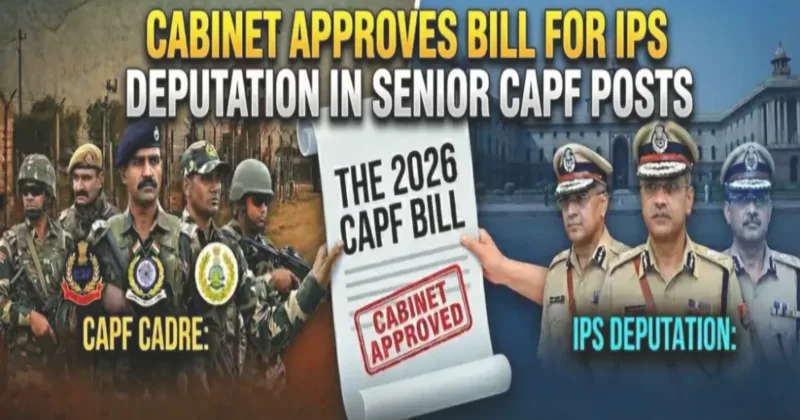
NEW DELHI: The Central Government has introduced the Central Armed Police Forces (General Administration) Bill, 2026, a proposed legislation designed to bring structural clarity and administrative uniformity to India’s premier paramilitary forces. The Bill covers the five major Central Armed Police Forces (CAPFs)—the Central Reserve Police Force (CRPF), Border Security Force (BSF), Central Industrial Security Force (CISF), Indo-Tibetan Border Police (ITBP), and Sashastra Seema Bal (SSB)—collectively comprising over one million personnel.
One of the key features of the Bill is the formalisation of leadership patterns that have evolved through executive practice over the years. It proposes reserving 50 per cent of Inspector General (IG)-level posts and 20 per cent of Deputy Inspector General (DIG)-level posts for officers on deputation from the Indian Police Service (IPS). This move is aimed at ensuring continuity in leadership, enhancing coordination with state administrations, and leveraging the experience of officers trained in diverse policing environments.
According to the Ministry of Home Affairs report dated 9 March 2026, the revised number of sanctioned IPS deputation posts now includes;
- Director General (DG): 15 posts — unchanged
- Special Director General (SDG): 14 posts — reduced
- Additional Director General (ADG): 33 posts — increased
- Inspector General (IG): 150 posts — reduced
- Deputy Inspector General (DIG): 256 posts — unchanged
- Superintendent of Police (SP): 229 posts — increased
The Bill also seeks to codify recruitment procedures, service conditions, disciplinary frameworks, and administrative protocols, replacing the current reliance on executive orders. By doing so, the government aims to provide a clear legal framework to improve transparency, accountability, and operational efficiency within the forces.
Additionally, provisions for restructuring deputation posts and creating new leadership roles are expected to address long-standing cadre management concerns. These changes are intended to balance promotional opportunities within the CAPFs while maintaining a stable leadership pipeline.
The proposed reforms come against the backdrop of evolving security challenges. Over the past decade, the government has reported a significant decline in Maoist-related violence, with affected districts and casualty figures witnessing a steady drop. Violent incidents dropped 89 per cent (from 1,936 in 2010 to 222 in 2025), deaths fell 91 per cent (1,005 to 95), and “most-affected” districts shrank from 36 (2014) to just 3 (2025). Simultaneously, security forces continue to manage sensitive borders with Pakistan and China, requiring high levels of coordination, strategic planning, and restraint.
The CAPFs also play a crucial role beyond conventional security duties. Forces like the CISF are responsible for safeguarding critical infrastructure, including airports and ports, while others are frequently deployed in disaster response situations. The Bill aims to strengthen these multifaceted roles by improving organisational efficiency and ensuring better resource utilisation.
The Govt extended Modernisation Plan-IV (Rs 1,523 crore, 2022–2026) for state-of-the-art weapons, IT upgrades, and equipment. Recent IPS leadership in CRPF achieved 100 per cent timely PPO generation for retirees, boosting morale amid high-risk deployments. Bill ensures this winning formula continues. IPS officers provide “glue”—a pan-India perspective, adherence to the rule of law, and coordination with elected Govts—that prevents silos or over-militarisation. By retaining apex oversight, the Govt avoids risks of fragmented command in hybrid warfare scenarios.
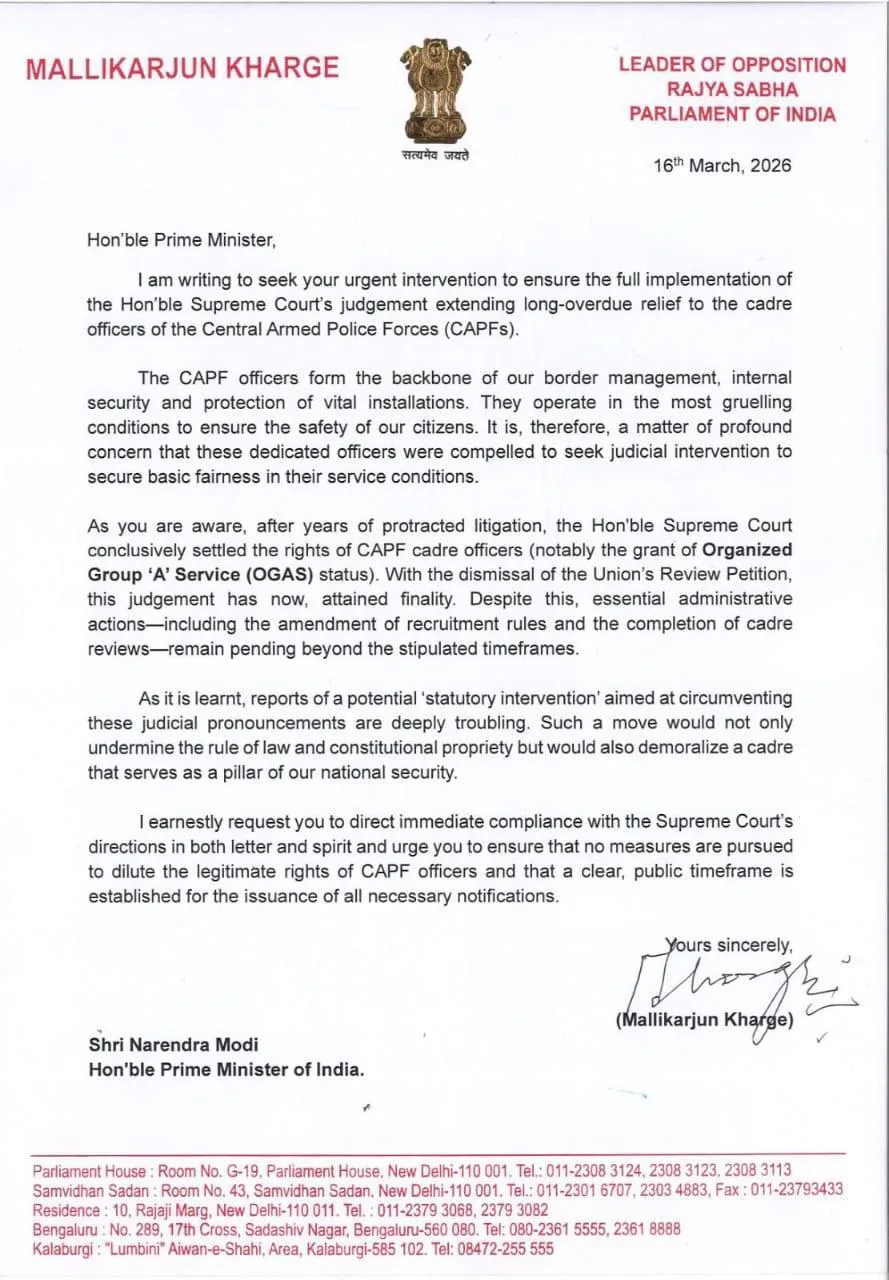
However, the proposed legislation has sparked debate in political and policy circles. The Congress party has raised concerns about the implications of reserving a significant proportion of senior posts for IPS officers, arguing that it may impact the career progression of cadre officers within the CAPFs. Some have also pointed to previous judicial observations on service matters, suggesting that the Bill could invite legal scrutiny.
Supporters, on the other hand, argue that integrating IPS leadership ensures a broader administrative perspective, facilitates coordination between central and state agencies, and helps maintain a balance between operational effectiveness and adherence to legal frameworks.