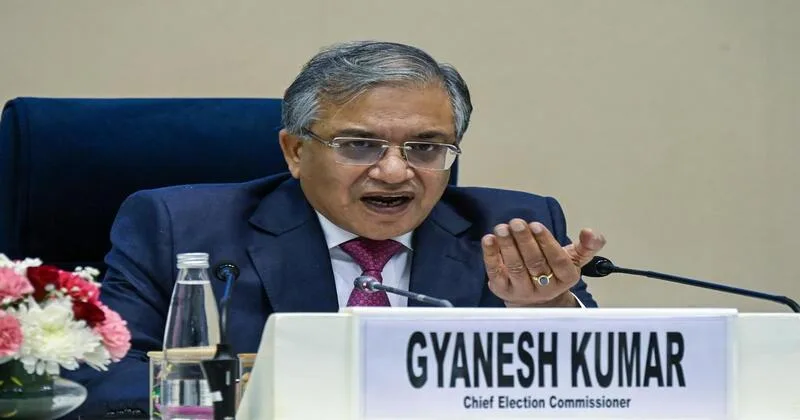
The Election Commission of India has decided to conduct the West Bengal Legislative Assembly Elections 2026 in two phases. According to the schedule released by the Commission, polling will take place on April 23, 2026, and April 29, 2026, while the counting of votes will be held on May 4, 2026.
The decision is being viewed as a significant change in the way elections are conducted in West Bengal. Traditionally, assembly elections in the state have been held in multiple phases spread over several weeks, primarily because of concerns related to law and order and the need to deploy large numbers of central security forces across districts. Conducting the election in only two phases therefore represents a notable shift in electoral strategy, as the Commission attempts to streamline the process while maintaining security and administrative control.
First two-phase assembly election in 25 years
The upcoming assembly election will be the first time in nearly 25 years that the state votes in only two phases. In previous elections, the Election Commission of India had typically adopted a staggered polling schedule with several phases to ensure that central forces could be moved from one region to another and deployed effectively.
Election officials, however, believe that long multi-phase elections can sometimes create opportunities for organised groups to travel between constituencies and influence polling outcomes. Such movements, officials say, may allow politically motivated networks to intimidate voters or create disturbances in different districts.
By limiting the election to two phases, the Commission hopes to reduce the time window available for such activities and strengthen its monitoring capabilities. The strategy is expected to help authorities keep closer watch on sensitive areas and respond more quickly to any incidents that may occur during the polling process.
Poll violence remains a major concern
The issue of election-related violence has long been associated with electoral politics in West Bengal. Over the years, various elections in the state, including municipal, panchayat and parliamentary contests have witnessed incidents involving clashes between party workers, intimidation of voters and disturbances near polling booths.
One of the most recent examples was the 2023 panchayat elections, which saw widespread unrest across several districts. On July 8, 2023, at least 11 people were killed in incidents involving gunfire, assaults, rioting and arson. The violence drew national attention and once again raised concerns about the safety of voters and polling personnel.
Almost every major election in the state has experienced some degree of violence, making security arrangements a central component of election planning. Against this backdrop, the decision to hold the upcoming assembly election in only two phases has naturally sparked debate about whether the strategy will succeed in reducing conflict or create additional pressure on security forces.
Security concerns and logistical challenges
Some election experts believe that conducting polls in fewer phases could create logistical difficulties. In multi-phase elections, central security forces can be deployed gradually across districts, allowing authorities to concentrate manpower in sensitive constituencies during each phase.
However, when polling takes place in fewer phases, security agencies must ensure that a large number of personnel are available at the same time across multiple constituencies. This raises questions about whether there will be adequate police and paramilitary forces to guard polling booths, manage crowd control and conduct mobile patrols in vulnerable areas.
According to sources familiar with the discussions quoted in media, the Commission assessed several critical factors, including the deployment capacity of central security forces, the possibility of troublemakers moving between districts, the administrative readiness of state authorities and historical patterns of violence recorded during previous elections.
Review of past election violence ordered
In another step aimed at strengthening accountability, the Office of the Chief Electoral Officer in West Bengal has directed senior police officials to submit a detailed report on past incidents of election-related violence. The directive has been sent to the Additional Director General of Police (Legal) as well as the State Police Nodal Officer.
Authorities have been asked to identify officers responsible for maintaining law and order in areas where violence occurred during previous elections. The report must include detailed information about pre-poll and poll-day violence during the 2021 Assembly elections, as well as pre-poll, poll-day and post-poll violence during the 2024 Lok Sabha elections.
Officials are also required to identify police station-level officers under whose jurisdiction these incidents took place. The Commission has set March 16, 2026, as the deadline for submitting the report. The exercise is being seen as an effort by the Commission to evaluate past lapses and ensure greater accountability within the law enforcement system.
Administrative reshuffle signals strict monitoring
Alongside these measures, the Election Commission of India has carried out significant administrative changes in the state bureaucracy. The reshuffle came shortly after the announcement of the election schedule and the enforcement of the Model Code of Conduct.
Within hours of the code coming into effect, the Commission appointed Dushyant Nariyala, a 1993-batch IAS officer, as the new Chief Secretary of West Bengal. He replaces Nandini Chakrabarty, marking one of the first major bureaucratic changes ahead of the polls.
In another key decision, the Commission removed the state’s Home Secretary Jagadish Prasad Meena. The position will now be taken over by Sanghamitra Ghosh, a 1997-batch IAS officer. According to administrative sources, both officials are expected to assume charge by Monday afternoon.
Political parties react to poll schedule
Despite the debate surrounding the two-phase polling format, political parties have expressed confidence about the upcoming election. Leaders from both the ruling and opposition camps have indicated that they are prepared for the contest.
From the Bharatiya Janata Party, leader Shamik Bhattacharya said that it is the responsibility of the Election Commission to ensure peaceful and fair elections. He stated that the party was satisfied with the two-phase polling arrangement and expressed confidence about its electoral prospects.
“We are satisfied with the two-phase polling and are confident of winning,” Bhattacharya said while reacting to the Commission’s announcement.
Leaders from the ruling All India Trinamool Congress also expressed optimism about the electoral process. Party leader Jayprakash Majumdar said that his party had no doubts about the peaceful conduct of the polls and remained confident about the outcome.
Both parties claim to have strong grassroots networks across the state, which could intensify political competition during the campaign period.
The West Bengal Legislative Assembly Elections 2026 will ultimately serve as a major test for the Election Commission of India.