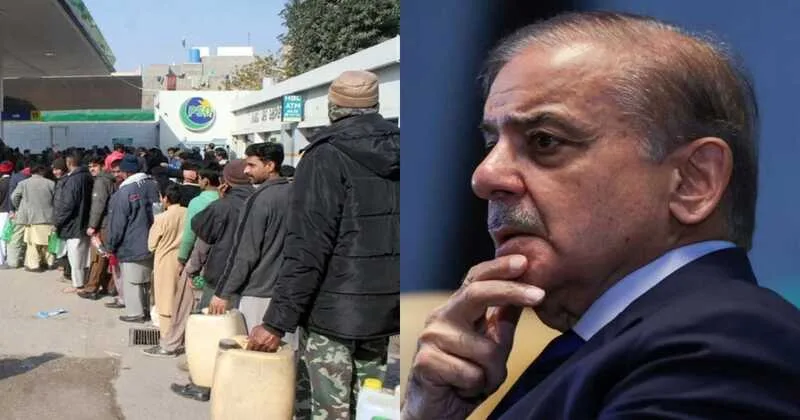
Islamabad: Pakistan’s already fragile economy has come under severe strain as the war in West Asia disrupts energy supplies and trade routes. The country, which has long depended heavily on imported fuel, is now facing an acute shortage of petrol and diesel after Iran closed the Strait of Hormuz in the backdrop of the conflict. The closure has almost halted fuel supplies to Pakistan, triggering transport disruptions and long queues at petrol pumps across the country.
The crisis comes at a time when Pakistan is already burdened with massive debt and struggling to manage daily expenses through external borrowing. The sudden energy disruption has intensified public hardship, especially during the fasting month, as the government simultaneously raised fuel prices in an attempt to manage the economic fallout.
Fuel supplies disrupted after Hormuz closure
Pakistan relies heavily on crude oil imports from the Gulf region. Nearly 85 per cent of its crude oil is purchased from the United Arab Emirates and Saudi Arabia, and these shipments traditionally pass through the Strait of Hormuz. With the Strait now closed due to the war, the flow of oil to Pakistan has been severely disrupted. In response, Pakistan has approached Saudi Arabia with a request to explore alternative routes for crude oil shipments, particularly through the Red Sea. However, the immediate impact of the supply disruption has already been felt across the country.
The shortage of petrol and diesel has affected transport systems nationwide. Long queues of vehicles have been reported at petrol stations as people struggle to secure limited fuel supplies. Rising fuel prices have added to the public distress, particularly during the fasting month when household expenses are already high.
The disruption has also affected maritime logistics. Cargo ships carrying fuel and other essential goods are reportedly stranded at Karachi port following the closure of the Hormuz route. This has further complicated supply chains and delayed the arrival of essential imports.
Government imposes austerity measures
As the fuel shortage worsened, the Pakistani government introduced a series of austerity measures aimed at conserving fuel and reducing expenditure. Working days were reduced in many sectors, including government offices, and employees were allowed to work from home to minimise travel.
Fuel allowances for government employees have been suspended, while many schools in different regions have been closed for extended periods. Educational institutions have increasingly shifted to online learning as commuting becomes difficult and costly.
The government has also reduced fuel allocations for official vehicles. For the next three months, around 60 per cent of government vehicles will remain off the roads. The fuel quota for the remaining vehicles has been reduced by half.
Additional spending restrictions have also been introduced. The purchase of new government vehicles has been prohibited during this period, and other government procurement activities have also been suspended as part of cost-cutting efforts.
Another major decision involves salary cuts for employees in government-owned companies and autonomous institutions. Their salaries will be reduced by 5 to 30 per cent, a measure approved by Prime Minister Shehbaz Sharif. According to a statement from the Prime Minister’s Office, these measures are necessary to manage the economic crisis triggered by the war and to protect the broader public interest.
The government has also announced that ministers, advisers and special assistants will not receive salaries for two months. The withheld amount will be transferred to the Public Welfare Fund. Those holding such positions have also been barred from travelling abroad during this period. Furthermore, payments made to government representatives serving on the boards of corporations and institutions have been suspended.
Border closure ends Iranian fuel flow
The crisis has been compounded by the sudden halt of illegal oil smuggling from Iran into Pakistan. The two countries share a 909-kilometre border, and for years, fuel has been transported through unofficial channels across this frontier.
After the US-Israeli attack on February 28, the border was closed, effectively cutting off this supply. It is estimated that nearly one million litres of petrol reach Pakistan daily from Iran through informal routes, although some estimates place the figure as high as six million litres. Most of this fuel was sold in Pakistan’s Balochistan region, where smuggled petrol forms an important part of the local economy. With the supply route now shut, the livelihoods of thousands of people in the region have been disrupted.
Formal trade between the two countries has also been affected. Pakistan exports goods worth around 800 million dollars annually to Iran, while imports from Iran are valued at about 3.5 billion dollars. These trade activities have largely come to a standstill since the war began.
Economic pressure mounts across sectors
The fuel crisis is rapidly spreading across different sectors of Pakistan’s economy. Transport costs have increased sharply, forcing many people to reduce travel. Some families have even moved their children to schools located closer to their homes to avoid transportation expenses. Rickshaw and taxi drivers are among the worst affected, as many are unable to afford fuel to operate their vehicles. Daily wage workers have also been hit, with reports indicating reduced working hours and job losses in several sectors.
Agriculture, which forms the backbone of Pakistan’s economy, has also been affected by rising fuel prices. The sector contributes about 23 per cent of the country’s GDP and provides employment to roughly 37 per cent of the population. Higher fuel costs have increased the price of agricultural inputs and transportation, further straining farmers.
Meanwhile, under the guidance of the International Monetary Fund (IMF), the Pakistani government has increased petrol prices by Rs 55 per litre. This sharp hike has triggered public dissatisfaction, as it has pushed up the prices of essential commodities and transportation across the country.
Pakistan is heavily dependent on financial assistance from the IMF, and the government is therefore obligated to follow the institution’s policy directions. The rising international crude oil prices have also worsened the country’s import burden. Pakistan’s monthly oil import bill is expected to reach nearly 600 billion dollars, an amount equivalent to approximately 5.5 lakh crore Indian rupees.
Already struggling with high debt levels, Pakistan is finding it increasingly difficult to manage this growing financial pressure. Although there have been discussions about purchasing Russian oil as an alternative if supplies through Hormuz remain unavailable, reports indicate that the Pakistani government has not yet taken steps in that direction.
With fuel supplies disrupted, prices rising and economic activity slowing down, Pakistan is among the countries facing the most severe economic consequences of the war in West Asia.