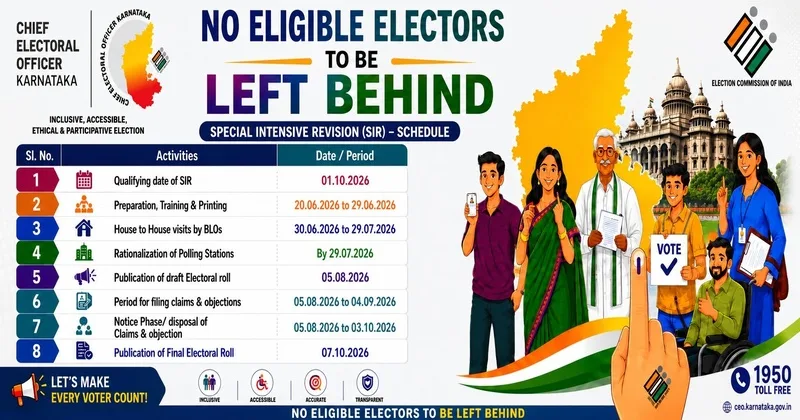
Bengaluru: The Karnataka government’s decision to issue residential verification certificates at the gram panchayat level to assist voters during the Special Intensive Revision (SIR) of electoral rolls has triggered a fresh debate over citizenship verification and voter eligibility. Critics argue that the move could become a shortcut that dilutes the purpose of strict documentation requirements prescribed by the Election Commission of India (ECI).
The controversy stems from the state government’s recent order empowering Panchayat Development Officers (PDOs) to issue “residential verification certificates” to individuals who may not possess all the documents required during the ongoing voter list revision process. The government has maintained that the measure is intended to ensure that genuine voters do not lose their voting rights due to documentation issues.
Deputy Chief Minister D.K. Shivakumar had earlier stated that eligible voters should not be deprived of their franchise because of procedural hurdles. Following discussions held at the state level earlier this month, the government issued an order on June 20 authorising gram panchayat officials to provide residential certificates to eligible applicants.
However, election authorities have pointed out a crucial distinction between a “residential verification certificate” and a “permanent residence certificate.” Under the ECI’s SIR guidelines, voters seeking to establish their eligibility and citizenship status must furnish one among 11 approved documents. Among these is the Permanent Residence Certificate, which serves as a stronger proof of domicile and citizenship-related credentials.
Officials familiar with the electoral revision process argue that a residential certificate merely confirms that a person resides at a particular address, whereas a permanent residence certificate carries greater legal validity and is issued only by designated revenue authorities after verification of supporting documents.
Election Commission sources have clarified that certificates issued by village-level officials such as PDOs do not automatically qualify as valid documents under SIR norms. According to existing rules in Karnataka, only officials of the rank of Deputy Tahsildar and above are authorised to issue Permanent Residence Certificates that can be accepted during voter verification exercises.
The issue has drawn comparisons with a similar exercise conducted in West Bengal during a previous Special Intensive Revision. In that case, questions were raised regarding the validity of residence certificates issued by lower-level authorities. The Election Commission subsequently clarified that only certificates issued by competent officers such as District Magistrates, Additional District Magistrates, Sub-Divisional Officers and other authorised officials would be accepted.
Election authorities maintain that the rules governing SIR are uniform across the country and cannot be altered by individual state governments. As a result, any certificate issued outside the framework prescribed by the Election Commission may face scrutiny during the verification process.
Critics of the Karnataka government’s move allege that the decision could effectively create an easier route for individuals lacking adequate documentation to seek inclusion in electoral rolls. They argue that residence alone cannot establish citizenship and that voter eligibility must be based on documents recognised under national electoral regulations.
Officials, however, insist that the final decision on voter inclusion will continue to rest with electoral authorities and not with local bodies issuing residence certificates. They stress that every application will still be subject to verification under Election Commission guidelines.
Experts note that applicants seeking a Permanent Residence Certificate are required to submit supporting documents such as Aadhaar, voter identity card, ration card, passport or other recognised identity proofs. In many cases, possession of these documents may itself satisfy voter verification requirements, reducing the practical significance of the residential certificates being proposed by the state government.
With the Special Intensive Revision process underway, the debate has now shifted to whether the government’s initiative is a genuine effort to protect voting rights or a move that could weaken established safeguards governing voter registration and citizenship verification. The issue is expected to remain politically sensitive as electoral authorities continue implementing the nationwide revision exercise.