The Safety Valve Thesis Revisited: Congress, colonial design and western alignment
October 10, 2026
  • Read Ecopy
  • Circulation
  • Advertise
  • Careers
  • About Us
  • Contact Us
Android AppiPhone AppArattai
Organiser
  • ‌
  • Bharat
    • Assam
    • Bihar
    • Chhattisgarh
    • Jharkhand
    • Maharashtra
    • View All States
  • World
    • Asia
    • Europe
    • North America
    • South America
    • Africa
    • Australia
  • Editorial
  • International
  • Opinion
  • RSS @ 100
  • More
    • World Hindu Congress 2026
    • Op Sindoor
    • Analysis
    • Sports
    • Defence
    • Politics
    • Business
    • Economy
    • Culture
    • Special Report
    • Sci & Tech
    • Entertainment
    • G20
    • Azadi Ka Amrit Mahotsav
    • Vocal4Local
    • Web Stories
    • Education
    • Employment
    • Books
    • Interviews
    • Travel
    • Law
    • Health
    • Obituary
  • Subscribe
    • Subscribe Print Edition
    • Subscribe Ecopy
    • Read Ecopy
  • ‌
  • Bharat
    • Assam
    • Bihar
    • Chhattisgarh
    • Jharkhand
    • Maharashtra
    • View All States
  • World
    • Asia
    • Europe
    • North America
    • South America
    • Africa
    • Australia
  • Editorial
  • International
  • Opinion
  • RSS @ 100
  • More
    • World Hindu Congress 2026
    • Op Sindoor
    • Analysis
    • Sports
    • Defence
    • Politics
    • Business
    • Economy
    • Culture
    • Special Report
    • Sci & Tech
    • Entertainment
    • G20
    • Azadi Ka Amrit Mahotsav
    • Vocal4Local
    • Web Stories
    • Education
    • Employment
    • Books
    • Interviews
    • Travel
    • Law
    • Health
    • Obituary
  • Subscribe
    • Subscribe Print Edition
    • Subscribe Ecopy
    • Read Ecopy
Organiser
  • Home
  • Bharat
  • World
  • Operation Sindoor
  • Editorial
  • Analysis
  • Opinion
  • Culture
  • Defence
  • International Edition
  • RSS @ 100
  • Magazine
  • Read Ecopy
Home Bharat

The Safety Valve Thesis Revisited: Congress, colonial design and western alignment

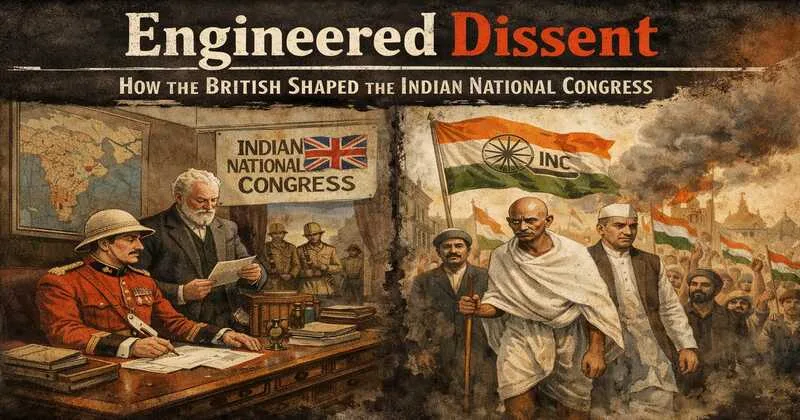
The founding of the Indian National Congress in 1885 has often been examined through the lens of the “Safety Valve Theory,” which suggests that British authorities encouraged its creation to manage rising political awareness among Indians. Initiated by Allan Octavian Hume, the organisation later evolved from a moderate constitutional forum into the central force of India’s freedom movement

Adv Karan ThakurAdv Karan Thakur
Mar 14, 2026, 08:00 pm IST
inBharat, World, Special Report, International Edition
Follow on Google News
Representative image

Representative image

Facebook
Twitter
WhatsAppTelegramEmail

The origins of the Indian National Congress have long been debated under the “Safety Valve Theory,” which suggests that its founding in 1885 by Allan Octavian Hume was encouraged by the British to manage rising Indian political consciousness. Rather than suppress dissent, the colonial state provided a constitutional platform to channel it safely. Yet questions remain about whether its intellectual and institutional foundations continued to reflect Western influence even after independence.

The foundation and evolution of the Indian National Congress must be examined not merely as a chapter of nationalist awakening, but as part of a broader imperial strategy. The “Safety Valve Theory” offers a structural explanation: that Congress was encouraged by British authorities as a controlled political platform to regulate rising Indian consciousness and protect imperial interests. When this thesis is extended critically, some scholars and political commentators argue that even beyond its founding moment, the Congress, by orientation, leadership culture, and institutional design, remained deeply aligned with Western intellectual and political frameworks, at times prioritising them over indigenous civilisational interests.

In 1885, under the initiative of Allan Octavian Hume, a retired ICS officer, the Congress was formed at a time when the British Empire faced a new kind of challenge. After the Revolt of 1857, the Crown had consolidated authority but remained wary of unrest. By the late nineteenth century, English education had produced a politically articulate Indian elite trained in Western liberal thought, constitutionalism, rights discourse, and parliamentary procedure. This class was increasingly vocal about economic exploitation, racial discrimination, and administrative exclusion. From an imperial governance perspective, the question was how to channel this dissatisfaction.

The Congress provided an answer. It was moderate, constitutional, loyal in tone, and focused on incremental reforms. Its early leadership, including figures such as Dadabhai Naoroji, petitioned the British Parliament rather than mobilising mass resistance. Demands were framed within the logic of imperial justice. The British administration tolerated, and arguably saw utility in, such a body. It centralised political articulation into a visible forum, reduced the risk of underground revolutionary movements, and projected Britain as a liberal empire permitting dialogue.

In this formative phase, Congress functioned in a way that did not threaten imperial sovereignty. Instead, it absorbed elite political energy into procedural debate. The “safety valve” metaphor captures this containment function: pressure was released through speeches, resolutions, and memoranda rather than rebellion.

However, history evolved. Leaders such as Bal Gangadhar Tilak began pushing beyond constitutional gradualism. By the time Mahatma Gandhi emerged as a central figure, the Congress had transformed into a mass-based movement. Gandhi was not installed by British design; rather, his South African experiments with satyagraha shaped his independent philosophy of resistance. Yet even Gandhi’s method of non-violent civil disobedience operated within a moral and legal framework that engaged British constitutional principles rather than rejecting them outright.

Also Read: Sanskrit Beyond India: How ancient Buddhist monasteries in Termez preserved a transregional language of devotion

Similarly, Jawaharlal Nehru represented a generation deeply shaped by Western education and intellectual currents. Educated at Harrow and Cambridge, influenced by European socialism and liberalism, Nehru’s worldview was globalist and modernist. Under his leadership, independent India adopted a parliamentary democracy modelled on Westminster, retained colonial administrative structures, and continued English as a language of governance.

Critics who extend the safety valve thesis argue that this continuity reflects more than institutional pragmatism. They contend that Congress leadership internalised Western frameworks to such an extent that indigenous political thought and civilizational models were sidelined. In this view, the Congress, even while leading the freedom struggle, operated within intellectual boundaries set by the West. After independence, rather than constructing governance rooted entirely in indigenous traditions, it preserved the colonial state’s bureaucratic skeleton and legal architecture.

From this critical perspective,Congress served Western interests in three structural ways:

1. Institutional Continuity: The retention of colonial administrative systems ensured that governance logic remained aligned with British constitutional norms.

2. Intellectual Orientation: Leadership discourse prioritised Western liberal and socialist paradigms over indigenous political philosophies.

3. Global Alignment: Early foreign policy emphasised internationalist frameworks shaped by European political thought.

What can be argued, however, is more subtle: the Congress was born within a colonial constitutional framework, and even as it radicalised, it did not fundamentally reject that framework’s institutional logic. It sought to transfer sovereignty rather than dismantle the administrative model. Thus, while political control shifted from British rulers to Indian leadership in 1947, many structural elements of governance remained Western in origin.

The safety valve thesis, therefore, explains the Congress’s origin convincingly. The British likely encouraged its formation to manage elite dissent. In its early decades, it operated within limits comfortable for imperial authorities. Over time, it exceeded those limits and became the spearhead of anti-colonial struggle. However, the ideological and institutional imprint of its colonial birth persisted.

To claim that the Congress consistently and consciously served Western interests even during the freedom struggle would oversimplify historical reality. But it is equally simplistic to deny that its intellectual and structural foundations were deeply shaped by Western paradigms. The paradox of the Congress lies precisely here: conceived in an imperial context, shaped by Western education, it became the vehicle of independence, yet carried forward many of the frameworks it inherited.

In the final analysis, the Indian National Congress may have begun as a safety valve for the empire. It ultimately dismantled that empire. Yet the state it constructed bore unmistakable marks of its colonial and Western intellectual origins. Whether one interprets this as pragmatic continuity or as prolonged Western alignment depends on one’s ideological lens, but the structural continuity itself is historically undeniable.
 

Topics: Safety Valve TheoryAllan Octavian HumeBritish colonial strategyColonial governanceWestern political influenceindian freedom movementIndian National Congress
Share
Tweet
SendShareSend
✮ Subscribe Organiser YouTube Channel. ✮
✮ Join Organiser's WhatsApp channel for Nationalist views beyond the news. ✮
Previous News

The Kerala Model of Corruption: From rice scams to temple gold

Next News

The LPG crisis misinformation is just a conspiracy

Related News

Dadabhai Naoroji

Birth Anniversary of Dadabhai Naoroji:  Tribute to man who laid foundation for swadeshi economics

Vande Mataram: Pandit Paluskar ji, still alive

Rani Lakshmibai, the Queen of Jhansi

Remembering Rani Lakshmibai on her death anniversary: Warrior queen who defied the British empire & inspired a nation

AICC General Secretary KC Venugopal and Opposition Leader VD Satheeshan

Keralam: Congress CM row escalates as K.C. Venugopal and V.D. Satheeshan camps clash openly on streets

From Khera to Rahul: The Pathological Trait of Lies & Legacy of Apologies

Keralam BJP President Rajeev Chandrasekhar

Keralam Election 2026: “Muslim League remote-controls Congress, seeks Deputy CM & six ministries,” says Chandrasekhar

Load More

Latest News

Trump administration escalates sanctions against the ICC over its jurisdiction and American sovereignty concerns.

US imposes sweeping sanctions on International Criminal Court, citing violations of American sovereignty & jurisdiction

From Christmas carols to ganga aarti: Historic Allen Park in West Bengal set to host first-ever Durga Puja

Union Health Minister J P Nadda

Combatting Tuberculosis: JP Nadda launches JOSH teams under TB Mukt Bharat Abhiyaan to strengthen youth-led fight

Republicans and Democrats redraw maps across 10 US states in a battle for control of Congress in the 2026 midterms.

Delimitation in America: How gerrymandering across 10 states could reshape control of Congress in 2026 US midterms

(From Left To Right) Alexandra Leeper, Carolyn Hull, Ruth Schilling, Tom Pickerell, Anusha Kesarkar Gavankar Hem Kaur Saroya

Sagarmanthan 2026: Global experts call for systemic shift to drive women into top maritime leadership positions

DWWA President Mahalakshmi Subramani meets women trainees at NSG Training Academy

From Resilience to Leadership: DWWA President encourages women trainees at NSG academy to embrace ‘Mahila Shakti’

National Investigation Agency

Kishtwar Terror Attack Case: NIA chargesheets OGW Maneer Ahmed; Traces plot directly to Pakistan

Telangana Row: Journo Jalli Rekha Detained With Sick Infant Over Post on CM Revanth Reddy’s Daughter

Outrage as Hyderabad Police grill journalist with sick baby for hours over post on CM Revanth’s daughter’s business

Raghoo Puri, the Indian delegate at the UN

Indian delegate at UN Raghoo Puri mauls Pakistan over terrorism: Calls Shehbaz Govt as illegitimate ‘Form 47’ regime

Indian Knowledge Systems:Adding Ātma to Ātmanirbhar Bhārat

Load More
  • Privacy
  • Terms
  • Cookie Policy
  • Refund and Cancellation
  • Delivery and Shipping

© Bharat Prakashan (Delhi) Limited.
Tech-enabled by Ananthapuri Technologies

  • Home
  • Search Organiser
  • Bharat
    • Assam
    • Bihar
    • Chhattisgarh
    • Jharkhand
    • Maharashtra
    • View All States
  • World
    • Asia
    • Africa
    • North America
    • South America
    • Europe
    • Australia
  • Editorial
  • Operation Sindoor
  • Opinion
  • Analysis
  • Defence
  • Culture
  • Sports
  • Business
  • RSS @ 100
  • Entertainment
  • More ..
    • Sci & Tech
    • Vocal4Local
    • Special Report
    • Education
    • Employment
    • Books
    • Interviews
    • Travel
    • Health
    • Politics
    • Law
    • Economy
    • Obituary
  • Subscribe Magazine
  • Read Ecopy
  • Advertise
  • Circulation
  • Careers
  • About Us
  • Contact Us
  • Policies & Terms
    • Privacy Policy
    • Cookie Policy
    • Refund and Cancellation
    • Terms of Use

© Bharat Prakashan (Delhi) Limited.
Tech-enabled by Ananthapuri Technologies