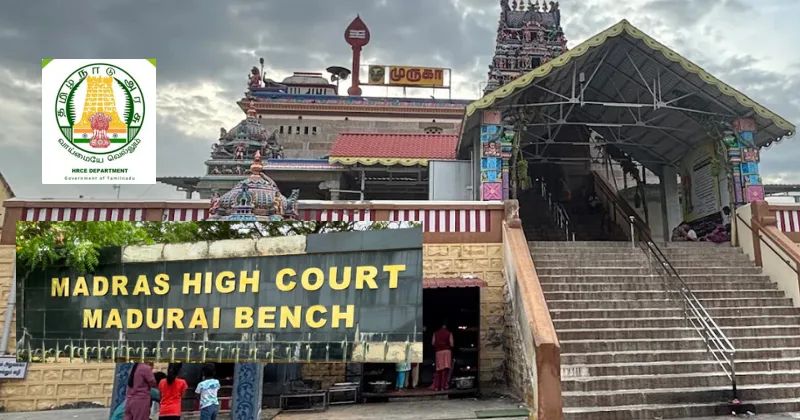
The Madurai Bench of the Madras High Court has come down heavily on authorities for failing to recover 507 acres of temple land belonging to Arulmighu Balasubramaniyaswami Temple in Vennaimalai, Karur district, allegedly under encroachment, observing that temple properties are sacred endowments and not commercial assets of the State.
The Court noted that 507.88 acres of temple land remain under encroachment while only 93.64 acres have been recovered so far, and pointed to official records showing a steady decline in temple lands across Tamil Nadu—from 5.25 lakh acres in 1986–87 to 4.90 lakh acres in 2000–01, 4.79 lakh acres in 2002–03, and 4.78 lakh acres in 2008–09.
The observations were made while hearing a contempt petition over the implementation of earlier directions issued in October 2019 to recover temple lands recorded in the name of the over 1000-year-old temple. Despite several years and repeated monitoring by the Court, the directions remain only partially complied with.
According to reports placed before the Court, authorities had to deploy three Deputy Superintendents of Police, five Inspectors of Police and 132 police personnel merely to install a flex board declaring the temple’s ownership over the land, indicating the intensity of opposition from encroachers.
Justice P. Velmurugan and Justice B. Pugalendhi, noting that the total extent of temple land under encroachment is 507.88 acres and that only 93.64 acres stand recovered, observed: “This Court has monitored this matter for over two years. Numerous orders were passed in this contempt application. Personal appearances were secured. Protection was ordered. Yet compliance remains partial.
The poor deity has no voting right. On the other hand, the mighty encroachers have valuable votes. In a democratic polity, electoral arithmetic sometimes appears to influence administrative resolve. But constitutional governance is not subordinate to electoral expediency. A deity, recognised as a juristic person in law, cannot be left remediless because it does not participate in elections. The deity may not vote, but the Constitution speaks. The Court is exercising its parens patriae jurisdiction. But, when judicial orders are stalled by organised resistance, then the rule of law itself stands tested,” it added.
The Bench, referring to policy notes of the Tamil Nadu Hindu Religious and Charitable Endowments (HR&CE) Department, noted a worrying decline in the extent of temple lands across the State.
According to official records, temple lands have reduced from 5.25 lakh acres in 1986–87 to 4.90 lakh acres in 2000–01, 4.79 lakh acres in 2002–03, and 4.78 lakh acres in 2008–09.
The Court further observed: “…Temple lands are not commercial assets of the State. They are sacred endowments made by generations of devotees with a definite object to sustain religious worship and charitable services. If endowed properties diminish year after year, it is not a mere clerical anomaly, but reflects systemic erosion.”
The Court was further informed that certain organisations, including one styled as the “Inam Land Farmers Lessees and House Site Owners Protection Movement”, had mobilised protests against the implementation of the Court’s orders
The Court noted that among the 230 identified encroachers, 27 are government officers, 49 are industrialists, and 38 are persons wielding considerable influence. The Bench remarked that such a composition raises a disturbing possibility that the presence of powerful individuals among the encroachers may be contributing to the reluctance of authorities to enforce eviction orders.
Out of the 230 encroachers, 13 filed review applications in 2023 before the High Court but did not pursue them further. The Court observed that the remaining encroachers had not even filed petitions challenging the orders and that it appeared they trusted the HR&CE officials would not take action against them.
Despite the absence of any legal impediment following these dismissals, the Court observed that officials of the HR&CE Department had still failed to implement the earlier directions for recovery of the temple lands.
Closing the contempt petition for the present, the Court issued several directions to ensure progress in the recovery of temple lands. It directed civil courts dealing with suits relating to the temple lands to dispose of them preferably within six months, subject to pendency and in accordance with law. The Court also directed that where interim protection has been declined, such suits should be taken up for early final disposal.
The HR&CE Department was directed to file a comprehensive status report every three months, detailing lands recovered, proceedings initiated, suits filed, the stage of litigation and eviction steps taken. The Superintendent of Police, Karur, was directed to provide adequate protection to officials implementing eviction proceedings and to deal strictly with any obstruction in accordance with law. The Court also directed the Registrar of Societies to examine the activities of organisations that mobilised protests and to take appropriate action if any illegal activity is found.
The observers say that this case reflects how the DMK government is not executing the Court’s orders even after repetitive reminders and remains ignorant of temple lands, as the HR&CE is controlled by elected governments in Tamil Nadu.