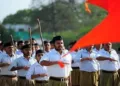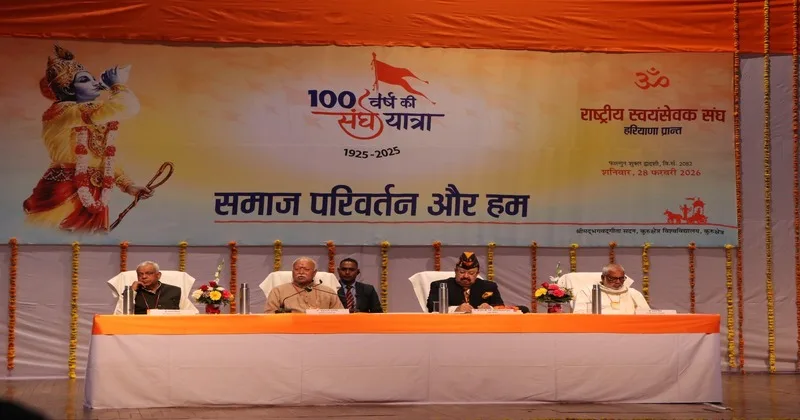
Kurukshetra: Society, culture, values, morality, and noble conduct form the core foundation of Sangh work. The coordination of moral values, conduct, sanskars, commitment to society, and purposeful effort is essential for building a healthy society, said Rashtriya Swayamsevak Sangh (RSS) Sarsanghchalak Dr Mohan Bhagwat while addressing a gathering at the Srimad Bhagavad Gita Auditorium of Kurukshetra University, Haryana on February 28, 206.
Emphasising the role of the family, he said that a tradition of meaningful dialogue must develop in homes, where heart-to-heart communication takes place and children are guided about right and wrong. Not mere preaching, but dialogue and a value-based environment protect individuals from deviation. Many stand together in times of prosperity, but who stands in adversity is determined by the values of family and society. If a person fails or falls into bad company, it is the responsibility of family and society to guide and support him. He stressed that creating an atmosphere of values within the family and society is the need of the hour, as it shapes responsible, sensitive, and character-driven individuals.
He stated that to understand the Sangh, one must come and experience it from within. It cannot be understood merely by observation from outside, imagination, or prevailing narratives, because the kind of work the Sangh does is unique. Today, important individuals from all five continents visit to observe and understand the Sangh, and some seek cooperation to build similar thought-based organisations for their youth, as they lack such a framework.
He said that just as there is no other sun like the sun, and no other sky like the sky, there is no other organisation like the Sangh. The Sangh runs over 130,000 service activities across the country, yet it is not merely a service organisation. From arts to sports and from diverse social fields to politics, workers inspired by Sangh thought are active, yet the Sangh itself is not a political organisation. It did not arise from competition, reaction, or opposition to any one situation, but works with commitment to the nation by uniting society. The Sangh seeks neither dominance over anyone nor political power; its work is dedicated to society and the nation.
Referring to history, he said that in the 1857 War of Independence, India faced defeat against British aggressors. A long period followed when invaders ruled over us, leading to introspection on why we were losing on our own land. In 1860, revolutionary Vasudev Balwant Phadke awakened the spirit that losing one battle does not mean losing the nation, and the struggle for freedom must continue. Thereafter, a long chain of patriots—from Dr Keshav Baliram Hedgewar to Bhagat Singh, Shivaram Rajguru, and Subhas Chandra Bose—carried forward the national movement. Phadke is still regarded in Maharashtra as the Adya Krantikari (the first revolutionary).
Recalling the life of RSS founder Dr Keshav Baliram Hedgewar, he described him as a born patriot. From childhood, young Keshav displayed intense national spirit; at the age of 11, he threw away sweets distributed as a symbol of British rule. His parents were devoted to social service, especially during the plague, which deeply influenced his character. As a student, he actively participated in the Vande Mataram movement. Recognising his talent and dedication, nationalist leaders from Nagpur sent him for medical education, which he completed with distinction. He was also associated with the Anushilan Samiti and came in contact with revolutionaries of the freedom movement.
Dr Hedgewar interacted with many patriots during the freedom struggle and assisted revolutionary activities. From his childhood to becoming the founder of the Sangh, his journey was rooted in national thought, experimentation, and organisation-building. After long historical subjugation, he realised that political change alone was insufficient; society must be organised and character must be built. Over 10–11 years, he conducted various experiments and developed a unique methodology, which led to the establishment of the RSS.
He said that the organisational form of the Sangh was strengthened through early experiments after its establishment. Dr Hedgewar believed that without organising society, nation-building was impossible, and national work could not be left to any one individual or institution. While great personalities provide immediate inspiration, lasting change comes through the conduct and effort of society. Social transformation is essential for systemic change, and this requires individuals of character who create a conducive environment.
The core work of the Sangh, he said, is personality development and social organisation. The Sangh does not consider itself a saviour, but works to make society capable. In every village and locality, individuals must emerge as examples of national character. The Sangh speaks of uniting the entire society. He clarified that Hindu does not represent a narrow identity but a cultural and qualitative way of life rooted in values, conduct, and national interest.
Lt. Gen. (Retd.) B.S. Jaiswal began his address with the chant of “Vande Mataram” and described the hundred-year journey of the Sangh as extraordinary. He said that few organisations in the world have expanded continuously with such influence over so many decades. He experienced a morally uplifting atmosphere at the event and described the Sangh as a value-based organisation, similar to the armed forces in its emphasis on discipline, values, and nationalism. He stated that Hindu culture is India’s identity; without culture, only land remains, not character.
He emphasised that in the Sangh there is no concept of higher or lower. Referring to Mahatma Gandhi’s visit to Wardha, he noted that equality was visible even in the Sangh shakha there. A nation’s true strength lies not only in its military or industry, but in the character of its citizens, and character-building is the Sangh’s core mission.
He cited the role of swayamsevaks during Partition, the Bhoodan movement, the 1962 war, and the Kargil war, mentioning relief camps, traffic management, and blood donation activities. These services were appreciated even by then Prime Minister Jawaharlal Nehru.
Referring to Vinayak Damodar Savarkar, he described Indian civilisation as one of the world’s most ancient. In the Indian Army, he said, religion does not matter—uniform and the tricolour are supreme, reflecting the spirit of equal respect for all faiths. He called for abandoning divisive thinking, noting that in hospitals, blood identity is paramount; similarly, unity must prevail in society. Discipline and values are regarded as true dharma in the Sangh.
He urged taking a resolve to make Bharat a Vishwaguru and concluded his address with “Jai Hind.”
Documentary, Exhibition and the Sangh’s Journey
On the occasion, an exhibition depicting the Sangh’s 100-year journey, a temporary literature centre, a Swadeshi products centre, and a Panchgavya products centre were set up in the university campus. The exhibition illustrated the Sangh’s gradual development—from the seed sown by Dr Hedgewar to its growth into a vast banyan tree. It also showcased affiliated organisations such as Swadeshi Jagran Manch, Rashtra Sevika Samiti, Akhil Bharatiya Vidyarthi Parishad, Bharatiya Mazdoor Sangh, Vidya Bharati, Samskar Bharati, Hindu Jagran Manch, Vishwa Hindu Parishad, Akhil Bharatiya Adhivakta Parishad, Akhil Bharatiya Vanvasi Kalyan Ashram, and Bharatiya Kisan Sangh.
Before the formal commencement of the programme in the auditorium, a documentary presentation showcased the Sangh’s hundred-year journey, including the life of its founder and major milestones from its inception to the present. Dr Hedgewar’s guiding principle—“Organisation lives not on paper, but in the hearts of people”—was highlighted through the film.
On the dais were Lt. Gen. (Retd.) B.S. Jaiswal, Uttar Kshetra Sanghchalak Pawan Jindal, and Prant Sanghchalak Pratap Singh.